Getting to Malbork Castle from Gdańsk
What is the best way to get from Gdańsk to Malbork Castle?
The regional or InterCity train from Gdańsk Glowny to Malbork takes roughly 35-50 minutes for about 50-60km, with frequent departures through the day. It is an interurban rail journey, not a Tricity SKM commuter service, and the station leaves a 15-20 minute walk to the castle gate.
Train, not SKM: understanding the route
Malbork sits about 50-60km south-east of Gdańsk, and the trip is a straightforward interurban rail journey on Poland’s national network — not an extension of the Tricity’s SKM commuter system. That distinction matters because visitors who have just ridden the SKM between Gdansk, Sopot and Gdynia sometimes assume Malbork works the same way: frequent, flat-fare, turn-up-and-go.
It doesn’t. The SKM (Szybka Kolej Miejska) is a dense metropolitan network confined to the Tricity coastline, run on its own ticketing and timetable. Malbork is reached instead by regional trains (often branded Regio or similar) and faster InterCity services, both part of the national PKP network, departing from Gdańsk Glowny station in the Old Town.
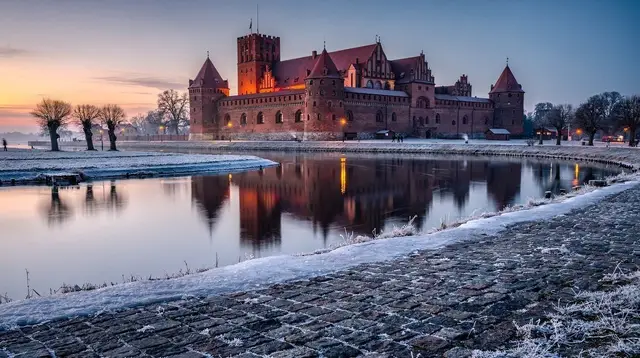
This is a genuinely useful trip to get right, because Malbork Castle — the largest brick fortress in the world — is one of the most-visited sites outside Gdańsk itself, and the logistics of the day are simpler than they first look once the train system is understood. For the castle’s history, room-by-room layout and ticketing details once you arrive, see the Malbork Castle visitor guide; for a full day plan that folds in food, timing and a return route, see the Malbork day trip itinerary. This page stays narrowly on the transport question: how to get from Gdańsk to Malbork and back, and what to expect along the way.
Journey time: what to actually expect
The honest range is 35 to 50 minutes, train-dependent. Faster InterCity services, which sometimes run through Malbork on longer routes toward Warsaw or elsewhere, cover the distance at the shorter end of that range. Slower regional trains, which stop more often, sit closer to 45-50 minutes. Neither option gets you there in under half an hour — the distance alone, roughly 50-60km depending on which Gdańsk station or Malbork platform is used as the reference point, rules that out. Itineraries or blog posts promising a 20-25 minute hop are describing something else, not this route.
A rough table for planning purposes:
| Train type | Typical journey time | Frequency |
|---|---|---|
| Regional (Regio) | 40-50 minutes | Roughly hourly through the day |
| InterCity (faster, fewer stops) | 35-45 minutes | Several per day, less frequent than regional |
Exact frequency and timing shift with the season and the annual timetable change, so treat the table as a planning guide rather than a fixed schedule — checking the current timetable close to your travel date is worth the two minutes it takes.
Departure station and buying tickets
Trains to Malbork leave from Gdańsk Glowny, the main station just north-west of the Old Town and an easy walk from the Długi Targ area. This is a different platform area from the SKM’s dedicated tracks, so allow a few extra minutes at the station to find the right platform if this is your first PKP journey in Poland — departure boards list the destination and train number clearly, but the layout differs from the SKM’s simpler commuter setup.
Tickets are sold at station counters, at self-service machines, and through national rail apps; regional trains generally do not require seat reservations, so a same-day ticket bought shortly before departure is normal practice outside the busiest summer weekends. All transactions are in Polish zloty (PLN) — Poland is not in the eurozone, and station machines and counters do not process euro cash. Contactless card payment is widely accepted at both ticket machines and staffed counters, which makes carrying euros as a backup unnecessary; a card is the more reliable option than assuming cash will be taken in a foreign currency.
Booking far in advance is not typically necessary. Regional services run often enough — roughly hourly for much of the day — that arriving at the station and buying a ticket for the next departure works for most travellers. The exception is July and August weekends, when both the trains and Malbork Castle itself get busier; if your schedule is tight around a specific castle entry time (see the timed-entry system covered in the visitor guide), buying your train ticket a little ahead removes one variable from the day.
Regio or InterCity: which ticket to choose
For a same-day trip to Malbork, the choice between a Regio ticket and an InterCity ticket comes down to time versus flexibility rather than comfort — both are ordinary, adequate trains for a journey under an hour. Regio services are generally unreserved: a valid ticket for that train lets you board and take any free seat, which means missing one departure by a few minutes just means waiting for the next rather than losing a fare. InterCity tickets, by contrast, are usually tied to a specific train and sometimes a specific seat, and changing to a later departure can mean a fee or a fresh ticket depending on the fare type bought.
Both can be bought the traditional way, at a station counter or a self-service machine, or through Poland’s national rail apps — Koleo and the PKP Intercity app are the two most widely used, and both sell tickets in English with a QR code shown on screen rather than a printed slip.
For a first visit, buying at the Gdańsk Glowny counter or machine shortly before departure is simplest and avoids any uncertainty about which app covers which operator’s trains; the apps become genuinely useful once you’re comfortable with the system, mainly for checking live departure times rather than for the ticket itself. Regio fares for this route sit at the cheaper end of Polish regional rail pricing; InterCity costs somewhat more but buys a marginally faster, marginally quieter ride.
By car: the alternative, with real caveats
Driving from Gdańsk to Malbork takes roughly 45 minutes to an hour depending on traffic and route, similar to the train once parking and city traffic are factored in. A car adds flexibility if you’re combining Malbork with other stops in the Zulawy area or the Elbląg Canal on the same day, since those sit without direct rail connections from Gdańsk. The trade-off is parking: paid parking near the castle fills up in peak summer, and unlike the train there’s no fallback if a lot is full beyond circling for a space. For a first visit focused solely on the castle, the train is simpler and removes the need to navigate an unfamiliar road network and parking system in a second language.
Renting a car is not something this page recommends as a default — for most visitors doing Gdańsk plus Malbork as a single add-on, the train is the more practical and less stressful choice. It only starts to make sense once Malbork is one stop among several on a longer, self-driven day.
The walk from Malbork station to the castle
This is the detail most visitors underestimate: the train does not drop you at the castle gate. From Malbork’s station, it’s a walk of roughly 15-20 minutes through the town to reach the castle’s ticket entrance, following a signposted route that most visitors find easy to follow on foot. It is not a strenuous walk — flat, through an ordinary small Polish town — but it is a genuine walk, not a two-minute stroll from platform to gatehouse. Comfortable shoes matter more here than at almost any other stop in the region, partly because the castle itself, once you’re inside, involves a further three to four hours of walking across the High, Middle and Low Castles if you’re doing the full route.
Taxis are available at the station for visitors who’d rather skip the walk, particularly useful if arriving with heavy luggage or limited mobility, though for most travellers the walk itself is a reasonable, unhurried way to arrive and get a first look at the castle’s scale as it comes into view.
Luggage, mobility and platform access
Gdańsk Glowny is a large, renovated station with lifts and ramps between the main hall and the platforms, plus left-luggage lockers in the station building — useful if you want to drop a bag before a same-day trip rather than carry it around Malbork’s Old Town. Malbork’s own station is far smaller and more basic: platform access can mean a set of stairs rather than a lift on some platforms, and there is little to no formal left-luggage facility, so the practical approach is to travel light for this particular day trip rather than plan on storing bags at the Malbork end.
The walk from the station to the castle is flat and on paved streets, which helps travellers with limited mobility or a pushchair, but it is still a genuine 15-20 minute walk with no shuttle bus laid on. Anyone who needs step-free travel throughout should check the specific train’s rolling stock in advance where possible, since not every Regio or InterCity service on this route uses the newest low-floor carriages, and boarding can occasionally involve a step up from the platform. None of this makes the trip impractical — thousands of visitors manage it every week — but it is worth knowing before arriving at Gdańsk Glowny with heavy suitcases rather than a day bag.
Return trains and timing your day
Trains back to Gdańsk run on a similar frequency to the outbound journey, roughly hourly for regional services with additional InterCity departures through the day. Because Malbork Castle genuinely needs three to four hours to see properly — this is the largest brick fortress on earth, and rushing it defeats the point — the practical shape of a day trip is: an outbound train in the morning, several hours at the castle including the walk there and back, lunch in Malbork or before departure, and a return train in the afternoon or early evening.
It’s worth checking the return timetable before you leave Gdańsk rather than assuming departures are frequent enough to wing it; regional trains outside peak hours can space out to roughly hourly gaps, and missing one by a few minutes means a real wait rather than a quick next-departure fix. For a fully worked-out schedule that accounts for the castle’s opening hours, the walk, and lunch, the Malbork day trip itinerary lays out timing in more detail than this transport-focused page attempts to.
If your return train is missed or delayed
Because Regio tickets on this route are generally valid for a specific train rather than the whole day, missing your planned departure back to Gdańsk means catching the next available service rather than freely hopping on any later train — but with departures running roughly hourly for much of the day, that usually means a wait of under an hour rather than a stranded evening. Many of the trains that call at Malbork continue on to or arrive from Tczew, a junction town a short distance away, which also has connections back toward Gdańsk; this rarely matters in practice, but it’s a useful thing to know if a specific train is cancelled and the departure board looks confusing.
Delays on Polish regional rail do happen, as on any network, though they are not a defining feature of this particular route. The more common cause of a late return is simply underestimating how long the castle takes, or lingering over a late lunch in Malbork’s Old Town — padding an extra 30-45 minutes into your planned return time covers most ordinary overruns without needing to think about contingency trains at all.
What this trip is not
A few expectations worth resetting before you go. This is not a sub-30-minute hop — the distance and the nature of regional and InterCity rail service rule that out, whatever a rushed itinerary elsewhere might imply. It is not the SKM — Malbork sits outside the Tricity’s metropolitan commuter network entirely, on separate trains with separate ticketing. The station is not at the castle door — budget the 15-20 minute walk into your timing rather than assuming an immediate arrival. And the currency is not the euro — every transaction along the way, from the ticket machine at Gdańsk Glowny to a coffee in Malbork, is in zloty, with cards accepted almost everywhere but euro cash accepted essentially nowhere.
Handled with those expectations in place, the journey itself is one of the easier day-trip logistics in the region: a single train, a walkable town, and one of Europe’s great brick fortresses at the end of it. If you’re also weighing whether to go as an independent traveller or join an organised group, an audioguided option such as the Malbork Castle tour from Gdańsk with audioguide covers the same train route with transport and entry handled for you, which can simplify the day considerably if you’d rather not manage tickets and timing yourself.
For travellers who prefer a guided full-day option that also handles the walk and the castle route, a private arrangement like the private tour of Malbork Castle or the more compact Malbork Castle regular tour from Gdańsk removes the need to plan train times at all. And for a simpler visit-only option that still includes return transport, the Malbork Castle visit from Gdańsk covers the round trip without a full guided commentary.
A couple more practical questions
Is there luggage storage at Gdańsk Glowny or Malbork station?
Gdańsk Glowny has left-luggage lockers in the main station building, so it’s possible to drop a bag before heading to Malbork for the day. Malbork’s station is much smaller and does not reliably offer the same facility, so the simplest approach is to travel with just a day bag rather than count on storing luggage at the Malbork end.
What happens if I miss my return train from Malbork?
Missing a specific Regio departure usually means waiting for the next one rather than losing the whole day — services run roughly hourly through most of the afternoon and evening. It’s a genuine wait, not a five-minute gap, so it’s worth checking the timetable rather than cutting your castle visit right up against a single planned train.
Malbork transport at a glance
| Question | Answer |
|---|---|
| Departure station | Gdańsk Glowny |
| Journey time | 35-50 minutes by train |
| Network | National rail (regional/InterCity), not SKM |
| Distance | Roughly 50-60km |
| Currency for tickets | Polish zloty (PLN); cards widely accepted |
| Walk from Malbork station to castle | 15-20 minutes |
| Advance booking needed? | Usually not, except peak summer weekends |
| Car alternative | 45-60 minutes drive; parking can fill in summer |
Whichever way you travel, pairing the transport with a clear plan for the castle itself makes the day work better. The Malbork Castle visitor guide covers tickets, opening hours and what to see once you’re through the gate, the history of the Teutonic Knights who built it gives context to what you’re walking through, and if Malbork is one stop among several, the best day trips from Gdansk sets it alongside the region’s other options.
Transport options
Verified deep-linked GetYourGuide tours. Book through these links and we earn a small commission at no cost to you.
GetYourGuide does not provide a product photo for this activity — the image shows the meeting point, photographed by us.