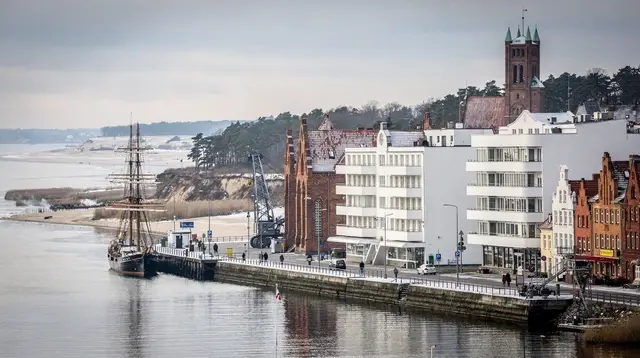
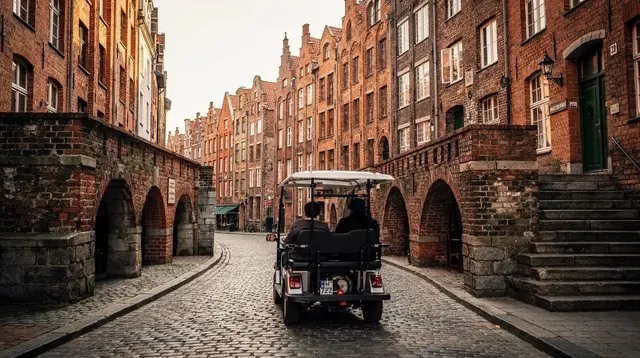
A port city with no old town to find
Most travelers arrive in Gdynia expecting a smaller version of Gdansk - a market square, gabled townhouses, a river lined with medieval warehouses. None of that exists here, and it never has. In 1920, the spot where Gdynia now stands was a fishing village of a few hundred people on a stretch of Baltic coast that newly independent Poland needed as its own deep-water port, since Gdańsk itself was at the time the semi-autonomous Free City of Danzig, outside Polish sovereign control.
Construction of the port began in earnest in 1921, and the city grew up around it through the interwar decades almost from a blank sheet of paper. There was no medieval nucleus to preserve or rebuild, no Gothic brick church to restore after the war - just open ground, ambitious planners, and roughly twenty years to build a functioning city and harbor before 1939 brought everything to a halt.
That is the honest frame for a visit: Gdynia rewards people looking for early 20th-century urban planning and maritime history, not people hunting for a historic core. Its interest is real, but it is a different kind of interest from Toruń’s UNESCO Gothic streets or Gdańsk’s rebuilt Hanseatic gables. Coming here expecting an “old town” sets up a disappointing afternoon; coming here to see how a Polish port city imagined itself in the 1920s and 30s delivers exactly what the city has to offer.
Why Gdynia looks the way it does
The absence of an old town is not a gap in the city’s story - it is the story. Poland regained independence in 1918 with a narrow, contested strip of Baltic coastline and no major port fully under its own control, since Danzig’s status was fixed by international treaty rather than Polish administration. The government’s answer was to build a new port and a new town beside it, on the site of that small fishing village.
The decision to start building the harbor in 1921 set off two decades of rapid growth: population, infrastructure and construction all expanded together, and the architects working on Gdynia in the 1920s and 30s had none of the older layers that usually constrain a European city center. They built in the modernist idiom of their moment - clean lines, ocean-liner curves, flat roofs, ribbon windows - producing what is now recognized as one of Europe’s more complete surviving collections of interwar modernist architecture, a body of work generally referred to as Gdynia Modernism.
The Second World War and the following decades changed the city’s fortunes but not this basic identity. Gdynia stayed a working port through Poland’s communist era and remains one today, its harbor still central to the local economy. What visitors see now is a genuine port city going about its business, with a cluster of protected interwar buildings at its center rather than a curated heritage district built for tourism. That gives Gdynia an unpolished, functional feel that some travelers love and others find underwhelming after the postcard prettiness of the Old Town - it is worth knowing which kind of traveler you are before budgeting a full day here.
Two ships you can actually walk aboard
Gdynia’s most concrete, most photographed landmarks are not buildings at all but two vessels moored permanently at the waterfront, both open to paying visitors.
The Dar Pomorza is a three-masted steel sailing ship, a “tall ship” of the kind used for training generations of Polish naval and merchant marine cadets. Retired from active sailing and now a museum ship at her permanent berth, she lets visitors walk the deck, descend into the crew quarters and get a physical sense of what months at sea under sail actually involved - a stark contrast to the abstract “maritime tradition” language used elsewhere on this stretch of coast. Budget roughly an hour aboard.
The ORP Blyskawica sits nearby, a Polish Navy destroyer with a genuine Second World War combat record, now preserved as a museum ship. Visitors can go below deck through engine spaces, crew areas and gun positions that were, within living memory, working military hardware rather than exhibits. Pairing the two ships - one sail, one steel and steam-turbine - makes a natural hour-and-a-half to two-hour block of the day, and both sit an easy walk from the SKM station, needing no separate transfer.
a private guided walk through Gdynia’s maritime landmarks, tickets to the museum ships included is the straightforward way to see both vessels with someone explaining what you are looking at rather than reading placards alone.
Kamienna Gora: the view that explains the city
Kamienna Gora (“Stone Hill”) is a modest, wooded hill rising directly behind the harbor and city center, reachable on foot in a steady ten- to fifteen-minute climb from the waterfront.
It is not a mountain by any measure - this is flat Baltic coastline, and Kamienna Gora tops out at a height measured in tens of meters, not hundreds - but the climb is worth it precisely because of what it shows: the full sweep of Gdynia’s harbor, the container cranes and grain silos of a working port, the curve of the bay toward Hel, and, looking back down the hill, the quiet interwar villas built on its slopes for the city’s more prosperous 1930s residents. It is the single best vantage point for understanding Gdynia as a planned, purpose-built port rather than a picturesque old town, and it costs nothing beyond the walk.
a private walking tour that takes in the Kamienna Gora viewpoint pairs the climb with a guide’s explanation of what the harbor below is actually doing, rather than leaving visitors to guess at container terminals and ferry berths on their own.
The Emigration Museum: leaving from here, not living here
Gdynia’s role in the 20th century was not only as a naval and cargo port but as the departure point for a large share of Polish transatlantic emigration in the interwar decades - the harbor that opened in the 1920s quickly became the country’s main gateway to ships bound for the Americas.
The Emigration Museum, housed in the former Maritime Station building where many of those departures actually took place, tells that story through personal documents, ship models and reconstructed waiting-hall interiors. It is a different register from the naval swagger of the museum ships: quieter, more personal, and a useful corrective to any impression that Gdynia’s 20th-century story is only about architecture and battleships. Give the permanent exhibition around ninety minutes to two hours.
a private tour of the Emigration Museum with tickets and lunch included works well as a midday anchor for a longer Gdynia day, breaking up the walking with a proper sit-down meal.
The aquarium and the working waterfront
The Gdynia Aquarium, run by Poland’s National Marine Fisheries Research Institute, sits at the harbor’s edge and focuses on Baltic Sea marine life alongside tanks of species from further afield - a natural stop for families and anyone curious what actually lives in the cold, brackish water visible from Kamienna Gora or the Sopot pier a few kilometers up the coast. Budget an hour to ninety minutes. Around it, the waterfront promenade (the Skwer Kosciuszki and the pier area) is where Gdynia’s port-city character is most visible day to day: fishing boats selling the morning catch, ferry terminals, and views straight out into the working shipping lanes that define the city rather than decorate it.
Getting to Gdynia and around it
Gdynia sits at the northern end of the Tricity, the fastest and easiest of the three cities to reach from Gdansk by rail. The SKM commuter line runs frequently between Gdańsk Glowny and Gdynia Glowny, with the ride taking roughly 25 to 30 minutes and passing through Sopot along the way, close enough to the shoreline for sea glimpses on a clear day.
Trains run every 10 to 20 minutes at peak times, and tickets are sold by time validity rather than by number of stops, so a single ticket can cover a Gdansk-Sopot-Gdynia day if timed correctly - see the guide to getting around the Tricity by SKM, tram and bus for the mechanics. From Gdynia Glowny station, the harbor, museum ships and Kamienna Gora are all within a 10- to 20-minute walk; a car is not needed for a Gdynia day trip, and parking near the waterfront is limited in summer in any case.
Many visitors combine Gdynia with Sopot in a single day, using the SKM to hop between the two - see the two-day Gdańsk and Sopot itinerary or the fuller three-day Tricity itinerary for how Gdynia slots in alongside Gdańsk’s Old Town and Sopot’s pier. For visitors without much time, how many days to spend in Gdańsk and the Tricity lays out realistic pacing, and travelers flying in should check the Gdańsk airport to city center guide before planning a same-day Gdynia add-on, since the airport sits northwest of Gdańsk proper rather than near Gdynia.
a private Tri-City tour covering Gdańsk, Sopot and Gdynia in one guided day is worth considering for visitors who want all three cities handled without managing the SKM timetable themselves.
A city best read through its buildings
Beyond the two headline sights, Gdynia’s real texture is in its streets: the interwar apartment blocks along Swietojanska and around the city center, built in a restrained, functional modernist style that Polish architectural historians now treat as a coherent national style rather than a footnote to Bauhaus or Art Deco elsewhere in Europe. None of it demands an entry ticket - the value is in walking with some sense of what you are looking at, since an unlabeled 1930s apartment block looks, to an untrained eye, simply like an old apartment block.
A guided walk solves that gap efficiently; the self-guided Gdynia modernist walking tour and the broader guide to Gdynia Modernism both work as route notes for exploring independently, while a guided walk combining Gdynia’s forest, cliff and beach paths extends the day beyond the center into the wooded coastal edge of the city, a green, quieter counterpoint to the harbor.
For a lighter, more playful way to see the center, a spy-themed walking game through Gdynia with a host turns the same modernist streets into a puzzle-driven route, useful for families or anyone who finds a straight architectural walking tour a little dry.
Readers weighing where this fits against the rest of the Tricity may want the Gdańsk versus Sopot versus Gdynia comparison or, for an overnight stay, Sopot versus Gdynia for where to stay - most visitors base themselves in Gdańsk or Sopot and treat Gdynia as a half-day or full-day excursion, which is also the pattern this guide assumes.
The wider category page for things to do in Gdynia and the Tricity rounds up activity options beyond the sights covered here, and the background piece on Gdynia being built from nothing goes deeper into the planning history behind the city’s unusual origin, alongside a companion piece explaining why Sopot is not Saint-Tropez despite superficial comparisons sometimes drawn between the two resort towns.
Gdynia versus Gdańsk and Sopot, plainly
| Gdańsk | Sopot | Gdynia | |
|---|---|---|---|
| Core identity | Rebuilt Hanseatic old town | Interwar seaside spa resort | Interwar planned port city |
| Historic center | Yes, reconstructed after 1945 | Small, resort-scale | None - no old town |
| Signature sight | Długi Targ, St Mary’s Basilica | Europe’s longest wooden pier | Museum ships, Kamienna Gora |
| Feel | Historic, dense, touristic | Relaxed, beach-resort | Working port, modernist |
| Typical time needed | 1-2 full days | Half a day to a day | Half a day to a full day |
Frequently asked questions about visiting Gdynia
Does Gdynia have an old town like Gdańsk?
No. Gdynia was built almost entirely after 1920 as Poland’s new seaport, on the site of a small former fishing village, so there is no medieval or Hanseatic-era old town to see here - its interest lies in interwar modernist architecture and maritime history instead.
What are the must-see sights in Gdynia?
The two permanently moored museum ships, the sailing ship Dar Pomorza and the destroyer ORP Blyskawica, are the most concrete landmarks, alongside the Kamienna Gora viewpoint above the harbor, the Emigration Museum in the former Maritime Station, and the Gdynia Aquarium on the waterfront.
How do you get from Gdańsk to Gdynia?
The SKM commuter train runs frequently between Gdańsk Glowny and Gdynia Glowny, taking roughly 25 to 30 minutes and stopping in Sopot along the way; tickets are sold by time validity rather than per stop, and no car is needed for the trip.
How much time should you spend in Gdynia?
Half a day covers the museum ships and Kamienna Gora at a reasonable pace; a full day allows time to add the Emigration Museum, the aquarium and a longer walk through the modernist city center.
Can Gdynia be combined with Sopot in one day?
Yes, and it is the most common pattern: the SKM connects the two in well under 30 minutes, making it easy to spend the morning on Gdynia’s harbor and museum ships and the afternoon on Sopot’s pier and beach, or the reverse.
Is Gdynia worth visiting if you are short on time in the Tricity?
It depends on interest: travelers drawn to architecture, naval history or working ports find it genuinely rewarding, while those with only one day and a preference for historic streetscapes are usually better served spending that day in Gdańsk’s Old Town instead.
What is Gdynia Modernism?
It is the name given to the substantial body of interwar modernist architecture built in Gdynia during the 1920s and 30s as the city grew rapidly around its new port, now recognized as one of the more complete surviving collections of that architectural style in Europe.
Is Gdynia a good destination for families?
Yes - the museum ships, the Emigration Museum and the aquarium are all hands-on and reasonably compact, and the harbor and Kamienna Gora walk give children an easy, visual sense of a working port that few other Tricity sights offer.