Gdynia: A City Built from Nothing, and Its Modernist Landmarks
What makes Gdynia different from Gdańsk and Sopot?
Gdynia was built almost from scratch after 1921 as Poland's new seaport, so it has no medieval old town - its landmark is interwar modernist architecture, plus a working port, two museum ships and a hilltop viewpoint. It sits on the SKM line about 35 minutes from Gdańsk.
A port city with no old town to speak of
Most guides to the Tricity slot Gdynia in as a beach-and-modernism day trip from Gdansk, and that’s roughly right - but it’s worth being precise about what Gdynia actually is, because the usual language of European sightseeing doesn’t quite fit it. There is no old town here. Not a rebuilt one, not a ruined one, not a small surviving fragment behind a modern facade - none at all.
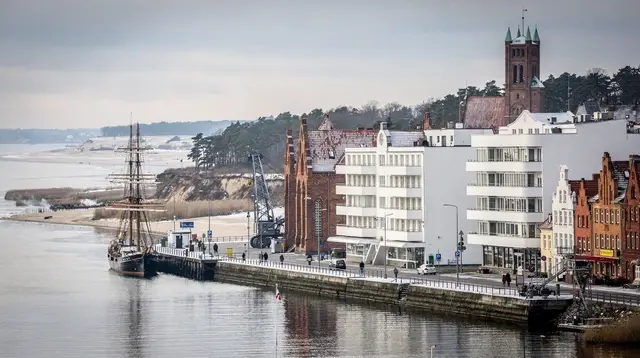
Before 1921, the site of central Gdynia was a fishing village of a few thousand people on the shore of Gdańsk Bay. Everything that now reads as “central Gdynia” - the seafront boulevards, the apartment blocks with their rounded corners and ribbon windows, the harbour basins, the grid of streets climbing back from the water - was built essentially from nothing over the following two decades, as newly independent Poland raced to construct a seaport of its own.
That’s the detail that makes sense of everything else about visiting Gdynia. It has no Długi Targ, no St Mary’s Basilica, no medieval crane gate, no Mariacka street lined with amber shops. It has a harbour that was still under construction when the ink on the plans was barely dry, a skyline of interwar apartment blocks that were genuinely cutting-edge for their decade, and a pair of retired naval vessels you can walk aboard. If you arrive expecting a smaller, quieter version of Gdańsk’s Old Town, you’ll be looking for something that was never there. Come instead for a very different kind of history: a planned city, built at speed, by a young state trying to prove it could build one.
Built from a fishing village, on purpose
The trigger was geography and politics rather than economics alone. After the First World War, the reborn Polish state found itself with a long Baltic coastline but no major port it fully controlled - Gdańsk existed as the semi-autonomous Free City of Danzig under League of Nations oversight, and Poland needed direct, unrestricted access to the sea.
The decision to build a new harbour at the fishing village of Gdynia was made in 1921, and construction of the port began that same year. What followed was one of interwar Europe’s fastest urban growth spurts: from a population in the low thousands, Gdynia grew to a genuine city of well over 100,000 people by the eve of the Second World War, with a working deep-water port handling a large share of Poland’s seaborne trade.
The architecture that survives from this period is the reason Gdynia gets written up in architecture guides internationally, not just Polish ones. Because the city was built in a short, concentrated window - roughly the mid-1920s through the late 1930s - its residential and public buildings share a coherent modernist vocabulary: white or pale rendered facades, curved corner balconies, porthole windows, horizontal banding, nautical detailing that nods openly to the ships in the harbour below.
It’s often grouped internationally with contemporary modernist enclaves in cities like Tel Aviv, and it’s the reason a dedicated walking route through the centre - covered in full in our Gdynia modernist walking tour guide
- is worth a slot of its own if architecture is your focus. This page takes the wider view: the port, the ships, the museums, and the hill above it all.
Getting to Gdynia: SKM, not a walk
It bears repeating because visitors sometimes assume the Tricity is one continuous urban strip: Gdynia is not within walking distance of the Gdańsk Old Town, and there is no scenic riverside route between them. The three cities of the Tricity - Gdańsk, Sopot and Gdynia - sit along roughly 30km of coastline, stitched together by the SKM commuter rail line, and Gdynia is the northernmost of the three.
| From | Journey | Approx. time |
|---|---|---|
| Gdańsk Glowny | SKM commuter train | ~35 minutes |
| Sopot | SKM commuter train | ~10-15 minutes |
| Gdańsk Airport | Train via Gdańsk, or direct bus | ~45-60 minutes |
Trains run frequently, every 10-20 minutes at peak times, and tickets are sold by time validity rather than by number of stops - the same system covered in our guide to getting around the Tricity. Gdynia Glowna station sits a short walk from the seafront sights, so once you’re off the train, the port, the ships and Kamienna Gora are all reachable on foot.
That last point is worth underlining for anyone tempted to base themselves in Gdańsk and treat Gdynia as a quick add-on between other stops: the SKM ride alone is 35 minutes each way from Gdańsk Glowny, so a there-and-back trip eats well over an hour of the day before any sightseeing starts. It’s not a deterrent, just an honest planning number - factor it in the same way you would a transfer between two separate cities, because that’s functionally what it is, even though a single train ticket covers the whole Tricity.
Dar Pomorza: the training ship on the water
The first thing most visitors see on the Gdynia waterfront is a genuinely striking silhouette: a full-rigged sailing ship, white-hulled, three masts of rigging against the harbour cranes behind it. This is the Dar Pomorza, a sail training ship built in the 1900s and used for decades to train cadets of the Polish merchant marine before it was retired and permanently moored as a museum ship. Boarding it means walking decks that were, within living memory, worked by trainee sailors on long ocean voyages - the rigging, the cramped cadet quarters and the navigation instruments are all preserved roughly as they were in service. It’s a compact visit, realistically 45 minutes to an hour, and it pairs naturally with the destroyer moored close by.
ORP Blyskawica: the destroyer that survived the war
A short walk along the same stretch of harbour is ORP Blyskawica, a Polish Navy destroyer built in the 1930s and one of the very few ships of its class to survive the Second World War intact - it served throughout the conflict, including in the defence of British ports during German air raids, and was preserved afterwards as a memorial to the Polish Navy’s wartime service.
Visitors can walk the deck, look into the gun turrets and bridge, and get a sense of a working warship’s cramped, functional interior in a way that’s rare to experience up close. Combined with Dar Pomorza, the two ships make for a genuinely worthwhile hour or two on the water’s edge, and between them they say something true about Gdynia’s identity: this was always, first and last, a maritime city built around its port and its navy, not around a market square.
Neither ship keeps identical hours year-round, and it’s worth checking before building a day around them rather than assuming they’re always open. Summer sees the longest boarding windows, typically running through the afternoon into early evening; outside the June-to-September season, hours contract and Dar Pomorza in particular can close for stretches of weeks at a time for maintenance or dry-docking work, since it remains a genuine, maintained vessel rather than a static display. A shoulder-season or winter visit built entirely around boarding both ships carries some risk of finding one gangway closed - a quick check close to the date avoids the disappointment.
a private guided tour covering the harbour’s ships and maritime history with tickets included is a good way to get the context behind both vessels rather than reading placards alone.
Kamienna Gora: the viewpoint over it all
From the harbour, a walk of ten to fifteen minutes up into the streets behind the seafront leads to Kamienna Gora, a hill lined with some of the best-preserved interwar villas and apartment buildings in the city - a genuinely pleasant residential quarter to wander through even before reaching the top.
The payoff is the viewpoint: a sweeping outlook over the harbour basins, the grain elevators and container cranes, the curve of the bay, and on a clear day the low outline of the Hel Peninsula stretching out into the Baltic. It’s the single best spot in Gdynia to physically understand what the city is - a port carved out of open coastline within living memory, still very much a working harbour rather than a heritage backdrop.
a private walking tour that takes in the Kamienna Gora viewpoint alongside the seafront landmarks covers this stretch efficiently if you’d rather not navigate the hill’s residential streets solo.
The Emigration Museum: the story behind the harbour
Set in a restored former Maritime Station building right on the waterfront, the Emigration Museum tells a story that’s easy to miss if you only look at the ships and the architecture: Gdynia’s harbour was, for a stretch of the interwar and postwar decades, the main departure point for Poles emigrating overseas, many of them bound for the Americas.
The museum is a modern, purpose-built exhibition rather than a collection of preserved period rooms, using personal testimony, documents and reconstructed departure-hall scenes to trace what that journey actually involved - the paperwork, the medical checks, the wait, the goodbye on the quay. It rewards an hour to ninety minutes and adds a human layer to a city that otherwise reads mostly as architecture and steel.
a private tour of the Emigration Museum with tickets and lunch included bundles the visit with a meal, useful if you’re building it into a longer day on the waterfront.
Gdynia Aquarium: a seafront stop with children
Immediately next to the Dar Pomorza mooring sits the Gdynia Aquarium, a mid-sized aquarium focused mainly on Baltic Sea species - a useful counterpoint to the region’s beaches and boat trips, since it shows visitors what’s actually swimming in the cold, brackish water beyond the piers - alongside a selection of tropical tanks. It’s a standalone paid ticket, not bundled with the museum ships, and works well as an hour-long stop with younger children who’ve had enough of looking at building facades. It’s a sensible one to slot into a family day that also takes in Oliwa’s park and zoo back toward Gdańsk.
What Gdynia genuinely isn’t
Worth stating plainly, because the comparison to Gdańsk comes up constantly: Gdynia has no reconstructed Hanseatic old town, because there was nothing there to reconstruct - the city itself didn’t meaningfully exist before the 1920s. It isn’t a smaller, quieter version of Sopot either; Sopot’s identity is its pier and its resort history, while Gdynia’s is its port and its architecture.
And it isn’t walkable from central Gdańsk - budget the SKM journey both ways, and treat Gdynia as a half-day or full-day excursion rather than an add-on stroll. Our comparison of Gdańsk, Sopot and Gdynia lays out how the three cities differ if you’re deciding how to split your time across them, and where to stay across the three is worth a look before booking a base.
If you only have a few hours
Not every visitor budgets a full day, and if the choice is between the harbour and the hill, it’s worth arbitrating honestly rather than trying to rush both. The harbour - Dar Pomorza and ORP Blyskawica together - is the stronger pick for anyone whose interest is maritime history or who’s travelling with children drawn to a real ship’s deck; it’s also the lower-effort option, flat and close to the station.
Kamienna Gora rewards a specific kind of visitor: someone who wants to understand the architecture and the geography of the port in one view, and who doesn’t mind a ten-to-fifteen-minute uphill walk to get it. Doing both properly, without rushing either, is realistically a three-to-four-hour block once the walk between them and photo stops are counted - closer to the “half day” end of the estimate than the “quick stop” some shorter itineraries imply.
What actually disappoints on the ground
Worth saying plainly rather than glossing over: visitors who arrive hoping for a scaled-down version of Gdańsk’s Old Town, or who’ve seen photos of the modernist facades and expect a dense, walkable historic quarter at every turn, sometimes come away flat. Central Gdynia is a working port city first - much of the seafront is functional harbour infrastructure, container cranes and cargo berths rather than curated waterfront promenade, and the modernist buildings that photograph so well are scattered through an otherwise ordinary residential grid rather than concentrated into one obviously “sight-worthy” district.
None of that makes the city not worth visiting; it just means the reward is architectural and historical rather than immediately photogenic on arrival, and it helps to know that going in rather than discover it standing on the platform at Gdynia Glowna wondering where the “old town” part starts.
Putting a Gdynia day together
A workable half-day: SKM to Gdynia Glowna, a walk to the waterfront to board Dar Pomorza and ORP Blyskawica, then up to Kamienna Gora for the viewpoint before heading back down. Add the Emigration Museum or the Aquarium and it stretches comfortably into a full day. Travellers building a longer architecture-focused itinerary should pair this page with the dedicated Gdynia modernist walking tour, which routes through the residential streets behind the seafront in detail.
For a broader coastal day that folds Gdynia into Sopot as well, our Tricity three-day itinerary and shorter Gdansk-Sopot two-day plan both show where Gdynia fits against the rest of the coast. If you’d rather explore the forested cliffs and beaches either side of the centre than the harbour itself, a guided walking tour along Gdynia’s forested cliffs and beaches covers the quieter, greener side of the city that the harbour visit doesn’t reach.
Are Dar Pomorza and ORP Blyskawica open all year?
Both ships operate on reduced winter hours, and Dar Pomorza in particular sometimes closes for weeks at a time for maintenance or dry-docking, so a visit that’s central to the plan is worth confirming close to the date rather than assumed. Summer hours are the most reliable window, typically with boarding through the afternoon; outside the June-to-September stretch, arriving without checking risks finding the gangway closed.
What disappoints visitors about Gdynia?
Visitors expecting a photogenic old town or a Gdańsk in miniature are usually the ones who come away unimpressed, because that comparison sets up a disappointment Gdynia was never going to answer. Taken on its own terms, as a working port city with a specific interwar architectural identity, it holds up much better; taken as a day trip to see “another old town”, it doesn’t, and no amount of walking finds one that isn’t there.
Gdynia at a glance
| Landmark | What it is | Typical time |
|---|---|---|
| Dar Pomorza | Historic sail training ship, museum vessel | 45-60 minutes |
| ORP Blyskawica | WWII-era destroyer, museum vessel | 45-60 minutes |
| Kamienna Gora | Hillside villas and harbour viewpoint | 30-45 minutes |
| Emigration Museum | Story of Polish emigration through the port | 60-90 minutes |
| Gdynia Aquarium | Baltic and tropical marine life | 60-90 minutes |
Tricity tours
Verified deep-linked GetYourGuide tours. Book through these links and we earn a small commission at no cost to you.
GetYourGuide does not provide a product photo for this activity — the image shows the meeting point, photographed by us.