Sopot vs Gdynia: Where to Stay for the Tricity
Should I stay in Sopot or Gdynia for visiting the Tricity?
Stay in Sopot for a beach-resort base with the longest wooden pier in Europe, a lively evening scene, and the shortest SKM ride into Gdańsk, around 20 minutes. Stay in Gdynia for a calmer, more affordable, working port city with modernist architecture, at the cost of a longer commute, roughly 35 minutes, and a much quieter night out.
Picking a base in the Tricity usually comes down to two towns, not three. Gdańsk’s Old Town has its own hotel scene and its own logic, covered elsewhere; this page assumes you already know you want the coast, and are choosing between Sopot and Gdynia. The two sit a few minutes apart on the same SKM line but function as almost opposite kinds of base, and the choice is worth thinking through before you book, not after.
The short version
Sopot is a beach resort. Gdynia is a working port city that happens to have a beach. That single sentence explains most of the difference in price, noise, nightlife and atmosphere between them, and it is worth keeping in mind through everything below.
Sopot built its identity over more than a century as a spa and seaside resort, centred on Europe’s longest wooden pier and a compact, walkable core of grand hotels, restaurants and bars. Gdynia, by contrast, is a largely twentieth-century city, developed rapidly as Poland’s main seaport after 1918-20, which is why its centre reads as modernist rather than historic or resort-like. Neither description is a value judgement — they are simply different products, and each suits a different kind of trip.
Distance to Gdańsk: the number that actually differs
This is the one comparison where the two towns are genuinely not interchangeable, and it is worth being precise about it rather than rounding both to “close to Gdańsk.”
| Sopot | Gdynia | |
|---|---|---|
| SKM ride to Gdańsk Glowny | ~20 minutes | ~35 minutes |
| Distance along the coast | Closer, roughly midway | Furthest of the three Tricity cities |
| SKM ride to each other | — | ~10-15 minutes from Sopot |
The SKM (Szybka Kolej Miejska) is the commuter train that stitches Gdansk, Sopot and Gdynia together, running every 10 to 20 minutes at peak times and hugging the shoreline for much of the route, with sea glimpses along the way. If your priority is minimising travel time back to Gdańsk’s Old Town after a late dinner or an evening at the European Solidarity Centre, Sopot’s roughly 20-minute ride is a real, measurable advantage over Gdynia’s roughly 35 minutes — not a marketing rounding error.
Neither town requires a car; see getting around the Tricity by SKM, tram and bus for the full network. For a fuller three-way comparison including Gdańsk itself as a base, see Gdańsk vs Sopot vs Gdynia.
Airport transfers: a wash, not a factor
One thing that does not actually differ between the two towns is the trip in from Gdańsk Airport. The airport sits northwest of the city centre, and a taxi, private transfer or rideshare to either Sopot or Gdynia runs a broadly similar distance and time, typically 40 to 60 minutes depending on traffic and the exact address — there is no meaningful advantage to either base on arrival day.
The SKM does not run directly from the airport terminal itself, so most arriving travellers take a transfer or taxi for that first leg regardless of which town they are headed to, and only switch to the train once they are settled in. Worth checking specifically: some hotel shuttles and pre-booked transfers default to a Gdańsk city-centre drop-off, which then requires a second SKM leg out to Sopot or Gdynia, so it pays to confirm the transfer actually terminates at your chosen town rather than assuming.
Atmosphere and what an evening actually looks like
Sopot after dark is the Tricity’s main event. The pedestrianised strip running from the town centre down toward the pier, sometimes nicknamed Monte Cabo for its concentration of bars and clubs, fills up through the summer months, and the pier itself stays lit and busy well after sunset at this latitude, when June evenings hold light past 9pm. It is genuinely a resort in the evening: crowded, music-heavy near the centre, and built around visitors rather than residents.
Gdynia’s evenings are calmer, and that is the honest way to put it rather than pretending the two towns compete on nightlife. There are good bars and a growing food scene around Gdynia’s centre and its Skwer Kosciuszki waterfront, but the city was not built as a resort, and it does not perform as one after dark. Refuse the comparison some listings imply — Gdynia is not “Sopot but quieter,” because the baseline itself is different: Gdynia is a port city with a few good nights out in it, not a beach town with a subdued version of Sopot’s scene.
Seafront: a pier is not a promenade
It is tempting to assume both towns offer an equivalent “seafront experience,” and that assumption causes real disappointment. They do not.
Sopot’s molo is a purpose-built wooden pleasure pier, among the longest of its kind in Europe, designed from the outset for promenading rather than as working harbour infrastructure — walking to the end and back is a 30 to 45 minute stroll, and the pier is the town’s centrepiece.
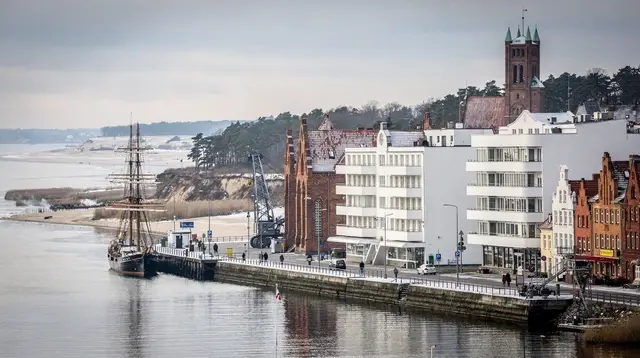
Gdynia’s waterfront is a working one: a marina, a South Pier, and docked museum ships including the tall ship Dar Pomorza and the destroyer Blyskawica, each worth an hour with its own ticket as part of the city’s modernist architecture circuit. It is a genuinely interesting stretch of city, but it is a port promenade with maritime exhibits, not a resort pier, and booking Gdynia expecting Sopot’s pier experience is the single most common mismatch between expectation and reality on this coast.
Both towns sit on the same Bay of Gdańsk beach, and swimmers get comparable sand and the same Baltic water — cool by any southern-European standard, rarely above 18-20°C even in August — in front of either town. Sopot’s stretch is busier and better served by cafes and beach bars near the pier; Gdynia’s beaches, including Orlowo further south, tend to feel less crowded.
Price and value
Sopot’s resort status and seafront demand generally push accommodation rates higher, particularly for anything within easy walking distance of the pier in July and August, when the Tricity’s beaches and the Old Town are at their busiest. Gdynia, as a working city rather than a dedicated resort, tends to offer better value for comparable quality — not dramatically cheap, but a real saving is common for equivalent room standards, especially outside the very centre.
That gap narrows outside high season. From September onward, as the crowds and the premium both ease, Sopot’s price advantage over Gdynia shrinks, and the choice becomes less about budget and more about which atmosphere you actually want for the trip.
The off-season version of this choice
Everything above describes the Tricity at its summer best, roughly June through September, when both towns are fully open and the contrast between them is sharpest. Outside that window, the calculation shifts in Gdynia’s favour. Sopot is a genuinely seasonal town: many of its beach bars, seafront kiosks and some restaurants close or cut their hours from October, and a chunk of the evening atmosphere that makes it worth choosing in July simply is not there in January. The pier stays open and the town is still pleasant to walk, but a winter visitor booking Sopot for its summer reputation will find a quieter, thinner version of it.
Gdynia does not have the same problem, because it was never built around a summer crowd in the first place. Its restaurants, bars and museum ships run on something closer to a normal city’s year-round rhythm, so a November or February stay there feels less like an off-season compromise. If a trip falls outside the June-to-September window, Gdynia’s case gets modestly stronger, and Sopot’s main selling points — the lively pier scene and the resort buzz — are the parts of it most affected by the calendar.
If you only have one night in the Tricity
For a single night between a longer stay elsewhere and an early train or flight, the calculus narrows to almost one factor: how much of the evening you actually want to spend outside a hotel room. One night in Sopot gets you a walk on the pier at dusk, a drink somewhere on the pedestrianised strip, and still a short, easy SKM ride back to Gdańsk the next morning if needed — it makes the most of a short window.
One night in Gdynia is a reasonable choice if the modernist architecture itself is the draw, or if a quieter, cheaper room matters more than an evening out, but it is a harder sell purely as a one-night stopover, since its appeal is more about daytime exploring than a single evening’s atmosphere. Neither is wrong for a one-nighter, but Sopot rewards a short stay more reliably than Gdynia does.
Who should choose Sopot
Sopot suits travellers who want the beach-resort feel built into the trip itself, not just visited on a day out: falling asleep and waking up within a short walk of the pier, an evening scene on the doorstep, and the shortest possible commute back from Gdańsk’s Old Town or the Gdańsk Shipyard sites after a full day of sightseeing. It also suits shorter stays, where every extra 15 minutes each way on the SKM adds up over a long weekend. A guided bike tour of the town itself is a good way to get oriented on arrival.
Who should choose Gdynia
Gdynia suits travellers who want a real working city as a base rather than a resort — quieter streets, an interest in twentieth-century architecture and port history, and a preference for value over proximity to nightlife. It rewards a bit more patience with the extra 15 minutes of commute, and it pairs naturally with a day spent exploring its own modernist centre rather than treating the city purely as a dormitory for Gdańsk sightseeing.
A base does not lock you out of the other town
Whichever you choose, the SKM makes the other town an easy half-day, not a commitment. From Sopot, Gdynia Glowna is typically under 15 minutes away; from Gdynia, Sopot is the same short hop in the other direction. A common pattern is to base in one and simply ride through both on the way to and from Gdańsk, which several guided options build in directly — a private tour covering all three Tricity cities in one day or a tour linking Gdańsk, Oliwa, Gdynia and Sopot removes the need to plan the connections yourself.
Travellers who want a private, flexible version of the same route can look at a private Tri-City tour taking in Sopot and Gdynia, and for a Sopot-based morning before heading elsewhere, a three-hour guided bike tour of Sopot covers the pier, the centre and the seafront efficiently.
Practical comparison at a glance
| Sopot | Gdynia | |
|---|---|---|
| Character | Beach resort, spa town | Working port city, modernist architecture |
| Nightlife | Lively, resort-driven | Quieter, more local |
| Seafront | Wooden pleasure pier | Working marina, museum ships, South Pier |
| SKM to Gdańsk | ~20 minutes | ~35 minutes |
| Typical accommodation cost | Higher, especially near the pier | Generally better value |
| Best suited to | Short stays, evenings out, easy Gdańsk access | Quieter trips, architecture interest, budget-conscious stays |
Sopot vs Gdynia: frequently asked questions
Which is closer to Gdańsk, Sopot or Gdynia?
Sopot is closer. The SKM commuter train covers Sopot to Gdańsk Glowny in around 20 minutes, while Gdynia to Gdańsk Glowny takes roughly 35 minutes on the same line, since Gdynia sits further along the coast past Sopot.
Is Sopot or Gdynia better for nightlife?
Sopot, by a clear margin. Its pedestrianised strip and pier-side bars are the Tricity’s main evening destination in summer. Gdynia has a handful of good bars and a growing food scene, but it closes down earlier and was never built as a resort town.
Is Gdynia cheaper than Sopot for accommodation?
Generally yes. Sopot’s resort status and seafront demand push room rates up, especially in July and August near the pier. Gdynia, as a working city rather than a beach resort, tends to offer better value for similar quality, though it is not dramatically cheap either.
Does Gdynia have a pier or seafront like Sopot?
Gdynia has a working seafront with a marina, a South Pier and museum ships, but it functions as a port promenade, not a pleasure pier. Sopot’s molo is a purpose-built wooden pier for strolling, among the longest of its kind in Europe, and the two are not equivalent experiences.
Can I stay in Sopot and still see Gdynia’s architecture easily?
Yes. Gdynia is one SKM stop or so beyond Sopot, and the ride from Sopot to Gdynia Glowna is typically under 15 minutes, so a Sopot base does not meaningfully cut you off from a day exploring Gdynia’s modernist streets.
Which town has better beaches, Sopot or Gdynia?
Both sit on the same Bay of Gdańsk coastline with comparable sand, but Sopot’s beach is more developed, busier, and better served by cafes and beach bars right off the pier, while Gdynia’s beaches, including Orlowo, feel less crowded and more local.
Is Gdynia worth staying in if I want a quiet trip?
Yes, that is Gdynia’s strongest case. It is a real working city with its own life beyond tourism, so evenings are calmer, streets are less crowded in summer, and a hotel there often costs less than an equivalent Sopot room without a major increase in travel time to Gdańsk’s Old Town.
Do both Sopot and Gdynia work as car-free bases?
Yes. Both sit directly on the SKM line, so neither requires a car. Trains run every 10 to 20 minutes at peak times in both directions, and Gdańsk, Sopot and Gdynia stations are all a short walk from their respective town centres.
Which town is closer to Gdańsk Airport, Sopot or Gdynia?
Neither has a meaningful edge. The airport sits northwest of central Gdańsk, roughly equidistant from both towns in practice, since a taxi or transfer to either one runs through or around the city rather than in a straight line. Budget 40 to 60 minutes by road to either base, and check whether your chosen transfer or hotel shuttle actually serves Sopot and Gdynia directly, since some default to a Gdańsk city-centre drop-off.
Does Sopot or Gdynia stay open in winter?
Both function year-round, but they contract differently. Sopot’s beach bars, seasonal kiosks and much of its evening buzz wind down from October, leaving the pier and a smaller core of restaurants open through the cold months. Gdynia’s centre is less seasonal to begin with, since it never depended on summer visitors, so a winter stay there feels closer to its usual self than a winter stay in Sopot does.
Trip planning
Verified deep-linked GetYourGuide tours. Book through these links and we earn a small commission at no cost to you.
GetYourGuide does not provide a product photo for this activity — the image shows the meeting point, photographed by us.