Gdynia Modernist Walking Tour: A City Built from Nothing
What does a Gdynia modernist walking tour actually show you?
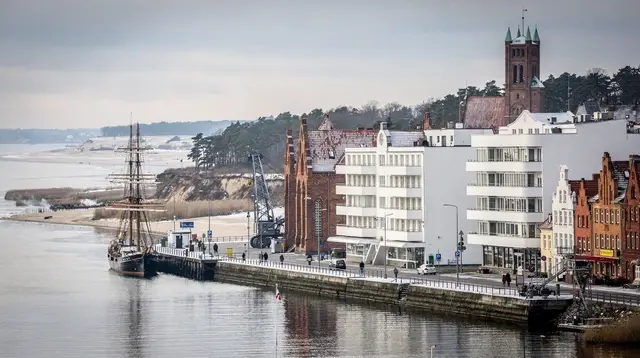
It shows the streamlined 1920s-1930s apartment blocks and port architecture of a city built from a fishing village after 1921, centred on the Kamienna Gora hillside and the waterfront promenade with the museum ships Dar Pomorza and ORP Blyskawica. There is no medieval old town or postwar reconstruction to see - Gdynia is genuinely new.
Why Gdynia looks nothing like Gdańsk
Set expectations before you get off the train: there is no gabled market square waiting at the end of this walk, no Gothic basilica, no rebuilt medieval lanes. Gdynia did not exist as a city before the 1920s. It was a fishing village of a few hundred people on the bay until Poland, newly independent and shut out of the German-controlled port of Danzig (today’s Gdansk), decided in 1921 to build its own port and city from scratch on this stretch of coast.
Within twenty years it had grown into a major Baltic harbour with a purpose-built centre to match - not restored, not reconstructed, just built once, fast, in the architectural language of its own moment. That moment happened to be the golden age of European modernism, and Gdynia is one of the more complete examples of it left standing anywhere on the continent, largely because the city escaped the scale of 1945 destruction that flattened Gdańsk’s Old Town.
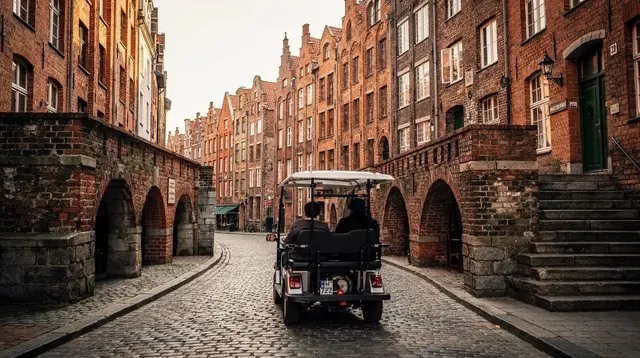
That is the whole premise of this walk. Where a guide to Gdańsk sends you hunting for brick facades and amber shops on Mariacka street, this one sends you looking at streamlined balconies, porthole windows and curved corner blocks that borrow their vocabulary from ocean liners rather than cathedrals. If you came to Gdynia expecting picturesque - narrow cobbled lanes, overhanging upper storeys, a market hall dating to the 1300s - you came to the wrong city.
What Gdynia offers instead is something rarer on this coast: a functioning look at what interwar Poland actually built when it built something new, plus a working harbour atmosphere that Gdańsk’s tourist-facing waterfront has largely traded away. For background on the wider style, see the Gdynia Modernism guide; this page is the walk itself.
Getting there and orienting yourself
The SKM commuter train from Gdańsk Glowny reaches Gdynia Glowna in roughly 30-40 minutes, running every 10-20 minutes at peak times and hugging the coast through Sopot on the way - worth a window seat for the sea glimpses alone. From Gdynia Glowna station, the walk down to the waterfront and the start of this route takes about ten minutes on foot, mostly downhill.
This is a no-ticket, no-booking walk in its own right - a map of the modernist buildings and a pair of comfortable shoes are the only requirements - but two stops along the way (the museum ships) do charge separate entry fees, and if you would rather have a local guide narrate the architecture and the city’s founding story, that is worth arranging in advance rather than hoping to find one on the spot.
a private walking tour that takes in the Kamienna Gora viewpoint covers the same ground as this self-guided route with a guide filling in the history block by block, which is useful precision for a city whose story is told through architecture rather than plaques.
Kamienna Gora: the hillside that explains the city
Start on Kamienna Gora (“Stone Hill”), the steep residential rise just south of the port. In the 1920s this was raw, undeveloped high ground; within a decade it had filled with white-rendered villas and apartment houses built for Gdynia’s new engineers, port officials and naval officers - the first wave of residents in a city that had no existing housing stock to inherit.
Walking up its narrow switchback streets, the pattern that defines Gdynia Modernism becomes obvious quickly: flat roofs, ribbon windows, rounded corners, balconies that curve like a ship’s railing rather than sit flush against the wall. Compare that to the steep-pitched, ornamented gables of Gdańsk’s Old Town and the difference is not subtle - it is two entirely different ideas of what a serious European city should look like, built twenty kilometres and about six centuries of architectural fashion apart.
At the top, the Kamienna Gora viewpoint opens onto the harbour, the breakwaters, the open bay and, on a clear day, the curve of the coast toward Hel. It is free, it needs no booking, and it is arguably the best vantage point in the Tricity for understanding how deliberately this port was planned - the piers, basins and quays laid out in one continuous engineering project rather than grown organically over centuries. Give the hill 45 minutes to an hour, more if you stop to look properly at individual buildings rather than just admire the view.
Down to the centre: Swietojanska and the modernist core
Descending from Kamienna Gora toward the city centre, the walk picks up Swietojanska street, Gdynia’s main commercial spine and the clearest single run of interwar architecture in the city. This is not a preserved museum street - it is a working high street, with shops and cafes occupying ground floors that were purpose-built for exactly that use in the 1930s. Look for the streamlined shopfronts, the symmetrical apartment blocks with their rounded balconies stacked in tidy rows, and the occasional flourish of Art Deco detailing around doorways and stairwells. None of it is roped off or labelled for tourists; it is simply how Gdynia looks, block after block, which is either underwhelming or exactly the point depending on what you came for.
Budget an hour or so to walk Swietojanska and the side streets that branch from it, without a fixed itinerary - this is a neighbourhood to wander rather than a checklist of named buildings, and the density of the style is more convincing walked slowly than photographed from a single spot.
The waterfront: Dar Pomorza and ORP Blyskawica
The walk ends, as Gdynia itself does, at the water. The city’s raison d’etre was always the port, and the waterfront promenade puts that on full display - working quays, container cranes in the distance, ferry terminals, and two retired vessels open to the public that between them tell much of Gdynia’s twentieth-century story.
Dar Pomorza is a three-masted sailing frigate built in 1909 and used for decades to train Polish naval cadets; she is now permanently moored as a museum ship, and going aboard means walking her decks and below-deck quarters much as a cadet crew would have known them. ORP Blyskawica, moored nearby, is a Second World War destroyer - one of the few Polish warships to survive the war in active service, and now preserved essentially as she was. Each ship is a separate ticket and roughly an hour’s visit; together they add up to a solid afternoon addition to the walk rather than a quick photo stop.
For a guide who threads the harbour’s history - naval, commercial and wartime - into a single narrated route, including entry to the ships, a private maritime-themed tour with tickets included removes the logistics of buying separate entries at each gangway.
A lighter way to see the same streets
Not every visitor wants pure architectural history for three hours straight. For a livelier way to cover the same modernist core with a game-like structure built around Gdynia’s Cold War-era port and spy history, a spy-themed walking game through the city with a host covers similar ground to the self-guided route above but frames it as a puzzle-driven walk rather than a straight architecture lesson - a reasonable option for families or anyone who finds pure building-spotting wears thin after an hour.
Putting the walk in context: three different towns
Because Gdynia sits between Gdańsk and Sopot on the same commuter line, most visitors see all three inside a couple of days, and the contrast between them is genuinely the most interesting thing about the Tricity as a whole. Gdańsk gives you rebuilt Hanseatic grandeur; Sopot gives you a Belle Epoque resort town built around Europe’s longest wooden pier; Gdynia gives you a city built once, fast, in the twentieth century, with no pretence of being older than it is. Seeing all three back to back is the best way to understand why none of them is a smaller copy of the others - see the full comparison in Gdańsk vs Sopot vs Gdynia.
For a single day that strings Gdańsk’s Old Town, Sopot’s pier and this modernist walk together in one manageable route, the private Tri-City tour covering Gdańsk, Sopot and Gdynia is built around exactly that pairing, with transport between the three towns handled for you rather than left to the SKM timetable.
What to skip expecting
Because so much travel writing about Poland defaults to old-town imagery, it is worth being direct about what Gdynia does not have, so the walk is not a disappointment. There is no medieval market square, no red-brick Gothic church comparable to St Mary’s Basilica in Gdańsk, no network of narrow historic lanes, and no postwar reconstruction story to tell
- Gdynia was barely a village when the twentieth century began, so there was nothing ancient here to rebuild after 1945 in the first place.
What the city offers instead - a coherent, still-inhabited body of interwar architecture built in one deliberate burst, plus a genuinely working harbour rather than a scenic one - is a different kind of reward, and one that a lot of first-time Tricity visitors skip past on their way to Sopot’s pier without realising what they are missing.
Practical notes for planning the walk
| Stop | Type | Approx. time | Ticket needed |
|---|---|---|---|
| Kamienna Gora | Viewpoint, residential hillside | 45-60 min | No |
| Swietojanska & side streets | Architecture walk | 60-75 min | No |
| Dar Pomorza | Museum ship | ~60 min | Yes, separate |
| ORP Blyskawica | Museum ship | ~60 min | Yes, separate |
A full loop with both ships comes to roughly four to five hours; skip the ships and it comfortably fits into an unhurried three-hour walk. Comfortable shoes matter more than timing here - Kamienna Gora’s switchback streets are genuinely steep, and the waterfront stretch is long and mostly unshaded.
Gdynia’s modernist centre has no dress code, no opening hours to work around beyond the ships’ own schedules, and no crowds to speak of outside peak summer weekends - it is, refreshingly for this coast, a walk you can start whenever you arrive.
FAQ: Gdynia’s modernist walking tour
Does Gdynia have an old town like Gdańsk?
No. Gdynia was a small fishing village before 1920 and was built up as Poland’s main seaport starting in 1921-22. There is no medieval core, no Gothic churches and no postwar reconstruction project - the modernist streets of the 1920s and 1930s are the oldest significant architecture the city has.
How long does the Gdynia modernist walking tour take?
A self-guided loop covering Kamienna Gora, the main modernist streets and the waterfront takes roughly three to four hours at an unhurried pace, longer if you go aboard both Dar Pomorza and ORP Blyskawica, which each deserve about an hour.
What is Gdynia Modernism?
Gdynia Modernism is the informal name for the functionalist and streamlined architectural style built across the new city in the 1920s and 1930s, drawing on Bauhaus, Art Deco and ocean-liner design. It survives largely intact because Gdynia saw comparatively little destruction in 1945 compared with Gdańsk.
Can you go aboard Dar Pomorza and ORP Blyskawica?
Yes, both are museum ships moored on Gdynia’s waterfront and open to visitors for a separate ticket each. Dar Pomorza is a tall ship once used to train naval cadets; ORP Blyskawica is a Second World War destroyer. Each visit takes about an hour.
Is Gdynia worth visiting if I’ve already seen Gdańsk’s Old Town?
Yes, precisely because it looks nothing like it. Gdynia trades gabled brick facades and market squares for clean modernist lines, ocean-liner curves and a working port atmosphere - a genuine contrast rather than a smaller version of the same thing.
How do I get from Gdańsk to Gdynia?
The SKM commuter train runs frequently from Gdańsk Glowny along the coast through Sopot to Gdynia, with the ride taking roughly 30-40 minutes depending on the service and stops.
Is Kamienna Gora worth the climb?
Yes. It is a short, steep residential hill above the port lined with 1930s villas and apartment houses, and the viewpoint at the top gives a wide view over the harbour, the waterfront and the bay - one of the better free views in the Tricity.
Walking tours
Verified deep-linked GetYourGuide tours. Book through these links and we earn a small commission at no cost to you.
GetYourGuide does not provide a product photo for this activity — the image shows the meeting point, photographed by us.