Gdańsk Old Town Walking Tour: A Self-Guided Route Through the Main Town
What does a Gdańsk Old Town walking tour actually cover?
A walk through the Main Town (Główne Miasto): Długi Targ, Neptune's Fountain, the Artus Court, the Motława riverfront with the Żuraw crane, and St Mary's Basilica. The gabled facades are careful postwar reconstruction, not medieval originals - the district was around 90 percent destroyed in 1945. Budget half a day if you climb the basilica tower's roughly 400 steps.
Walking the Main Town, not a “medieval” one
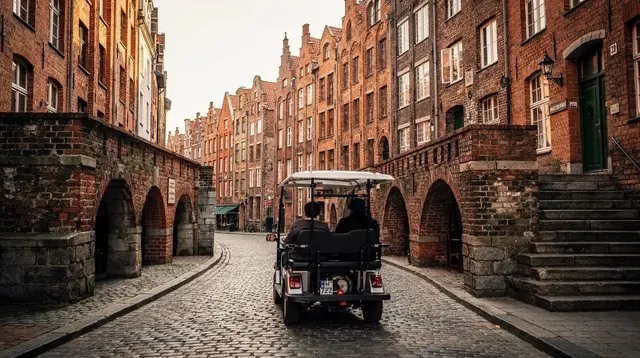
Every guidebook photo of Gdańsk shows the same scene: a row of narrow, gabled townhouses in ochre, teal and rust, marching down a wide cobbled street toward a Gothic church tower. It is a genuinely beautiful streetscape, and it is worth every minute of a slow walk. But it is not, whatever the postcards imply, an unbroken medieval survivor.
The single most important fact to carry into this walk is that the Gdansk Main Town (Główne Miasto) was reduced to rubble - roughly 90 percent of it - in the final assault of 1945, and almost everything standing today was rebuilt in the decades that followed. This guide covers a logical, on-foot route through that rebuilt Main Town: what you are actually looking at, what it takes to climb the basilica tower, and how the pieces connect along the Motława riverfront.
Before you start: the reconstruction, honestly
It is worth getting this out of the way at the start rather than treating it as a footnote, because it changes how the walk should be read. By the time Soviet and Polish forces took the city in March 1945, the historic core had been devastated by fighting, deliberate destruction and fire. Postwar Poland made a deliberate choice to rebuild the Main Town largely to its prewar appearance - the property lines, the general silhouette of the gabled facades, the pattern of streets - using old paintings, photographs and surviving architectural fragments as reference.
The result is not a replica in the theme-park sense; it is a genuine, decades-long reconstruction effort that gives the district real historical weight of its own. But it is reconstruction, not survival, and a walking tour that promises an “original medieval centre” or a town “unchanged since the Middle Ages” is simply wrong. Walk the Main Town for what it is: one of Europe’s most convincing postwar rebuilds, built on real medieval foundations and a real medieval street plan, wearing facades that are largely younger than living memory of the war that destroyed them.
The route in outline
The logical shape of this walk is a loop, not a straight line: start at the Golden Gate at the western end of the Royal Route, walk the length of Dlugi Targ and Dluga street, turn toward the river at the Green Gate, follow the Motława riverfront north past the Żuraw crane, then cut back inland via Mariacka street to finish at St Mary’s Basilica. Done without stops, it is under two kilometres of flat, easy walking. Done properly - with time at each stop and the tower climb included - it is a half-day, not an hour’s detour between other sights.
Długi Targ and the Royal Route
The walk traditionally begins at the Golden Gate, one of the historic gateways that once marked the ceremonial entrance to the city for visiting royalty, and follows Dluga street into Długi Targ (the “Long Market”), the broad square that is the heart of the Main Town. This is where the gabled townhouse facades are at their most photogenic, and where the reconstruction point matters most: nearly every building lining the square was rebuilt after 1945, some more faithfully documented than others.
At the centre of the square stands the Neptune Fountain, a bronze statue that is one of the few genuinely old elements here - the original figure survived the war and was reinstalled once the surrounding square had been rebuilt around it. Take the time to notice the detail on the surrounding facades: the ornamentation, the varied gable shapes, the painted friezes. It rewards slow looking more than a quick photo from the middle of the square.
The Artus Court
Facing Neptune’s Fountain is the Artus Court (Dwor Artusa), historically a merchants’ meeting hall and one of the most architecturally significant buildings on the square. Its interior, when open, preserves a sense of the wealth and civic pride of Gdańsk’s Hanseatic-era merchant class, with period furnishings and decoration. Pairing the exterior view from the square with a proper look inside is worth building into the walk rather than skipping past - the interior gives a much clearer sense of what the merchant elite of Hanseatic Gdańsk actually lived and worked among, in a way the rebuilt facades outside cannot on their own.
Down to the Green Gate and the river
Długi Targ ends at the Green Gate, a Dutch Renaissance-style gateway that opens directly onto the Motława riverfront. This transition point is one of the best moments on the whole walk: you pass from the enclosed, formal space of the market square into the open riverside promenade in a handful of steps, and the change in atmosphere is immediate. The gate itself once served as a residence and reception space, another reminder of how tightly the Main Town’s civic and commercial life were woven together.
The Motława riverfront and the Żuraw
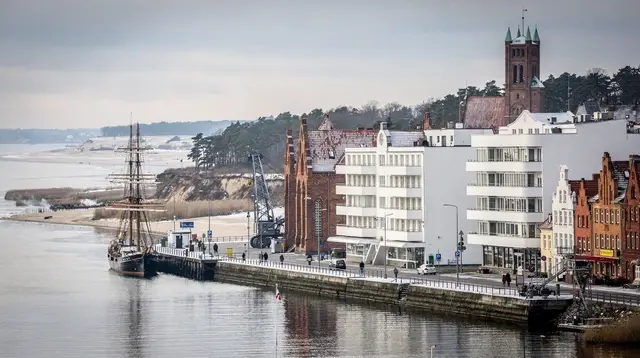
Turning north along the river brings you to the most recognisable single landmark in Gdańsk after the basilica: the Żuraw, a medieval crane gate that functioned for centuries as both a fortified city gate and a working crane, used to load cargo and step masts into ships moored below. It looks, from across the water, like a picturesque photo stop, and it is, but it is also the entrance to a branch of the National Maritime Museum - going inside to see the crane mechanism and the maritime exhibits is a different, ticketed experience from admiring it from the promenade.
The riverfront itself is lined with restaurants, amber stalls and, depending on season, boats offering short cruises out toward Westerplatte or across to the shipyard side of the water; a slower version of this same stretch is covered in more depth in the guide to Motława river cruises and Gdańsk boat tours if you want to see the Main Town from the water rather than only the embankment.
Mariacka street
From the riverfront, a short cut inland along Mariacka street brings the walk back toward the basilica. Mariacka is Gdańsk’s traditional amber-dealers’ street, lined with distinctive stone porches (przedproza) that once served as the stoops of individual townhouses and today host amber jewellery stalls and small galleries.
It needs no ticket and no fixed schedule, but it is worth knowing that reputable amber comes with a certificate of authenticity, and that prices at the smaller independent stalls are often negotiable rather than fixed. The full picture on what to look for is covered separately in the guide to spotting real amber in Gdansk and in the Mariacka street shopping guide.
St Mary’s Basilica and the tower
Mariacka street opens directly onto St Mary’s Basilica, one of the largest brick churches in the world and the natural endpoint of the walk. As a working parish church, entry to the nave is generally free, though it periodically closes for services, so it is worth having a second stop in mind if you arrive at the wrong moment. The tower is a separate matter entirely, with its own entrance and its own queue: the climb runs to roughly 400 steps on narrow stone and wooden stairways, and there is no lift.
This is a genuine physical climb, not a brief detour, and it is not well suited to anyone with limited mobility, a fear of tight enclosed stairwells, or young children who tire quickly on stairs. For those who make the climb, the reward is a wide, level view across the gabled roofs of the Main Town toward the shipyard cranes and the river - arguably the single best vantage point over the whole district, and a good way to see the shape of the walk you have just done from above. Anyone tackling the tower should also read the fuller account of the climb in St Mary’s tower and its four hundred steps before committing to it.
What the walk actually takes, in practice
A realistic plan looks less like the compressed “one hour, all highlights” version sold on some day-tour itineraries and more like this:
| Stage | Realistic time |
|---|---|
| Golden Gate to Długi Targ, with the fountain and facades | 20-30 minutes |
| Artus Court, exterior and interior | 20-40 minutes |
| Green Gate to the Motława riverfront, including the Żuraw | 30-45 minutes |
| Mariacka street, unhurried | 15-25 minutes |
| St Mary’s Basilica nave | 15-20 minutes |
| St Mary’s tower climb, round trip | 30-45 minutes |
| Total | 2-3.5 hours |
That total does not include a coffee stop, a sit-down lunch on the riverfront, or a longer browse through the Artus Court’s furnished rooms - add any of those and the walk becomes a genuine half-day rather than a morning errand. Anyone building a longer stay around this route should look at the one-day Gdańsk itinerary for how the Main Town fits alongside the shipyard and the riverfront in a single day, or the Gdansk-Sopot two-day itinerary for a more relaxed pace that spreads the Old Town over parts of two mornings.
Doing it self-guided versus with a guide
This route works well entirely self-guided: the streets are well signposted, the sights are close together, and nothing requires advance booking to simply walk past and admire. Where a guide adds real value is context - the Main Town’s reconstruction story, the layered history of the Hanseatic League, the Free City of Danzig period, and the postwar rebuilding effort are dense enough that a good guide turns the same walk into something far richer than a self-directed loop with a map.
For a first visit, a guided walking tour of the Old Town covers this exact route with someone who can explain what survived the war and what did not, building by building. Travellers who want a slower, storytelling-led version can look at the Old Town walking tour with a monk guide, which folds religious and civic history into the same ground covered here.
For anyone who wants the Artus Court’s interior included without working out opening hours separately, the private Old Town tour with an Artus Court visit bundles the two together. And travellers short on time who still want the Main Town and the basilica covered properly, with a meal built in rather than squeezed around it, might prefer the Old Town highlights and basilica tour with dinner. None of these are required to enjoy the walk - the route above works fine alone with a map - but each solves a different version of “I don’t want to research this myself.”
Extending the walk
The Main Town loop connects naturally to two nearby districts that reward extra time if a single walk is not enough. East across the shipyard side of the Motława lies the birthplace of the Solidarity movement, covered in the Gdańsk Shipyard Solidarity tour guide and the wider Gdańsk WWII history tour, both a short walk or a quick water-tram ride from the Green Gate. Inland and slightly south, the leafy district of Wrzeszcz - associated with the writer Gunter Grass - makes a good half-day add-on for a second day, detailed in the Wrzeszcz walking tour.
For a different pace entirely, the Oliwa district’s cathedral, organ recitals and park sit a short train ride away and are covered in the Oliwa park, zoo and cathedral guide. And if the Main Town’s crowds and pace leave you wanting the water instead of the pavement, the Motława sunset cruise retraces much of this same riverfront from a boat rather than on foot.
What to skip promising yourself
A few honest expectations are worth setting before you set out. This is not a walk through an intact medieval town - see the reconstruction note above, and treat any claim otherwise as marketing rather than history. It is also not a walk that fits comfortably into “under an hour,” despite how some compressed group itineraries frame it; the distances are short but the sights reward time, and the tower alone can eat 45 minutes round trip.
And the tower itself has no lift and no shortcut - roughly 400 steps up and the same back down, on foot, for anyone who wants that rooftop view over the Main Town. Plan around those three facts and the walk works exactly as described: a compact, walkable loop through one of northern Europe’s most convincing postwar reconstructions, with a genuine climb and a genuine river at either end of it.
Walking tours
Verified deep-linked GetYourGuide tours. Book through these links and we earn a small commission at no cost to you.
GetYourGuide does not provide a product photo for this activity — the image shows the meeting point, photographed by us.