Mariacka Street: Gdańsk's Amber Lane
What makes Mariacka street worth a visit in Gdańsk?
Mariacka is a short, narrow lane behind St Mary's Basilica lined with carved stone porches (przedproza) and small amber workshops and galleries. It is a walking and browsing experience rather than a single attraction, best paired with a slow look at the jewellery on display rather than a rushed purchase.
A street built for slow walking
Mariacka is short enough to cross in a few minutes and interesting enough that almost nobody does. It runs from the side door of St Mary’s Basilica, Gdańsk’s brick Gothic giant, down to the Motlawa riverfront near the medieval crane, and along the way it does something few streets in the Old Town manage: it keeps its own identity rather than folding into the general sweep of gabled facades.
Where Dlugi Targ is wide, formal and built for processions, Mariacka is narrow, intimate and built, it seems, for lingering. The two are close together and easy to confuse on a first visit, but they are not interchangeable - Długi Targ is the ceremonial spine of the Old Town, while Mariacka is a side street with its own trade, its own rhythm and its own decades, in some cases centuries, of amber dealing behind small shop windows.
What sets Mariacka apart architecturally is a feature called przedproza - raised stone porches with steps and low balustrades that once fronted nearly every townhouse on the street. Reconstructed after the devastation of 1945 along with the rest of the Old Town, the porches were rebuilt with real care for their original decoration: carved gargoyles jut out mid-step, grotesque faces peer down from door frames, and stone reliefs run along the balustrades. Even a visitor with no interest in buying anything gets something out of walking the length of Mariacka just to look at the stonework, which is denser and more playful here than almost anywhere else in the city.
Amber as the street’s trade, not its whole story
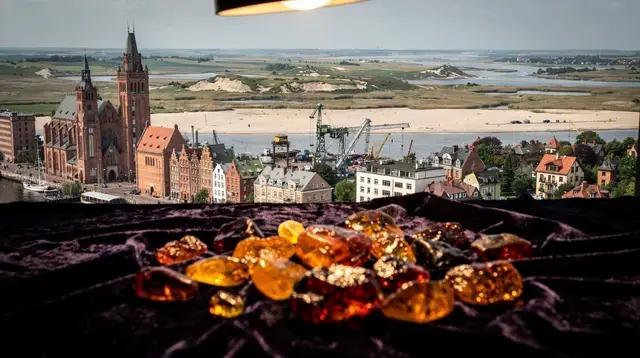
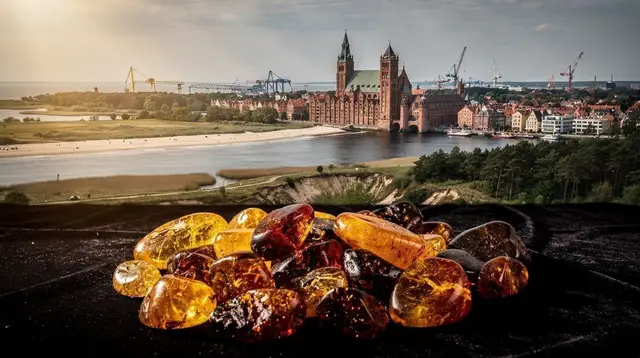
Amber shops occupy a large share of Mariacka’s ground floors, and have for a very long time - Gdańsk’s relationship with the Baltic’s fossilised tree resin goes back centuries, and Mariacka is where a large part of that trade has always been visible to passers-by rather than tucked into workshops. Shop windows along the street display amber set in silver and gold: rings, pendants, earrings, cufflinks, sometimes raw or lightly polished pieces sold loose. Colours range from pale lemon to deep cognac to nearly black, and pieces occasionally contain visible inclusions - a trapped insect or fragment of plant matter - which collectors particularly prize.
It is worth being honest about what a walk down Mariacka actually offers: browsing, not a guarantee. This is a public shopping street with dozens of independent businesses, not a single curated collection with uniform standards. Some workshops have traded amber for generations and stand firmly behind what they sell; others are more casual retail operations aimed squarely at passing tourist traffic. Nothing about being located on Mariacka certifies a stone as genuine amber rather than pressed amber, copal, or plastic imitation, and no seller’s claim should be taken as proof on its own. The street rewards visitors who look, compare and ask questions rather than those who assume every window holds the same quality.
For the specific criteria that separate genuine Baltic amber from the various imitations sold nearby, see how to spot real amber in Gdansk before treating anything you see on Mariacka as a confirmed purchase. That guide covers the practical tests and questions worth asking a seller; this page is about the street itself and the experience of walking it.
How Mariacka differs from the Amber Museum
It helps to separate two experiences that visitors sometimes conflate. The Amber Museum, housed in the medieval Foregate a short walk from Mariacka, is a museum in the strict sense: exhibits on how amber forms over millions of years, its use through history, and the craftsmanship behind cutting and setting it, without a single item for sale inside. Mariacka is the opposite kind of place - a working commercial street where the amber trade actually happens, with no curatorial framing and no explanatory panels, just shop windows and the people running them.
Many visitors find the two complement each other well: a stop at the museum first gives a working sense of what to look for - colour variation, clarity, weight, the kind of setting typical of quality work - and a subsequent walk down Mariacka becomes more informed browsing rather than a guess. Doing it in the other order works too, but the museum’s context is harder to absorb retroactively once a purchase decision is already made. Either way, treat the two as separate stops on a longer Old Town circuit rather than one combined attraction, since they sit only a few minutes apart on foot and suit different paces - the museum rewards unhurried reading, Mariacka rewards unhurried looking.
What buying amber actually involves
There is no single, universal price for amber, and any claim that it trades “by weight in gold” or at some fixed rate misrepresents how the market actually works. Value on Mariacka - as in any amber market - depends on a combination of factors: the size and weight of the piece, its colour and clarity, whether it contains a visible inclusion, the quality of the metalwork it is set in, and simply which particular workshop is selling it. Two similarly sized pendants in neighbouring windows can carry noticeably different price expectations for reasons that are not always obvious from outside the glass, which is exactly why it is worth stepping inside and asking rather than judging by display alone.
Negotiation exists on Mariacka but is not universal. Smaller, independent stalls and some of the more modest workshops tend to have room to move on price, particularly for simpler pieces or when buying more than one item. Established galleries with polished displays and fixed price tags are typically firmer, especially on larger or more intricate work. A polite question about whether there is flexibility on the price is common practice and rarely causes offence; a hard bargaining stance more suited to a street market elsewhere is less so.
Reputable sellers on Mariacka will generally provide some form of documentation or certificate with a purchase of any real value, and will answer direct questions about where a piece came from and how it was tested without visible reluctance. Vague answers, an unwillingness to let a piece be examined closely, or a price that seems sharply out of line with similar items nearby are all reasons to pause rather than reasons to move quickly, particularly for a first-time buyer unfamiliar with what genuine Baltic amber should look and feel like.
Walking the street itself
A visit to Mariacka works best without a strict plan. Starting at the St Mary’s Basilica end, the street opens onto a run of porches and shop fronts that narrows gently toward the river, and the short distance means there is little risk of getting lost or running out of time - the entire length is a walk of a few hundred minutes at most end to end. What extends a visit is the stopping: pausing at a porch to look at its carving, stepping into a workshop that catches the eye, comparing two or three shop windows before deciding whether to go in anywhere at all. Visitors who treat it as a stroll rather than an errand tend to enjoy it more than those trying to tick it off quickly.
Time of day changes the experience considerably. In July and August, particularly around midday, the street fills with visitors moving slowly in both directions and shop entrances can feel crowded. Early mornings before the main flow of Old Town tourism picks up, or an evening walk once shops have closed and the porches are lit differently, offer a much quieter version of the same street - worth considering for anyone who wants to appreciate the architecture without competing for space at the photogenic corners.
Mariacka connects naturally into a longer Old Town route. From the river end, it is a short walk to the Żuraw crane on the Motława waterfront, and from the basilica end back into the network of streets around Dlugi Targ. Visitors following a structured route sometimes prefer to build the whole area into a single morning or afternoon - the Old Town walking tour covers this ground with more context on the surrounding streets, and the Amber Museum guide covers the museum stop in full.
Making amber part of a wider visit
Mariacka rarely stands alone on an itinerary, and it does not need to - a short, memorable stop fits easily alongside the rest of central Gdańsk. Visitors staying near the Old Town often pair it with a look at Mariacka street itself as one stop within a fuller Old Town walking tour, or build it into a first full day using the one-day Gdańsk itinerary, which threads the basilica, the riverfront and the amber lane into a single walkable loop.
For a more structured introduction with a guide who can point out details easy to miss on a self-directed walk - from the meaning of specific porch carvings to which workshops have the longest track record - a guided option covering both the Old Town and the amber trade in one outing removes some of the guesswork.
A private Old Town walk that ends with dinner and an amber museum visit folds Mariacka’s surroundings into a single guided afternoon, while a private tour pairing the Amber Museum with skip-the-line Old Town access suits visitors who want the museum’s context clearly separated from the street browsing that follows it.
Visitors extending their Old Town time beyond amber and architecture sometimes add a stop at the Tower of Secrets and Wax Figure Museum, a different kind of indoor attraction within easy walking distance, or cover more ground on two wheels with a private bike tour of the city that swings past the riverfront near Mariacka’s lower end. None of these replace the walk down Mariacka itself - they simply give it a place within a longer day rather than treating it as an isolated errand.
Beyond Mariacka: where else amber shows up in Gdańsk
Mariacka is the densest concentration of amber sellers in the city, but it is not the only place amber appears in Gdańsk’s Old Town. Shops selling amber jewellery also cluster around Dlugi Targ and near the Żuraw crane on the waterfront, and visitors curious about the craft itself rather than just the finished product can watch or try amber jewellery-making at a dedicated workshop elsewhere in the city.
None of these alternatives change the basic advice that applies on Mariacka: judge each piece and each seller on its own terms, lean on documented sourcing rather than a shop’s location for reassurance, and treat the Amber Museum as the place to build the knowledge that makes browsing anywhere in the city more useful.
Frequently asked questions about shopping on Mariacka street
Is Mariacka the same street as Długi Targ?
No. Długi Targ is the grand main square-like avenue running through the Old Town, lined with merchant houses, restaurants and the Neptune Fountain. Mariacka is a separate, much narrower street that runs perpendicular to it, connecting St Mary’s Basilica to the Motława riverfront. They sit close together but are distinct streets with different characters.
Is every piece of amber sold on Mariacka street genuine?
Not necessarily. Mariacka has many long-established, reputable workshops, but it is a public shopping street, not a certification body, and quality and authenticity vary by seller. Genuine dealers typically provide documentation on request; treat unusually cheap pieces or vague answers about origin as reasons to ask more questions, not as proof of a bargain.
Do I need to negotiate the price of amber on Mariacka?
Prices at small stalls and independent workshops are often somewhat flexible, especially for smaller or simpler pieces, while established galleries with fixed displays tend to hold firmer prices. There is no universal rate for amber - value depends on the piece’s size, clarity, colour, craftsmanship and whether it contains inclusions, so treat any single figure you hear as one seller’s asking price, not a market standard.
What are the carved porches on Mariacka street?
They are przedproza, raised stone terraces with steps and low balustrades that once fronted the townhouses along the street, a design distinctive to historic Gdańsk. Many are decorated with carved gargoyles, grotesques and ornamental stonework, and they are a large part of what makes a walk down Mariacka worthwhile even without buying anything.
How long does it take to walk Mariacka street?
The street itself is short, a few hundred metres from the basilica to the river, so walking it end to end takes well under ten minutes. Most visitors spend considerably longer than that browsing shop windows, stepping into a few workshops and pausing at the porches, so a relaxed visit is closer to thirty minutes to an hour.
Should I buy amber on Mariacka or wait for the Amber Museum?
They serve different purposes. The Amber Museum, housed in the medieval Foregate nearby, explains how amber forms and how to judge it, without selling anything. Mariacka is where the actual buying happens, so many visitors find it useful to visit the museum first for context and then browse Mariacka’s shops with a clearer sense of what to look for.
Are there amber shops anywhere else in Gdańsk besides Mariacka?
Yes, amber jewellery is sold across the Old Town, including around Długi Targ and near the Żuraw crane, and Gdańsk also runs dedicated amber jewellery workshops where visitors can watch or try the craft. Mariacka is simply the most concentrated and best-known stretch, with the highest density of specialist amber businesses in one place.
Is Mariacka street busy or quiet?
It varies sharply by season and time of day. In July and August, particularly around midday and early evening, the narrow street fills with visitors moving slowly between shopfronts. Early mornings, shoulder-season months and evenings after the shops close are noticeably quieter, and the porches and architecture are easier to appreciate without a crowd.
Amber museum tours
Verified deep-linked GetYourGuide tours. Book through these links and we earn a small commission at no cost to you.
GetYourGuide does not provide a product photo for this activity — the image shows the meeting point, photographed by us.