Amber Museum Gdańsk: Mariacka Street and the Baltic Gold
What is the Amber Museum in Gdańsk and is Mariacka street worth visiting?
The Amber Museum, housed in the medieval Foregate near St Mary's Basilica, covers how Baltic amber formed and how it has been worked for centuries. Mariacka street, the amber-dealers' lane running from the basilica to the Motława, is worth a slow walk for its ornamental porches and shopfronts, though prices and authenticity vary stall to stall.
Gdańsk’s relationship with amber goes back centuries, well before the city became known for its shipyards or its Gothic brick churches. This guide covers the two places that relationship is easiest to see today: the Amber Museum, tucked into a medieval gate building near St Mary’s Basilica, and Mariacka street, the short, atmospheric lane that has served as the city’s amber-dealers’ row for generations. It also covers the one fact that most souvenir-shop patter tends to blur: amber is not a mined gemstone, and Gdańsk is not its only source.
What amber actually is
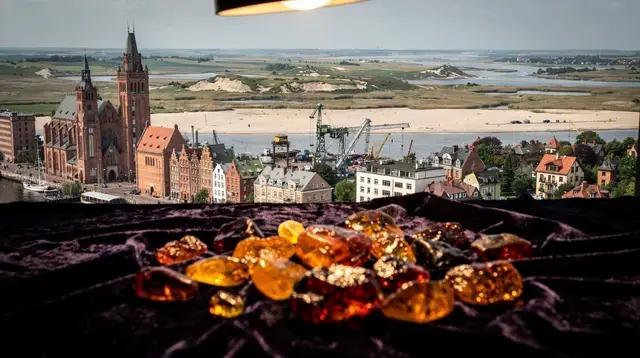
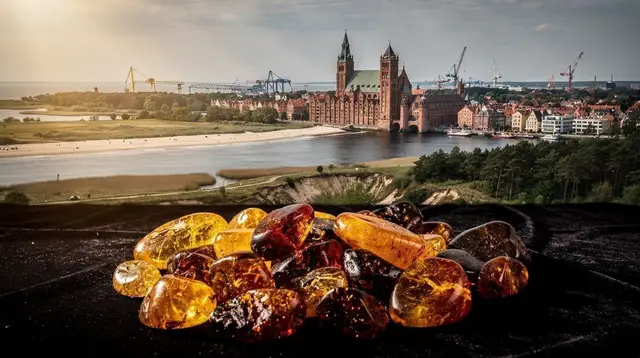
Amber is fossilised tree resin. Roughly 40 million years ago, dense coniferous forests covered much of what is now northern Europe. Resin oozed from those trees, sometimes trapping insects, seeds or air bubbles as it did, and over millions of years that resin hardened, buried in sediment, and eventually mineralised into the substance now called amber. It is an organic material, chemically closer to hardened tree sap than to a crystal, which is why gemologists classify it separately from true minerals and gemstones like diamond or quartz.
This distinction matters because it shapes how amber is actually obtained. It is not extracted from a mine or a quarry in the way most gemstones are. Along the Baltic coast, amber is collected from beaches after storms have churned up the seabed and washed pieces ashore, and it is also dredged commercially from marine sediments, particularly in deposits off the coast further east. Neither method resembles rock mining, and any account of amber that describes it as a mined mineral has the geology wrong.
The other point worth being precise about is where it comes from. The Baltic Sea basin as a whole is one of the richest amber-bearing regions on earth, and that richness is spread along the coastline, not concentrated at any single town. Poland’s coast produces amber, as does the coast further east around Kaliningrad, historically the single largest source of commercially extracted Baltic amber, and the shores of Lithuania and Latvia further along.
Gdańsk did not become an amber city because the resin only appears here. It became an amber city because it built, over centuries, the trading networks and craft guilds that turned raw material gathered across the wider Baltic into finished jewellery, carvings and objects sold onward through its port. This particular myth, that amber comes out of a mine like a gemstone, is common enough that a separate piece on this site, amber is not a mined gem, tackles it head-on.
The Amber Museum
Gdańsk’s Amber Museum sits inside the Foregate (Przedbramie), a fortified gate complex just off Długi Targ, a short walk from St Mary’s Basilica. The building itself has a layered history worth knowing before stepping inside: it served for a time as a prison, and its lower chambers were used as a torture room, a grim previous life for a space that now displays polished jewellery and worked amber pieces under glass.
The collection traces the material’s natural history first, explaining how resin becomes amber and what the inclusions occasionally found inside it, insects, plant fragments, tiny air bubbles, can reveal about prehistoric forests. From there it moves into the human side of the story: how amber has been worked, traded and fashioned into objects since prehistory, and Gdańsk’s specific role as a hub of that trade from the medieval period onward, reinforced by its long membership of the Hanseatic League.
A visit takes around an hour for most people. The rooms are not large, and the museum rewards a steady, unhurried pace rather than a rushed circuit, particularly in the sections explaining the geology, since the labelling carries more of the story than the objects alone. Combining the museum with a walk down Mariacka street immediately afterward makes sense logistically, since the two are a few minutes apart on foot, and seeing the collection first gives the shopfronts more context.
For visitors who would rather have the history narrated than read off a wall panel, a guided option that pairs the museum with the wider Old Town covers the same ground with commentary built in.
a private Old Town walk that includes the Amber Museum and finishes with dinner is one way to fold the visit into a broader half-day in Gdańsk, useful for a first-time visitor who wants the Old Town’s landmarks and the amber story covered together rather than as two separate stops.
Mariacka street
Mariacka is the short, cobbled lane that runs from the base of St Mary’s Basilica down to the Motława riverfront, and it has functioned as Gdańsk’s amber-dealers’ street for a very long time. Its character comes less from any single shop than from the architecture itself: a run of narrow townhouses fronted by przedproza, ornamental raised stone porches with carved gargoyles and decorative balustrades, a distinctive feature that appears on few other streets in the city.
Like almost everything in the Old Town, these facades are careful postwar reconstruction rather than untouched medieval fabric, since the district was reduced to rubble in 1945 and rebuilt in the decades afterward, but the reconstruction followed the original street plan closely enough that the walk still feels distinctly old.
Amber shops and workshops line both sides of the street, ranging from long-established family businesses to smaller stalls that set out tables in the warmer months. Wares span the full range of what amber can become: loose polished stones, set jewellery, carved figures, and pieces mounted in silver.
This guide will not quote prices, since they shift with the season, the size and quality of the stone, and the individual seller, but a rough rule holds across most amber markets: larger, clearer pieces with visible inclusions command more than small, cloudy fragments, and prices at Mariacka’s more established shops tend to sit above what a casual seasonal stall asks. A dedicated Mariacka street amber shopping guide goes shop by shop for visitors who want more detail before browsing.
What is worth saying plainly is that not every piece sold on the street comes with the same assurance of authenticity. Reputable dealers, particularly the longer-running shops, issue a certificate with any meaningful purchase, stating the amber’s origin and sometimes its estimated age. Smaller or more transient stalls do not always offer the same paperwork, and a street this well known for its trade inevitably also attracts a share of imitation material aimed at visitors who will not ask questions.
None of that makes Mariacka a place to avoid; it simply means a purchase worth caring about deserves a shop willing to explain what it is selling and to put that explanation in writing. A separate guide on this site, how to spot real amber in Gdansk, walks through the practical checks in more detail than belongs here. Visitors who would rather make something than simply buy it can look at an amber jewellery-making workshop, a hands-on alternative to browsing the shopfronts.
Mariacka needs no ticket and no timing. It works equally well as a five-minute pass-through on the way to the river or as a slow half-hour browse, and it is at its most atmospheric in the early evening, when the porches catch low light and the street empties out ahead of the dinner rush.
Amber, the Old Town, and what else sits nearby
The Amber Museum and Mariacka street both sit within a few minutes of Gdańsk’s other Old Town landmarks, which makes this stretch an easy one to fold into a broader walk rather than treat as a separate outing. St Mary’s Basilica itself is worth pairing with the museum visit, both for the church interior and for the climb up its tower, a separate ticket from the church entrance and one of the best vantage points over the Old Town’s rooftops. The Motława riverfront, with the medieval crane Żuraw, sits at the bottom of Mariacka, a natural point to continue toward after browsing the amber shops. Długi Targ, the grand main square lined with merchant houses, is a two-minute walk in the other direction.
Visitors building a longer itinerary around the Old Town’s history rather than its amber trade might look at the Gdańsk Old Town walking tour guide for a fuller route, or at where to stay in Gdansk if a base within walking distance of Mariacka is the priority. For visitors curious about other unusual small museums in the same part of the Old Town, the city’s Tower of Secrets and Wax Figure Museum sits a short walk away and makes for an easy add-on for anyone touring a cluster of Old Town sights in one afternoon, amber included.
Visitors who prefer a single guided thread through the Old Town’s amber history, architecture and market squares, rather than piecing the walk together stop by stop, might consider a private tour combining the Amber Museum with Old Town tickets, which keeps the amber theme central while still covering the wider Old Town in the same outing.
For those wanting the Old Town’s wartime and Solidarity-era history covered on the same day rather than the amber trade, a guided walking tour spanning medieval Gdańsk through to the Solidarity movement runs a different route through the same district, useful for splitting a longer stay into distinct themed walks rather than one long combined tour.
Table: Amber Museum and Mariacka street at a glance
| Amber Museum | Mariacka street | |
|---|---|---|
| What it is | Museum in the medieval Foregate | Amber-dealers’ lane, Old Town |
| Typical visit length | About 1 hour | 15-30 minutes, longer if browsing |
| Booking needed | No, ticket at the door | No |
| Best paired with | St Mary’s Basilica, Długi Targ | Motława riverfront, Żuraw crane |
| What to expect | Geology and trade history of amber | Ornamental porches, jewellery shops |
Practical notes for visiting
The Amber Museum and Mariacka street both sit inside Gdańsk’s compact Old Town, easily reached on foot from Dlugi Targ or from Gdańsk Glowny station in around fifteen minutes’ walk. Neither location requires advance booking outside of a guided tour package, and both work at almost any time of year, though Mariacka’s outdoor stalls thin out considerably in winter compared with the busier summer season, when St Dominic’s Fair fills the surrounding streets in August.
Comfortable shoes matter more than timing here, since the appeal of both stops is a slow walk rather than a fixed schedule. On a wet day, the museum’s indoor galleries make a sensible fallback, an option covered more broadly in Gdańsk in the rain.
A visit to the Amber Museum and a stroll down Mariacka together take under two hours, which makes them easy to slot into a longer day that also covers St Mary’s Basilica, the Motława waterfront and Długi Targ. For a fuller sense of how much time the rest of Gdańsk’s Old Town deserves, see how many days in Gdansk, or for a full first day built around these same streets, the one-day Gdańsk itinerary.
Frequently asked questions about the Amber Museum and Mariacka street
Is amber a mineral or a gemstone?
Neither, strictly speaking. Amber is fossilised tree resin, organic material that hardened and mineralised over millions of years, not a mineral formed through geological crystallisation like a true gemstone.
How old is Baltic amber?
Most Baltic amber formed around 40 million years ago, from resin exuded by coniferous forests that once covered northern Europe, later reworked into the sediments of the Baltic Sea basin.
Is Gdańsk the only source of Baltic amber?
No. The Baltic Sea and its coastal sediments produce amber all along the coastline, from Poland through Kaliningrad to Lithuania and beyond. Gdańsk’s role is historical and commercial, as a centre of trading and craftsmanship, not as a unique geological source.
Where is the Amber Museum in Gdańsk?
It occupies the medieval Foregate (Przedbramie), a former prison and torture chamber complex, close to St Mary’s Basilica and a short walk from the top of Mariacka street.
Is all amber sold on Mariacka street genuine?
Not automatically. Reputable dealers provide a certificate of authenticity, but the street mixes long-established workshops with more casual stalls, and buying without asking questions carries the usual risk of any open-air market.
How can a visitor tell real amber from imitation?
There is no single foolproof street test, but genuine amber is typically warm to the touch, relatively light, and sold with paperwork by an established dealer; a separate guide on this site walks through the checks in more detail.
How long does a visit to the Amber Museum take?
Around an hour is enough for most visitors to see the collection and the building’s own history as a former prison, without rushing.
What is Mariacka street known for besides amber?
Its ornamental stone porches (przedproza), a distinctive feature of Gdańsk’s Old Town architecture, rebuilt after the Second World War along with the rest of the street’s gabled facades.
Amber museum tours
Verified deep-linked GetYourGuide tours. Book through these links and we earn a small commission at no cost to you.
GetYourGuide does not provide a product photo for this activity — the image shows the meeting point, photographed by us.