Amber Jewelry Workshops in Gdańsk: Make Your Own Souvenir
Is it worth doing an amber jewelry workshop in Gdańsk?
Yes, if you go in wanting a hands-on craft experience rather than a guaranteed professional-grade piece. A short workshop teaches the basics of setting a genuine amber cabochon into silver wire or a simple mount, and you leave with something you made yourself, not a factory souvenir.
Gdańsk sells more amber jewelry per square metre than almost any other city on the Baltic, but nearly all of it arrives at the tourist already finished - set, polished, boxed. An amber jewelry workshop flips that around: instead of choosing a piece someone else made, you spend an hour or two learning why the material behaves the way it does, then set a piece of it yourself. It is a slower, more honest way to take a souvenir home than a five-minute purchase on Mariacka street, and it pairs naturally with the city’s identity as a historic amber-trading port.
What amber actually is, and why it matters for the craft
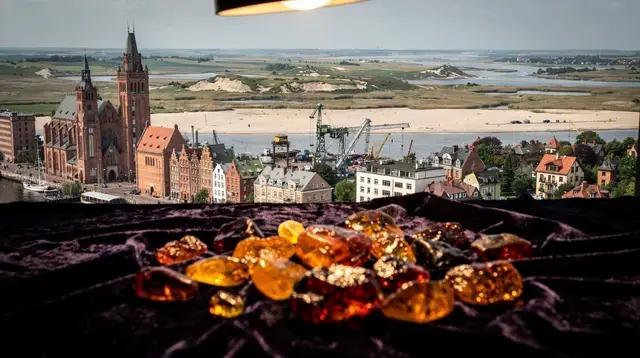
Before you sit down at a workbench, it helps to know what you are working with. Baltic amber is not a gemstone in the way a sapphire or an opal is - it is not mined from rock. It is fossilised tree resin, roughly 40 million years old, formed when sap from ancient coniferous forests oozed out, trapped debris and sometimes insects, and slowly hardened and fossilised over geological time.
That origin is why amber behaves so differently from a cut stone at the workbench: it is soft, roughly a 2 to 2.5 on the Mohs hardness scale, which means it can be shaped, sanded and polished with hand tools rather than industrial cutting equipment, but it also scratches and chips more easily than glass or quartz. It is warm to the touch rather than cold, and it is light - a piece of amber the size of a coin weighs noticeably less than a similarly sized stone.
This is the pedagogical hook that a good workshop leans on: understanding amber as fossil resin rather than as “just another stone” changes how you handle it. An instructor who explains why a rushed sanding step can crack a piece, or why amber shouldn’t be exposed to sudden heat, is teaching geology and craft at once. If you want to go deeper into the material itself before or after a workshop, the city’s Amber Museum, housed in the medieval Foregate, covers the science and history in more depth than any hands-on session has time for - see our Amber Museum guide for what the exhibition covers and how long to allow.
What a beginner workshop actually involves
Workshops vary by studio, but the core structure tends to follow a similar shape. You’ll typically start with a short introduction to the material - where Baltic amber comes from, how it differs in colour and clarity, and often a chance to handle a few raw or part-polished pieces before any tools come out. From there, most beginner sessions focus on a single technique: setting a pre-shaped amber cabochon into a simple wire frame or mount, rather than cutting or carving amber from scratch. Wire-wrapping is the most common beginner method because it needs no heat and forgives small mistakes, while soldering-based settings (more common in intermediate or professional classes) ask for steadier hands and more instruction time.
Expect to leave with one finished piece - commonly a pendant, sometimes a simple ring or a pair of earrings, depending on the studio’s format for that day. Groups tend to be small, which matters more than it might sound: with only a handful of benches and one or two instructors circulating, everyone gets individual correction, which is what actually makes a first attempt come out wearable rather than lopsided.
a small-group jewelry-making session where you shape and set your own piece of amber is the most direct way to book this experience without hunting down an independent studio yourself, and it bundles materials and instruction into one sitting.
What to honestly expect - and what not to expect
It’s worth being upfront about the limits of a short workshop, because overselling it sets visitors up to be disappointed with their own work.
Don’t expect a jeweler’s finish. An instructor with years of practice can set a cabochon cleanly in minutes; a first-timer, even with good guidance, will produce something with visible wire joins, an asymmetric bend, or a slightly off-centre stone. That’s not a failure of the workshop - it’s the nature of a first attempt at any hand craft. If you want a flawless, gallery-quality piece, buying from an established amber studio or the shops along Mariacka is the more reliable route; the workshop is about making something yourself, not matching a professional’s output on your first try.
Don’t assume you can walk in without booking. Unlike browsing a shop window, a workshop needs a bench, tools and materials set aside for you, and studios run to group sizes they can actually supervise. Sessions can and do sell out, particularly in the June-to-September season and especially around St Dominic’s Fair in August, when the Old Town is at its busiest. Book ahead rather than treating this as a spontaneous stop between the Motława waterfront and dinner.
Don’t assume every piece of workshop amber is verified genuine without asking. This might be the least intuitive point, but it matters: amber fraud - resin substitutes, reconstructed amber, plastic imitations - is a real issue in a city that sells this much of it, and workshop supply chains are not automatically exempt just because the session is billed as authentic.
A studio attached to a known name near the Amber Museum or with a visible reputation is a safer bet than an unbranded pop-up stall, but it is reasonable to simply ask how the workshop sources its amber. Our companion piece, how to spot real amber in Gdansk, covers the basic tests - the float test in salt water, the static test, the smell test when warmed - that apply just as well to workshop material as to a shop purchase, and it’s worth reading before you go so you know what a genuine piece should feel and behave like.
How this fits with the rest of Gdańsk’s amber story
Gdańsk’s relationship with amber goes back centuries; the city has traded what’s sometimes called the “gold of the Baltic” since its Hanseatic days, and that history is layered across several sites that make sense to combine with a workshop rather than treat as a one-off activity.
Mariacka street is the obvious starting point - the traditional amber-dealers’ street, running from St Mary’s Basilica down to the Motława, lined with ornamental porches and shopfronts that have sold amber for generations. It’s worth a browse before or after a workshop, partly for atmosphere and partly because seeing a wide range of finished, professional pieces gives useful context for what you’re about to attempt yourself. Our Mariacka street shopping guide covers what to look for and how pricing tends to work at the smaller stalls, where negotiation is normal rather than pushy.
The Amber Museum, inside the medieval Foregate near the Old Town, is the deeper dive - formation, trade history, craftsmanship techniques across the centuries - and pairs naturally with a workshop as a “theory and practice” combination. Some visitors do the museum first to build context, then the workshop to apply it; others prefer the workshop first, so the museum’s historical detail lands with fresher hands-on memory.
Either order works. If you’d rather have both guided in a single outing, a private Old Town walk that includes the Amber Museum with tickets covers the historical and curatorial side in one go, leaving the workshop as a separate, hands-on follow-up.
For a slightly different combination, a private Old Town tour that pairs Amber Museum entry with a evening meal works well as a full day’s amber theme if you’ve already booked a workshop earlier and want the city’s Hanseatic backdrop woven through the rest of the day.
Where a workshop fits in a Gdańsk itinerary
A workshop rarely needs a dedicated day on its own - it’s the kind of activity that slots into a broader visit to the Old Town. If you’re planning a first trip, our how many days in Gdansk guide covers how much time the city as a whole deserves, and a workshop is easy to fit into an afternoon alongside the Gdańsk Old Town walking tour, which passes both Mariacka street and the approach to the Amber Museum.
If you’re building a longer visit around the Gdańsk, Sopot, two days or Tricity, three days itineraries, a workshop is a natural addition to a lower-key morning or afternoon, ideally not stacked back-to-back with something equally hands-on like the Gdańsk food tour or a kayaking session, since fine motor work and a full walking day both draw on tired hands and attention differently.
For visitors more focused on the city’s craft and shopping identity generally, it’s worth browsing the things to do hub and specifically the workshops and classes category for other hands-on options nearby. a scent-creation workshop with a professional perfumer is a comparable studio-based craft session worth considering if amber specifically doesn’t end up available on your travel dates.
A note on cost, timing and what to ask when booking
We’re deliberately not quoting a specific price or a fixed duration here, because both vary by studio, by group size, and by which piece you choose to make, and quoting a number that changes month to month does more harm than good.
What’s worth doing instead is asking a few direct questions when you book: how long the session actually runs (not just the advertised slot, but realistic total time including introduction and clean-up), whether the price includes materials and any piece you make, whether the studio provides multiple project options or a single fixed design for beginners, and what happens if you want to buy or upgrade the setting afterward. A studio that answers these clearly and specifically is generally a better sign than one that keeps things vague.
The same applies to group size and accessibility: if you have any concern about standing for the session, fine motor limitations, or bringing children along, ask before booking rather than assuming - workshop formats differ enough between studios that a generic answer isn’t reliable.
Making the most of a first attempt
A few practical notes worth knowing before your session. Wear clothes you don’t mind getting a little dusty - amber sanding, even light beginner work, produces fine dust, and most studios provide aprons but sleeves can still pick some up. Take your time on the instructor’s demonstration steps rather than rushing to match the pace of other participants; amber’s softness is forgiving of a slow hand but not of a careless one.
And resist comparing your finished piece too harshly against the professional work on sale a few streets away on Mariacka - that comparison is a category error. What you’re taking home from a workshop isn’t a competitor to a jeweler’s finished pendant; it’s a piece you shaped yourself, with your own understanding of what amber is and where it came from, and that’s a different kind of souvenir than money alone can buy.
Frequently asked questions about amber jewelry workshops in Gdańsk
Do I need any experience to join an amber jewelry workshop?
No. These sessions are built for complete beginners, and instructors demonstrate each step before you try it. What you should not expect is a jeweler’s finish on your first attempt - the appeal is the process and the personal result, not a flawless replica of a shop piece.
Will the amber I use be genuine?
Reputable workshops, especially those run alongside established studios near Mariacka street or the Amber Museum, use real Baltic amber. Even so, it is worth asking directly how the workshop sources and verifies its material, rather than assuming - the same caution that applies to buying amber applies to workshop supplies.
Can I just walk in, or do I need to book ahead?
Book ahead. Workshops run in small groups with limited tools and benches, and popular sessions fill up in the June-to-September high season and around St Dominic’s Fair in August. Treat it as a booked activity, not a spontaneous stop.
How long does a workshop take?
It varies by studio and by how elaborate a piece you attempt, and organisers are usually vague about exact timing until the group is confirmed. Ask when you book rather than assuming a fixed length, and don’t schedule something tight immediately afterward.
What will I actually make?
Most beginner sessions centre on a single piece - commonly a pendant or a simple ring - built around a pre-cut amber cabochon that you set into wire or a basic mount. Freeform carving or faceting is a separate, more advanced skill that beginner workshops don’t usually attempt.
Is this suitable for children or teenagers?
Some studios welcome younger participants with supervision, since the tools involved (pliers, wire, sometimes a small torch) need care. Check the age policy when booking rather than assuming a family-friendly format.
How is this different from just buying amber jewelry on Mariacka street?
Buying is quicker and gives you a finished, professional piece. A workshop trades that polish for participation - you handle the material, learn what makes amber different from a cut stone, and leave with something you assembled, even if it is simpler than what a shop sells.
Workshops & classes
Verified deep-linked GetYourGuide tours. Book through these links and we earn a small commission at no cost to you.
GetYourGuide does not provide a product photo for this activity — the image shows the meeting point, photographed by us.