Gdańsk Food Tour: Pierogi, Smoked Fish and Goldwasser
What does a Gdańsk food tour actually include?
Most Gdańsk food tours are a guided walk through the Old Town with three to six stops for tastings - typically pierogi, zurek soup, Baltic smoked fish and a shot of Goldwasser, the gold-flecked herbal liqueur invented in Gdańsk in 1598. Format, stop count and price vary by operator, so check the listing rather than assume.
What a Gdańsk food tour actually covers
A food tour in Gdańsk is, at its core, a guided walk through the Old Town with a handful of stops for tastings along the way. The exact route and venues vary by operator and change over time, so nobody can promise a fixed list of restaurants or a fixed price here - what stays constant is the shape of the experience and the dishes it tends to build around: pierogi, zurek, smoked Baltic fish, and a taste of Goldwasser, the herbal liqueur that has been made in this city since the sixteenth century.
This is worth saying plainly at the outset, because a lot of travel content flattens Polish food into a single, homogenous “street food” category, as if Gdańsk offered the same stalls and snacks as Krakow or Warsaw. It doesn’t quite. Gdańsk sits on the Baltic, was a Hanseatic trading city for centuries, and its food culture carries that history - smoked fish from the coast, a distilling tradition tied to the port, and a rebuilt Old Town where old recipes are served in spaces that are themselves postwar reconstructions of a much older city. A tasting walk here is as much a walk through that layered history as it is a meal.
If you’d rather explore a specific angle of that in more depth, there are dedicated guides on pierogi and Polish cuisine and on food across the wider Tricity in Sopot and Gdynia, alongside this overview of the format.
The format: stops, not a sit-down meal
Guided food tours in Gdańsk are typically structured as a series of short stops rather than one long restaurant sitting. A group (sometimes small and private, sometimes larger) walks between several venues - a pierogi kitchen, a soup counter, a smokehouse or fish stall, perhaps a bar or liqueur shop - with a tasting portion and some commentary at each. Between stops, the guide usually fills in context: what the dish is, where it comes from, and how it fits into the city’s history. This pacing means a tour rarely feels rushed but also rarely leaves anyone full after the first stop - it’s built around variety, not volume.
Expect the walk itself to move through parts of the Old Town around Dlugi Targ, and possibly down toward the Motława riverfront, since much of the city’s historic food trade clustered near the water. A tour focused specifically on the amber and market street might also swing past Mariacka, though that stop is more about atmosphere than food.
Duration commonly runs three to four hours, split across three to six tasting stops. That’s long enough to cover a real spread of dishes without any single stop overstaying its welcome, and short enough to fit into a single afternoon or evening alongside other sightseeing.
Pierogi: the dish everyone expects, correctly
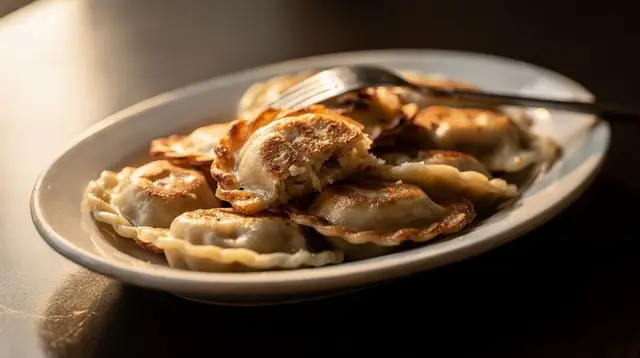
Pierogi need little introduction - the dumplings, boiled or pan-fried, filled with anything from potato and cheese to meat, mushroom or seasonal fruit, are one of Poland’s most recognisable foods and a near-certain stop on any Gdańsk tasting route. What’s worth knowing before a tour is that pierogi are genuinely regional and seasonal in their fillings: a summer tasting might include sweeter fruit-filled versions, while a winter stop leans toward heartier savoury combinations. A guide worth their salt will usually explain which filling is on offer and why, rather than serving a single generic version and moving on.
For travellers who want to go deeper than a single tasting stop, a dedicated pierogi and cuisine tour is a natural next step - see the pierogi and Polish cuisine guide for that angle.
Zurek: the sour soup that surprises first-timers
Zurek is the dish most likely to catch first-time visitors off guard, simply because “sour rye soup” doesn’t translate well onto a menu until it’s tasted. Made from a fermented rye starter, it’s tangy rather than sweet, often served with sliced sausage, a hard-boiled egg, and sometimes poured into a hollowed loaf of bread instead of a bowl. It’s one of the most traditional dishes in Polish cooking, and a tasting stop built around it tends to double as a short lesson in fermentation and preservation - techniques that mattered enormously in a climate this far north, long before refrigeration.
Smoked fish from the Baltic: flounder and eel
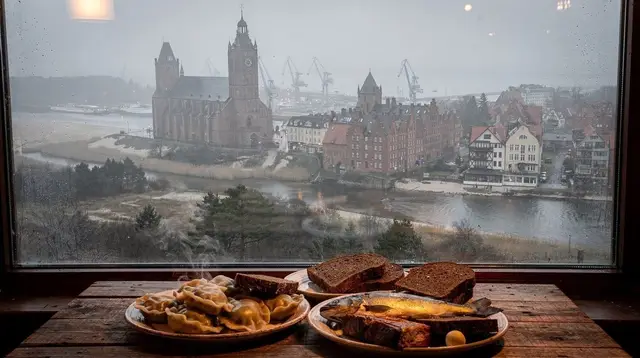
This is where a Gdańsk food tour diverges most clearly from what a visitor might expect from inland Polish cities. The Baltic coast has its own smokehouse tradition, and the two fish most associated with it are flounder (flądra) and eel (węgorz), both traditionally cured over wood smoke in small harbourside operations along the coast near Gdynia and the fishing villages further out toward the Hel Peninsula. A tasting stop built around smoked fish usually serves it simply - flaked onto bread, or on its own with a squeeze of lemon - letting the smoke and the fish itself carry the dish rather than heavy seasoning.
It’s worth being honest about scale here: this is not a fishing-village food crawl with boats moored outside the door. In central Gdańsk, smoked fish tastings are typically served at stalls or small restaurants sourcing from the coast, not caught and smoked on site. Travellers who want the coastal smokehouse experience itself, rather than a city tasting of it, are better served heading out toward the fishing towns directly, which the best day trips from Gdansk guide covers.
Goldwasser: invented in Gdańsk, not Warsaw
No food tour of this city is complete without Goldwasser, and it’s worth stating the historical fact clearly, because it gets muddled online with some regularity: Goldwasser (in Polish, Wódka Gdańska) was created in Gdańsk in 1598, not Warsaw. It is a herbal liqueur infused with a blend of botanicals and, famously, flecked with tiny pieces of edible gold leaf suspended in the liquid - a visual signature that gave the drink its name, literally “gold water.” The recipe and the tradition of producing it in this specific city run back more than four centuries, tied to Gdańsk’s history as a wealthy Hanseatic trading port with the means to import the exotic spices the liqueur calls for.
A tasting portion of Goldwasser is a fixture on most food-tour itineraries, usually served as a small shot toward the end of the route, sometimes paired with a short explanation of the gold leaf and the city’s distilling history. Travellers curious about the wider drinking side of the city - vodka, craft beer, and Goldwasser together - have a dedicated stop for that too: see a guided vodka tasting session through Gdańsk’s Old Town for a route built specifically around spirits rather than food.
Dietary needs: what pierogi and zurek do and don’t cover
Pierogi are usually the safest stop for anyone avoiding meat, since potato-and-cheese, mushroom, and sometimes sauerkraut fillings are standard on most tasting routes and rarely need special arrangement. Zurek is less reliable on that front: the soup’s depth typically comes from a meat-based stock, even when the bowl itself is served without visible sausage, so a traveller keeping strictly vegetarian should ask the guide before tasting rather than assume the broth is meat-free.
Smoked fish, by its nature, isn’t an option to work around for vegetarians or vegans - it’s simply not on the menu for that stop, and a tour built specifically around Baltic smokehouse fare will have little to substitute. None of this is unusual for Polish food more broadly, but it’s worth raising directly with the operator when booking, since group tours built around fixed stops have less flexibility to swap dishes on the spot than a sit-down restaurant would.
Morning tour or evening tour: which suits your day better
Operators generally run food tours either in the late morning through early afternoon, or in the early evening, and the choice changes the experience more than it might seem. An evening slot tends to feel more social - the Old Town is lit up, bars and restaurants around the route are filling up too, and a shot of Goldwasser toward the end of the walk fits naturally into a night that continues afterward.
A daytime tour, by contrast, works well for travellers who want tastings to double as lunch and would rather have the evening free for something else, whether that’s a sit-down dinner, a Motława riverfront walk, or an early night after a full day of sightseeing. Crowds at popular stalls also thin out somewhat in the late morning compared with a peak evening slot in July or August, which matters more during St Dominic’s Fair than in the quieter shoulder months. Neither timing is objectively better - it’s mostly a question of appetite and how the tastings should sit relative to the rest of the day’s plans.
Booking, price and what not to expect
Prices and exact itineraries change by season and operator, so this guide won’t invent a number - check the specific listing for what’s included before booking. What’s safe to say in general: most food tours bundle the cost of all tastings into one ticket price, so there’s no need to carry extra cash for individual stops, though a guide may mention optional extras along the way.
One practical note that trips up visitors more than any menu item: Poland is not in the eurozone. The currency is the zloty (PLN), and while card payments are widely accepted for both the tour booking itself and any incidental purchases along the route, don’t expect euros to be accepted as everyday currency at market stalls or small vendors. For more on this, see how to pay in Poland with zloty and cards.
Booking ahead is worth doing, especially in the busier summer months or during St Dominic’s Fair in August, when the Old Town is at its most crowded and small tasting venues have limited capacity per group.
A guided tasting walk through Gdańsk’s Old Town covering several traditional stops is one starting point for comparing what’s on offer, alongside a longer four-hour route through the city’s food spots for travellers wanting a fuller afternoon, and a tour built specifically around traditional Polish dishes for those prioritising classic plates over variety.
Pairing a food tour with the rest of your visit
A three- to four-hour food tour sits comfortably alongside a day otherwise spent in the Old Town around Dlugi Targ, and pairs naturally with an evening stroll along the Motława waterfront once the tastings are done. Travellers building out a longer stay might slot a food tour into the one-day Gdańsk itinerary or the two-day Gdańsk and Sopot itinerary, saving a free evening for it rather than squeezing it between museum visits.
Those spending more time in the region and wanting to see how Gdańsk’s food compares with its coastal neighbours should also look at the Tricity food tour covering Sopot and Gdynia, which extends the same idea - tastings paired with local history - up the coast.
What this guide is not promising
To be direct about the limits of what a page like this can responsibly claim: this is not a review of any specific restaurant or tour operator, and it does not list prices, because both change and vary by provider. It does not claim that Gdańsk’s food scene is a single, uniform “street food” experience - much of what’s distinctive here (smoked Baltic fish, Goldwasser) reflects a specific coastal and trading history rather than a generic Polish snack culture.
And it does not suggest euros are usable day to day; budget in zloty. What it does offer is an honest picture of the format - stops, not a sit-down meal, three to six tastings over three to four hours - and the dishes most tours build around, so a booking decision can be made with realistic expectations rather than marketing copy.
Frequently asked questions about Gdańsk food tours
Was Goldwasser invented in Warsaw or Gdańsk?
Gdańsk. Goldwasser (Wódka Gdańska) dates to 1598 and was produced in the city for centuries; it is one of Gdańsk’s signature exports, not a Warsaw product, and no credible source places its origin anywhere else.
Can I pay in euros on a Gdańsk food tour?
No. Poland’s currency is the zloty (PLN); it is not in the eurozone. Card payments are widely accepted for tour bookings and in restaurants, but everyday cash transactions run in zloty, not euros.
Is Gdańsk food a form of generic Polish street food?
Not quite. While pierogi and zurek are found across Poland, Gdańsk’s food culture carries its own Baltic and Hanseatic layer - smoked flounder and eel from the coast, and Goldwasser from the city’s centuries-old distilling trade
- that a generic “Polish street food” framing misses.
What is zurek?
Zurek is a sour rye-fermented soup, often served with sausage and hard-boiled egg, sometimes in a hollowed bread bowl. It is one of Poland’s most traditional dishes and a near-constant fixture on Gdańsk tasting menus.
What fish should I look for in Gdańsk?
Smoked flounder (flądra) and smoked eel (węgorz) are the two Baltic fish most associated with the Tricity coast, traditionally cured over wood smoke at harbourside smokehouses in Gdynia and the fishing villages nearby.
How long does a Gdańsk food tour take?
Most guided food tours in Gdańsk run three to four hours, covering a walking route through the Old Town with stops paced roughly every 30-45 minutes so appetite and pacing hold up.
Do I need to book in advance?
Booking ahead is sensible, particularly in July and August or during St Dominic’s Fair in August, when small tasting venues have limited capacity and popular tour slots fill first.
Are there vegetarian options on a Gdańsk food tour?
Usually yes for pierogi, since potato-and-cheese or mushroom fillings are standard, but zurek is often made with a meat-based stock and smoked fish is, by definition, fish - so a strict vegetarian or vegan traveller should flag dietary needs to the operator before booking rather than assume the standard route will fit.
Is a morning or evening food tour better in Gdańsk?
Evening tours tend to feel more social and pair naturally with the Old Town’s lighting and bar culture, while morning or early-afternoon tours mean tasting stops on an empty stomach and smaller crowds at each stall - neither is objectively better, so it comes down to appetite and how the rest of the day is planned.
Food tours
Verified deep-linked GetYourGuide tours. Book through these links and we earn a small commission at no cost to you.
GetYourGuide does not provide a product photo for this activity — the image shows the meeting point, photographed by us.