Motława River Cruise, Gdańsk
What does a Motława river cruise in Gdańsk actually show you?
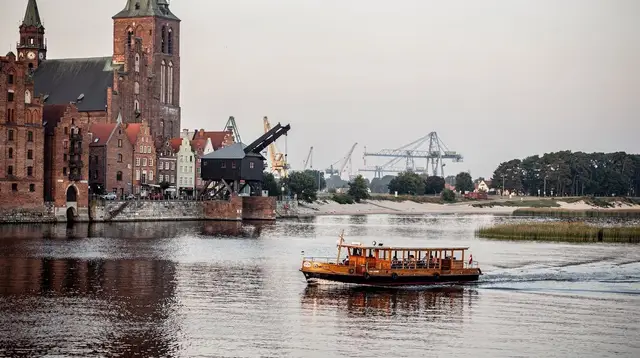
A short boat trip along the Motława past the Old Town waterfront, the medieval Żuraw crane, and the gabled facades of Długi Targ, usually lasting well under an hour. It stays on the river in central Gdańsk and does not sail out to the open Baltic or across to Hel.
The river that built the city
Most visitors meet the Motława on foot, standing on Dlugie Pobrzeze with the Żuraw crane looming on one side and a row of restaurant terraces on the other. It’s easy, from that vantage point, to mistake the Motława for a decorative feature of the Old Town - a wide stretch of still water put there to reflect the gables. It isn’t.
The Motława is a genuine river, a branch of the Vistula delta, and it flows on past the tourist quays, past the shipyard cranes north of the centre, and out into the Bay of Gdańsk, the arm of the Baltic Sea that shapes this entire coastline. Seeing it from a boat rather than a bench is the simplest way to understand that the Old Town waterfront is one short, ornamental stretch of a working waterway, not the whole story.
That distinction matters because it explains why Gdańsk looks the way it does. For centuries the Motława was the city’s connection to the sea and to inland Poland at once, the channel through which Hanseatic-era trade in grain, timber and amber moved between the Baltic and the river systems reaching deep into the continent. The grand facades along Dlugi Targ and the fortified Żuraw crane weren’t built to be pretty for boat trips; they were built because this was a port, and a rich one. A cruise along the water puts you inside that logic rather than just looking at its results from the pavement.
Geographically, the stretch a sightseeing cruise actually covers is short. The Motława itself runs only a handful of kilometres through the city before it joins the Dead Vistula (Martwa Wisla), the old, now-tidal branch of the Vistula that carries the water the rest of the way out to the Bay of Gdańsk. A standard cruise covers a fraction of that distance - the Old Town loop past the Żuraw and Dlugi Pobrzeze - rather than following the river all the way to open water. Knowing that scale in advance is useful: this is a city-centre outing measured in minutes on the water, not a journey down the length of a river system.
What the boat actually shows you
A short river cruise on the Motława is, by design, a modest outing. Boats typically depart from a quay near the Żuraw and the Old Town waterfront, and the standard sightseeing route stays within the city, tracing the curve of the river past the Main City’s defining landmarks before turning back. It is not a long voyage, and it is worth being clear about what it is not: this is not a trip out to the open Baltic, and it does not sail anywhere near the Hel Peninsula.
Those are different products entirely, usually run from different piers on larger boats built for open water, and conflating the two leads to disappointment on both counts. If a Baltic-facing excursion is what you’re after, that’s worth researching separately rather than assumed to be part of a Motława river cruise.
What the boat does deliver is a change of angle on a very familiar set of landmarks. From the water, the Żuraw crane - the largest surviving medieval port crane in Europe, once used to load and unload cargo and even to step masts onto ships - is seen face-on, its twin wooden towers and hoisting gear framed against the sky rather than glimpsed from below at street level. The same goes for the long run of merchant houses along Dlugi Targ: narrow, tall, and gabled, each one a small argument for how wealthy this port once was. Seen from a moving boat, the whole row reads as a single composition in a way it doesn’t quite manage from the crowded quay.
That composition is easiest to appreciate outside the busiest hours. Through July and August especially, the Old Town waterfront gets crowded in the middle of the day, and quays near the Żuraw can have several boats loading and unloading at once, with queues at the ticket kiosks to match. A cruise timed for the morning or the early evening, once the day-tripper crush eases, tends to feel calmer and gives clearer sightlines to the crane and the facades without other groups crowding the same rail. Outside the summer season, the whole experience is noticeably quieter, though fewer operators run departures once autumn sets in.
It’s worth saying plainly, because it’s easy to forget standing among the careful brickwork: almost everything visible from the boat along this stretch is reconstruction. Gdańsk’s Old Town was reduced to rubble in 1945, and the gabled skyline a cruise glides past was rebuilt from the 1950s onward, often based on old paintings, engravings and photographs rather than surviving fabric. That doesn’t make the view any less striking, but it changes what you’re actually looking at - a deliberate act of civic memory, not an untouched medieval streetscape.
Past the tourist stretch, many routes continue far enough to bring the working harbour into view: shipyard cranes, industrial quays, and the kind of unglamorous port infrastructure that has nothing to do with amber shops or restaurant terraces. It’s a useful corrective. The Gdańsk Shipyard, birthplace of the Solidarność movement, sits on this same river system, and a cruise that pushes even slightly beyond the Old Town facades is a reminder that Gdańsk’s identity as a port city didn’t end with the Hanseatic League - it carried straight through into the twentieth century and the shipyard strikes of 1980.
The mood on the water
The atmosphere on a Motława cruise is unhurried and low-key rather than dramatic - this is a calm inland river, not open sea, and the boats used for the standard sightseeing routes are built for stability and views rather than speed. Expect an open or partly covered deck, room to move around for photos, and often some narration or recorded commentary pointing out landmarks as they pass, though the level of detail varies a lot by operator.
Late afternoon and early evening tend to suit the water best: low sun catches the brick and stucco facades along the waterfront, and the crowds thin out compared with midday. A handful of operators run versions timed closer to sunset, worth checking if golden light matters more to you than an exact departure time.
Honestly, a couple of things catch first-timers off guard. Recorded commentary is often delivered in several languages in sequence, which means English narration can be a fraction of the total trip time rather than continuous; anyone who wants detailed history should not count on the onboard audio alone and is better served pairing the cruise with a proper walking tour or museum visit. On a busy summer afternoon, the view of the Żuraw can also be partly blocked by other tour boats manoeuvring near the same quay, since several operators share a tight stretch of water in front of the Old Town. Neither point ruins the trip, but going in with realistic expectations beats being disappointed by them on the day.
What the trip is not is a relaxing swim stop or a warm-water outing. The Motława through the city centre is a functioning urban waterway - lined with quays, restaurant terraces and moored boats rather than beaches - and cruises here don’t involve getting in the water at any point. If the idea of combining a boat trip with a dip in the Baltic appeals, that belongs to the coast proper, at Sopot or along the Hel Peninsula, not to a short river sightseeing trip in the Old Town.
Choosing between the options
Several operators run boats on the Motława, and the differences between them are less about the view - the river only offers so many angles - and more about format, pace and extras. A standard sightseeing cruise is the simplest version: a set route, a fixed timeframe, and a focus on the waterfront and crane. Group departures on a shared boat tend to be the most affordable way to try it.
a catamaran cruise along the Motława covers the core route past the Żuraw and the Old Town waterfront, and a shorter, roughly 45-minute sightseeing trip suits anyone slotting a boat ride between other Old Town sightseeing rather than building a whole afternoon around it. For a private group, a catamaran cruise booked for a private group keeps the same river route but without sharing the deck with strangers.
Some operators fold the river into a broader tour rather than treating it as a standalone activity. A golf cart tour of the Old Town paired with a Motława river cruise combines the water view with a guided spin through the surrounding streets, useful for anyone short on time or unsteady on cobblestones.
At the more social end, options built around an unlimited beer river cruise paired with a golf cart ride lean into the river as a backdrop for a party atmosphere rather than a quiet sightseeing trip - a different kind of evening, and worth choosing deliberately rather than by accident.
If it helps to arbitrate: choose a standard shared sightseeing cruise for a first visit, since it’s the cheapest way to test whether the water-level view suits you at all. Choose the private group option only if travelling with a group large enough to fill a boat comfortably, since the per-person cost climbs fast for a couple travelling alone. And treat the beer-and-golf-cart combinations as a night out with a boat attached, not as the best way to see the architecture - the narration and photo opportunities take a back seat to the party atmosphere on those departures.
Whichever format you pick, check the current listing for its exact departure point, duration and route before booking - these details are set by each operator and can shift with the season, and nothing here should be read as a guaranteed schedule.
Where the cruise fits into a Gdańsk visit
A Motława river cruise works best as one element of a day rather than the day itself. It pairs naturally with time spent on foot: walk the Gdańsk Old Town first, taking in Mariacka street and its amber workshops, then take to the water for a different perspective on the same skyline. Anyone weighing up boat options more broadly should look at the fuller picture of Gdańsk’s boat tours on the Motlawa, which covers the range beyond the standard sightseeing route, including the dedicated Motława sunset cruise for evening light.
The river also connects to Gdańsk’s more serious history. Boats bound for Westerplatte, where the Second World War began in 1939, follow a related but distinct route out through the harbour - a longer trip on different infrastructure from the short Old Town loop, covered separately in the Westerplatte guide. For the crane itself, pairing a river cruise with a proper visit inside the Zuraw and the National Maritime Museum branches along the waterfront rounds out the view from the water with the history behind it.
Travellers planning a longer stay might slot the cruise into a wider Gdańsk and Sopot two-day itinerary, where a relaxed hour on the water balances busier walking days. For a first visit overall, the how many days in Gdansk guide gives a sense of how a river cruise sits alongside the city’s bigger draws - useful context before deciding how much of a single day to give over to the water.
What to know before booking
Bring a light layer even on a warm day: river breezes on an open deck cool things down more than the same temperature on land, especially in the evening. Photography is a genuine highlight - the water-level angle on the Żuraw and the Długi Targ facades is hard to replicate from the shore - so a phone or camera is worth having ready rather than tucked away. Mobility is generally easier on the water than on the Old Town’s uneven cobbles, which makes a cruise a reasonable option for anyone finding a lot of walking tiring, though boarding a boat still involves a step down from the quay.
For families or anyone travelling with a pushchair, the step down onto the deck is the main thing to plan around; there is rarely a ramp, and staff generally help lift a pushchair aboard rather than expecting a fully level boarding. Restrooms are not a given on the shorter sightseeing boats, worth factoring in for a trip with small children. On the food and drink side, most standard sightseeing cruises do not include a bar or snacks - that’s reserved for the themed party-style trips - so anyone wanting a drink with the view should plan to pick one up on the quay beforehand.
Above all, treat a standard Motława river cruise for what it is: a short, scenic loop through the historic heart of Gdańsk, not an open-water excursion and not a swimming trip. Set against that realistic expectation, it’s a genuinely worthwhile half-hour or so - a chance to see the city that built its fortune on this river from the water that made it possible.
A couple more questions
Is a Motława cruise suitable for wheelchairs or pushchairs?
It depends on the boat and the quay used that day, since boarding usually means a step down from a stone quay onto the deck, with no ramp guaranteed. Anyone travelling with a wheelchair or a pushchair should ask the operator directly before booking rather than assume step-free access.
What happens to a Motława cruise if the weather turns bad?
Light rain rarely stops a sightseeing cruise, since most boats offer at least a partly covered deck, but operators can delay or cancel departures in strong wind or a serious storm for safety reasons. Policies on refunds or rescheduling vary by operator, so it is worth checking the specific booking’s weather terms rather than assuming a fixed rule applies across the board.
Motława river cruises
Verified deep-linked GetYourGuide tours. Book through these links and we earn a small commission at no cost to you.
GetYourGuide does not provide a product photo for this activity — the image shows the meeting point, photographed by us.