Boat Cruise from Gdańsk to Hel Peninsula
Can you take a boat from Gdańsk to Hel Peninsula?
Yes, but only as a seasonal service, roughly May to September, run by a handful of operators from Gdańsk, Sopot and Gdynia. Crossing time is usually 90 minutes to two hours and depends on Baltic weather, so it is one option alongside the direct summer train and the coastal road, not a year-round guarantee.
Why the boat is worth considering
A summer boat crossing to the Hel Peninsula is one of the more pleasant ways to reach the tip of Poland’s Baltic coast, and it is easy to see why it gets recommended so often: it swaps a slow drive or a train timetable for open water, gulls following the wake, and a first sight of the sandy spit from the deck rather than a car window. But it is worth being precise about what this service actually is, because a fair amount of loose talk online turns it into something it is not. It is a seasonal service, it does not run to a fixed schedule in bad weather, and it is one of three realistic ways to get to Hel, not the only one.
This guide sets out how the boat actually works, when it runs, what the alternatives look like, and what is waiting at the other end — including the seal sanctuary that draws a good share of the passengers in the first place.
Hel is a peninsula, not an island
Start with the geography, because it shapes every practical decision here. Hel is not an island sitting apart in the Baltic; it is a narrow, curved peninsula roughly 35 kilometres long, attached to the mainland near Władysławowo and enclosing Puck Bay behind it. At its narrowest points the strip of land is as little as 200 metres wide, sand and pine forest with the open Baltic on one side and the calmer bay on the other.
That narrowness is part of the appeal — from the peninsula’s shore you can genuinely watch two different bodies of water — but it also means Hel has always been reachable by road, and now by rail, not just by sea. A boat is a scenic option for getting there, not the only lifeline to a cut-off patch of land, and any page or tour listing that implies otherwise is describing the geography wrong.
How the boat service actually works
Several operators run passenger boats from the Tricity to Hel across the summer months, departing from Gdansk, Sopot and Gdynia. None of them run a year-round timetable. The season typically opens in May and winds down by September, tracking demand and the calmer weather window rather than a fixed calendar date, so exact start and end dates shift a little from year to year and operator to operator.
Crossing time is usually quoted as 90 minutes to two hours, depending on the departure point, the specific route and how much of the trip runs through the more sheltered bay versus open Baltic water. A cruise departing from Gdansk usually takes longer than one leaving from Gdynia, simply because Gdynia sits closer to the peninsula’s base. Some operators run a one-way transfer, useful if you plan to return by train; others sell a return sailing with a few hours ashore built into the schedule, which suits a straightforward day trip.
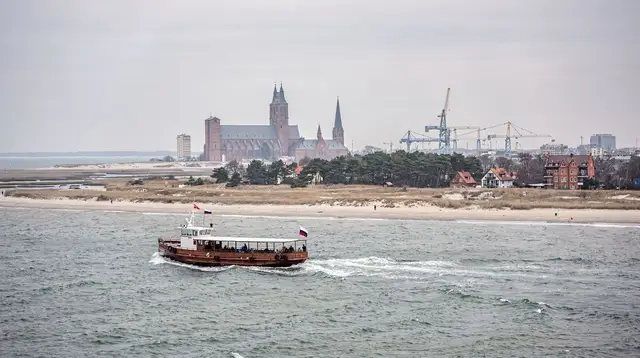
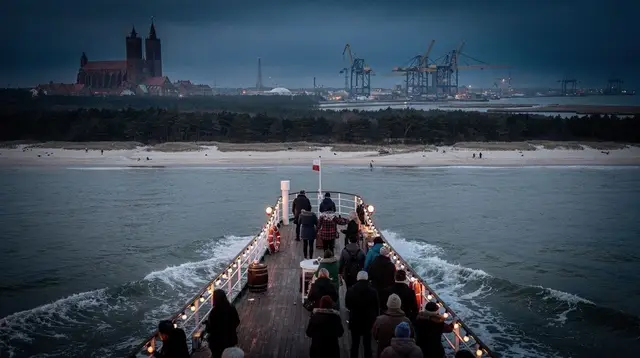
a return boat expedition from Gdańsk out to the tip of the peninsula covers the classic version of this trip, sailing past the harbour and out along the bay with commentary on the coastline as you go. For a smaller group wanting more flexibility on timing and stops, a private motorboat charter linking Gdańsk, Sopot, Hel and Jastarnia covers several of the peninsula’s towns in one outing rather than a single there-and-back run.
What can go wrong — and does
The honest caveat, and the reason this is not a “book it and forget it” purchase, is the Baltic itself. These boats cross open sea as well as bay water, and the Baltic can turn choppy with little warning, particularly on windy afternoons. Operators reserve the right to delay, shorten or cancel a crossing when conditions are unsafe or simply too rough for a comfortable ride.
This happens more often than glossy brochure photos suggest — not constantly, but often enough that building in a backup plan, rather than treating the boat as a fixed appointment, is the sensible approach. Anyone with an onward connection to catch that evening — a flight, an early train — should treat the boat as the scenic option and keep a fallback in mind, not the guaranteed one.
The alternatives: train and road
Because the boat is seasonal and weather-dependent, it helps to know what else gets you to Hel, and when each option actually makes more sense.
| Option | Typical duration | Runs when | Best for |
|---|---|---|---|
| Seasonal boat | 90 min – 2 hrs | Roughly May–September | Scenic approach, no traffic, a proper day out on the water |
| Direct summer train | About 2 hrs | Seasonal direct service, plus connections year-round | Reliability, weather-independent, no driving |
| Car via the coastal road | Variable, longer in summer | Year-round | Off-season visits, flexibility, side stops en route |
The direct train from Gdańsk to Hel runs in around two hours in the warmer months and is the most weather-proof of the three: it does not care whether Puck Bay is choppy. Outside the direct summer service, regional connections still reach the peninsula via Władysławowo, just with a change and a longer overall journey — worth checking specifically if visiting outside peak season.
Driving works year-round, which makes it the default for an out-of-season visit when neither the boat nor the direct train is running. The catch is the road itself: a single route runs the length of the peninsula, and in July and August, especially on weekends, it can back up badly with holiday traffic converging on Hel’s beaches. A weekday or an early start meaningfully changes that experience; a Saturday afternoon in August on that road is not a relaxing drive. For visitors who would rather not deal with any of this planning, a guided day trip bundling transport and a fixed itinerary removes the decision entirely.
None of these three options is objectively “the right one” — they suit different priorities. The boat rewards people who want the journey itself to be part of the day. The train rewards people who want certainty. The car rewards people travelling outside summer or wanting to stop along Puck or elsewhere on the bay en route.
Arriving in Hel: what fills the day
However you arrive, the peninsula’s main town, also called Hel, sits right at the tip, and most day visitors head straight there before working back along the shore if time allows.
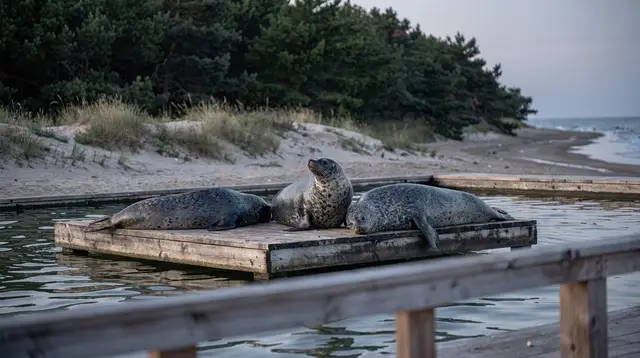
The single most popular stop is the Fokarium, a small marine research and rehabilitation station caring for Baltic grey seals, a species that was once hunted to near-extinction in these waters. It is a modest site rather than a large aquarium — a handful of outdoor pools you can walk around — but the scheduled feeding talks, usually held several times a day in season, are genuinely worth timing a visit around, and staff typically explain the seals’ history and the station’s conservation work during them. For visitors who arrive by the midday boat, checking the next feeding time on arrival is worth doing before wandering off to the beach.
Beyond the Fokarium, Hel town itself has a working fishing harbour, a small maritime museum in a former church, and streets of traditional fisherman’s cottages that give a sense of what the peninsula looked like before tourism took over the summer months. The beaches either side of town — bay-side and open-sea-side — are a short walk apart and noticeably different: the bay side is calmer and shallower, more forgiving for wading, while the open Baltic side has more of a proper wave and a wider stretch of sand.
Travellers heading further up the peninsula, rather than stopping only in Hel town, often continue to Jastarnia, a fishing town roughly midway along the spit known for a quieter, more residential feel and its own stretch of beach. A boat tour timed to depart from one town and return from another is one way some operators structure the day, though most standard sailings simply go out and back from the same point.
A practical day plan
For a first visit built around the boat, a fairly standard shape works well: an early departure from Gdańsk, Sopot or Gdynia, roughly two hours ashore in Hel covering the Fokarium and the harbour area, then either the same boat back or the train if the timetable and weather line up better that way. Trying to add a second peninsula town onto a single day trip is possible but tight, especially if the return sailing has a fixed time — it is easier with a private charter or a longer guided itinerary than with a standard scheduled return boat.
Visitors staying in the Tricity longer than a single day and wanting to fold Hel into a wider Baltic coast itinerary might pair it with a stop further along the shore, such as the shifting dunes near Leba — reachable separately via a day trip out to the moving dunes often nicknamed the Polish Sahara or a closer look at the Słowiński National Park itself through a private guided walk through Słowiński National Park’s dune landscape.
These are separate excursions from Hel rather than an easy add-on to the same day, since Łeba sits roughly two hours from Gdańsk in the opposite direction along the coast, but they are useful to know about when planning a longer stay that takes in more of the Baltic shoreline beyond the peninsula. For a broader look at how Hel compares with other day-trip options from the city, the best day trips from Gdansk guide sets it alongside options like Malbork and Kashubian Switzerland.
Practical notes before booking
A few points worth checking before committing to a date. First, confirm whether the sailing you are looking at is a return trip with time ashore built in, or a one-way transfer that assumes a different return method — the difference matters for planning the rest of the day. Second, on peak midsummer weekends and especially during Jarmark Swietego Dominika in August, when the whole Tricity gets busier, popular sailings can sell out in advance, so booking a few days ahead rather than turning up on the day is the safer approach in that window. Walk-up tickets are often available outside those peak periods, but treating availability as guaranteed at any time of year is optimistic.
Second, dress for wind rather than sunshine. Even on a warm, still day in the Old Town, the open water crossing is noticeably breezier, and a light jacket is worth having even in July or August. Sun protection still matters — there is little shade on deck — but temperature on the water tends to run cooler than it feels on land.
Finally, keep the seasonal caveat front of mind: outside roughly May to September, the boat is simply not running, and the train to Hel or a drive around the bay becomes the only way to reach the peninsula. If travelling in spring or autumn shoulder season, confirm the current year’s boat schedule before building a day around it rather than assuming the summer timetable still applies.
Getting to Hel Peninsula and back
For most first-time visitors, the boat crossing is less about being the fastest or most reliable route and more about making the journey itself part of the destination — a couple of hours on the water, arriving at a narrow strip of sand and pine that never feels quite like the mainland behind it, even though it always was one. Paired with a realistic sense of its seasonal limits and a train or road backup in mind, it is a genuinely good way to spend a Baltic coast day.
Hel peninsula cruises
Verified deep-linked GetYourGuide tours. Book through these links and we earn a small commission at no cost to you.
GetYourGuide does not provide a product photo for this activity — the image shows the meeting point, photographed by us.