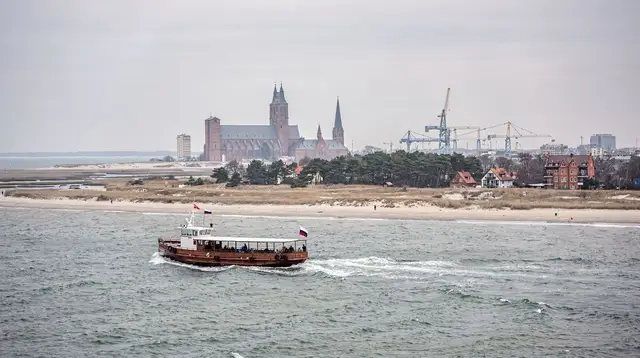
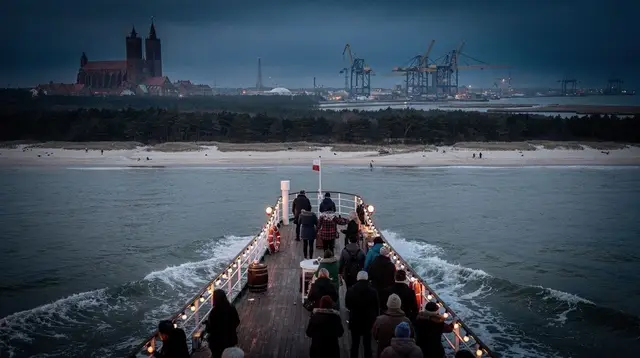
Puck sits on the shore of Puck Bay (Zatoka Pucka), the shallow inner bay tucked behind the Hel Peninsula, roughly 45-60 minutes from Gdańsk by car or regional train. It is a small town, not a resort, and this page is deliberately modest about what it offers: Puck’s real draw is the water in front of it, not a historic core or a list of monuments. If you are looking for Gdańsk’s gabled Old Town or Malbork’s brick towers, this is not that kind of place - Puck earns its spot on an itinerary because of what happens on the bay, not because of what stands on land.
Puck is a town, not a peninsula spot
It is worth being precise about geography here, because Puck is easy to mix up with its more famous neighbor. Puck is not on the Hel Peninsula - it sits on the mainland shore of Puck Bay, at the base of the bay rather than out on the narrow sand spit that runs out toward Hel town. Jastarnia, the fishing town partway along the peninsula, gets more attention in watersports circles and has a stronger identity as a beach and kitesurfing destination in its own right. Puck, by contrast, is a functioning small town with a harbor, a market square, and an everyday rhythm that has nothing to do with tourism for most of the year.
That distinction matters for planning. If you come to Puck expecting a lively boardwalk or a dense strip of beach bars, you will be disappointed - that is more the character of Sopot or the busier stretches of Jastarnia. Puck is quieter and more workaday, and its appeal is specific: the shallow, wind-exposed water of the inner bay, which happens to be some of the most consistent kitesurfing and windsurfing terrain on this coast.
Why the bay matters more than the town
Puck Bay is split by geography into two very different bodies of water. The outer bay, facing the open Baltic beyond the Hel Peninsula, behaves like the open sea - deeper, colder, and rougher. The inner bay, where Puck sits, is shallow, often just waist- or chest-deep for a considerable distance from shore, and largely sheltered from the heaviest open-sea swell by the peninsula itself. That combination - consistent wind funneling down the bay, shallow water that lets beginners stand up between falls, and a lack of serious waves - is exactly what makes a spot good for learning kitesurfing or windsurfing rather than just riding it.
This is the same stretch of water that has built Jastarnia’s reputation, and Puck shares in it directly; several schools and rental operations work the bay from both the Puck side and the peninsula side. If you are researching where to learn, see our dedicated guide to kitesurfing on Puck Bay and around Jastarnia for the practicalities - conditions, schools, and what a lesson day actually looks like. For a wider view of what the whole coast offers beyond kitesurfing, the Baltic coast watersports guide covers kayaking, paddleboarding, and other options along this shoreline.
How the wind and the water actually behave here
The wind pattern that makes Puck Bay reliable is not random luck - it is a function of the bay’s shape and the surrounding land. Because the inner bay is largely enclosed, land breezes and sea breezes both funnel along its length rather than dissipating the way they would on an open coastline, which is why afternoons here are often windier and steadier than the forecast for the open Baltic just a few kilometers away suggests.
Southwesterly and westerly winds tend to blow cross-shore or onshore along the Puck side of the bay, which schools generally treat as the safer, more teachable direction; a strong northerly can push conditions toward the choppier, more exposed end of the spectrum, closer to what the outer bay experiences. None of this is exact science for a casual visitor to predict from the shore, which is why local schools, not a general guidebook page, are the right source for a same-day call on whether conditions suit a beginner or only an experienced rider.
Water depth is the other half of the story, and it is worth being specific about what “shallow” means in practice. Close to Puck’s own shoreline, the bay can stay waist-deep for a genuinely long stretch out from the beach - useful for standing up, resetting gear, or simply wading out rather than swimming out, but it also means the water warms and cools faster than the open sea, and can turn choppy and opaque with stirred-up sediment on a windy day even without big waves. Visitors expecting clear, calm, bathtub-like water the whole time are sometimes surprised; shallow and wind-exposed are not the same as calm.
Where to eat and stay near the bay
Accommodation in Puck itself is limited and modest by design - a handful of guesthouses, pensions, and a few small hotels rather than anything resembling a resort strip, and most of it books up fastest in July and August when the wind is most reliable. Prices tend to run noticeably lower than equivalent rooms in Sopot or central Gdańsk, which is part of why some watersports visitors base themselves here for a week rather than commuting out from the city each day. Self-catering options and short-term apartment rentals fill in gaps that the limited hotel stock leaves, particularly for groups traveling with their own kit.
Eating out follows the same modest pattern: harbor-side and market-square restaurants serving straightforward Polish and coastal fare, with fish featuring heavily given the town’s fishing history, plus a scattering of cafes that pick up trade from watersports schools in summer. This is not a food destination in the way Gdańsk or Sopot can claim to be, and a visitor looking for an ambitious restaurant scene should plan that meal elsewhere and treat Puck’s options as functional rather than a highlight in themselves. Outside the June-to-September season, expect a fair number of these places to reduce hours or close outright, in keeping with the town’s quiet off-season character described above.
What Puck does not offer, and why that’s fine
It would be easy to overstate Puck’s appeal by reaching for grand claims about its history or its old town - Puck does have a long history as a fishing and boat-building settlement, and a modest market square, but there is no strong, well-documented set of landmark sights here to build a full day of sightseeing around. Unlike Gdansk with its Basilica and Motława waterfront, or Malbork with its castle, Puck does not have a headline monument that justifies a special trip on its own. Treat it honestly: this is a bay town whose value is mostly on the water, with a small, pleasant but unremarkable center behind it.
That is not a criticism so much as a planning note. If sightseeing is the priority, spend your day elsewhere on the coast and treat Puck as a pass-through or a watersports stop. If you are here to kitesurf, windsurf, or simply watch the kites from the shore on a windy afternoon, Puck does exactly what it needs to.
Getting to Puck
Puck is reachable from Gdańsk by car in around 45-60 minutes, following the road that curves around the bay through Reda. Regional trains also connect Gdańsk with Puck, generally in a similar timeframe depending on the service, making it a manageable half-day trip without a car. For visitors already staying further out on the peninsula in Jastarnia or Hel, Puck is a short hop back toward the mainland along the same coastal road, and a reasonable stop on the way to or from Gdańsk.
If you are combining Puck with a wider look at the peninsula and the bay, our Hel Peninsula day trip guide lays out a route that can take in the shoreline on both sides.
When to visit
Wind and water temperature both point toward the same window: June through September. This is when watersports schools are staffed and operating, when the bay’s shallow water is warm enough to be comfortable for lessons, and when the wind patterns that make the bay attractive are most reliable. Outside this window, particularly from November through March, expect a quiet, half-shuttered town with little tourist infrastructure open - some kitesurfers do chase strong autumn and spring wind here, but that is a specialist pursuit, not a general visitor’s plan.
Table: rough seasonal picture for a Puck Bay visit.
| Season | Water conditions | What’s open |
|---|---|---|
| June-September | Warmest, shallow water comfortable for lessons, consistent wind | Schools, rentals, harbor cafes fully operating |
| April-May, October | Cooler, wind can be strong and gusty | Limited, some operators just starting or winding down |
| November-March | Cold, choppy on windier days | Mostly closed to visitors; local life only |
A realistic half-day in Puck
For most visitors, Puck works best as a half-day stop rather than a full-day destination. A simple plan: arrive by late morning, walk the small harbor and waterfront to get a sense of the bay and watch kitesurfers or windsurfers if conditions are active, have a modest lunch in town, and either book a taster lesson with a local school or continue along the coast toward Jastarnia or Puck’s namesake bay further out. Those who want more than a half-day - a genuine kitesurfing trip - are better served basing themselves for several days, timing the visit around forecast wind rather than a fixed itinerary.
If you’d rather build Puck into a broader day exploring the Tricity and coast, an organized option like a private city tour from Gdańsk can be adapted with a driver to include a stop at the bay, though most tours default to the historic centers rather than the watersports coast.
Travelers based in Sopot sometimes pair a bay visit with a sunset yacht cruise along the coast the same evening, using the daylight hours for the bay and the evening for the water from a different angle. For those short on time and prioritizing Gdańsk’s actual sights instead, a standard walking tour of Gdańsk’s Old Town remains the better use of a single day if Puck’s watersports focus isn’t the draw.
Practicalities
Puck has ordinary small-town infrastructure: a handful of guesthouses and pensions rather than large hotels, a modest choice of places to eat centered on the harbor and market square, and seasonal kitesurfing and windsurfing rental points along the shore in summer. English is spoken at the watersports schools that cater to international visitors, though less reliably elsewhere in town. There is no significant nightlife here - for that, Sopot or central Gdansk are the better choices, with Puck reserved for its daytime, water-focused purpose.
Card payments are widely accepted at watersports schools and the larger cafes, in line with the rest of the Polish coast, though it is still worth carrying some cash (zloty, not euros - Poland is outside the eurozone) for smaller harbor stalls and market vendors who may not take cards. There is no train station right at the water’s edge, so plan on a short walk, taxi, or lift from wherever you arrive to reach the actual shoreline and rental points, particularly if traveling with bulky kitesurfing or windsurfing equipment.
Frequently asked questions about visiting Puck
Is Puck the same as Jastarnia?
No. Puck is a separate small town on the mainland shore of Puck Bay, while Jastarnia is a fishing town out on the Hel Peninsula itself. Both sit on the same bay and share similar watersports conditions, but they are distinct places with different characters - Puck is more of an everyday town, Jastarnia leans more toward a beach and sports identity.
Is Puck on the Hel Peninsula?
No. Puck sits on the mainland, at the base of Puck Bay, not on the narrow sand peninsula that extends out to Hel town. It is connected to the peninsula by road around the bay, not by being part of it.
What is Puck best known for?
Puck is known primarily as a kitesurfing and windsurfing base, thanks to the shallow, wind-exposed water of the inner Puck Bay. It does not have a major historic monument or landmark attraction to rival places like Gdańsk or Malbork.
How do I get to Puck from Gdańsk?
Puck is about 45-60 minutes from Gdańsk by car, following the road around the bay, or by regional train on a similar timeframe. It is a manageable half-day trip without needing to stay overnight.
When is the best time to kitesurf or windsurf near Puck?
June through September is the reliable window, when schools and rental operators are open, the water is warmest, and wind conditions are most consistent. Outside these months, infrastructure is limited and conditions are for experienced riders only.
Can beginners learn watersports in Puck Bay?
Yes - the bay’s shallow water is a common reason schools choose this stretch of coast for lessons, since beginners can stand up between attempts rather than treading deep water. See our guide to kitesurfing on Puck Bay for specifics on schools and conditions.
Does Puck have a historic old town worth visiting?
Puck has a modest market square and harbor with genuine history as a fishing settlement, but it does not have a strong, well-documented set of landmark sights. It is best approached as a watersports stop rather than a sightseeing destination in its own right.
Is Puck a good base for a multi-day stay?
It can be, particularly for kitesurfers and windsurfers who want to chase wind conditions over several days rather than commit to a single fixed day. For general sightseeing, most visitors are better based in Gdańsk, Sopot, or on the peninsula itself.
Do I need to bring my own kitesurfing or windsurfing gear?
No - the schools and rental points along the bay generally supply boards, kites or sails, and safety equipment for both lessons and rentals, so most visitors do not need to travel with their own kit. Experienced riders with strong preferences for specific gear sometimes do bring their own, but it is not a requirement to get on the water here.
Is the water in Puck Bay safe for swimming, not just watersports?
The shallow inner bay is generally calm enough for casual swimming close to shore, especially compared with the open Baltic on the peninsula’s outer side, but it is not a supervised swimming beach in the way some Baltic coast resorts are. On windier days the same conditions that suit kitesurfers - gusty wind and choppy, sediment-stirred water - make it less pleasant and less predictable for a casual swim, so check conditions before assuming a calm day.