Westerplatte: Where the Second World War Began
What is Westerplatte and is it worth visiting?
Westerplatte is the peninsula at the mouth of the Motława where the German battleship Schleswig-Holstein opened fire on 1 September 1939, starting the Second World War. It is an outdoor memorial park with ruined barracks and a hilltop monument, separate from the indoor Museum of the Second World War in central Gdańsk, and worth an hour or two for anyone interested in the war's origins.
A peninsula, not a museum
Westerplatte is easy to misjudge before arriving. The name carries the weight of a single date - 1 September 1939 - and it is natural to picture something built to match that weight: a large museum, dramatic staging, an indoor exhibition that walks visitors through the events hour by hour. That place exists in Gdańsk, but it is not here.
It is the Museum of the Second World War, a separate, purpose-built underground museum in the city centre with an extensive indoor exhibition. Westerplatte itself is something different: a peninsula at the mouth of the Motława, on the edge of Gdansk, where the war began and where the physical evidence of that morning has been left largely as it was, outdoors, exposed to the weather, without a roof over it.
That distinction matters for planning a visit. Westerplatte is not a wet-weather backup or an indoor break from sightseeing. It is a walk across open ground, past ruined buildings and along marked paths, to a hilltop monument. What it offers is not curation but proximity - the chance to stand on the actual site rather than read about it at a remove.
For a first-time visitor deciding how to spend limited time in Gdańsk, Westerplatte is worth being honest about: it rewards those with a specific interest in the events of 1939, or a broader interest in modern history, more than it does travellers looking for a self-contained afternoon out. Someone with only a single day in the city and no particular pull toward this period is often better served spending that time in the Old Town or at the European Solidarity Centre, and returning to Westerplatte on a later visit if the interest is there. It is not a site that needs to be ticked off - it rewards attention rather than time pressure.
What happened here
At dawn on 1 September 1939, the German battleship Schleswig-Holstein, which had been moored in Gdańsk harbour on what was presented as a courtesy visit, opened fire on the small Polish military transit depot at Westerplatte. The garrison stationed there held out against the bombardment for several days before surrendering. This engagement is conventionally marked as the opening act of the Second World War in Europe, and it is why Westerplatte carries a significance disproportionate to its size - a modest depot on a narrow spit of land became, in the space of a single morning, the place where a continental war started.
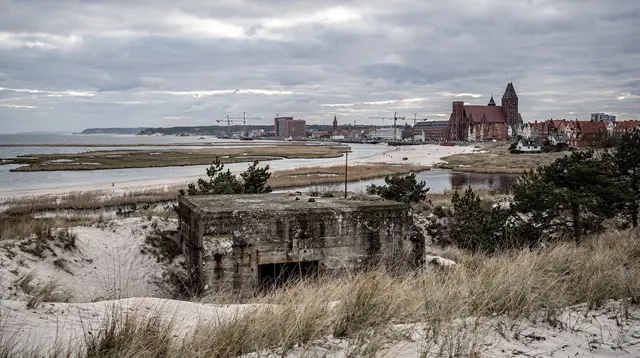
The site’s layout reflects that history rather than any attempt to dramatise it. Concrete fortifications, some intact and some reduced to broken slabs, sit among trees and open grass. A marked path connects the ruins of former barracks buildings to a large monument on a low rise, built to commemorate the Polish defenders. Information panels along the route give context in several languages, but there is no reconstruction, no staged scene, and no attempt to recreate the events of 1939 for visitors. What remains is what was left after the war - weathered by decades of exposure rather than rebuilt or restored.
The wider political backdrop helps explain why the attack happened here specifically. Between the two world wars, Gdańsk was not simply Polish or German territory but the Free City of Danzig, a semi-autonomous city-state under League of Nations protection, with its own postal service, currency arrangements and administration distinct from either neighbouring state.
Westerplatte’s status as a Polish military transit depot inside this unusual jurisdiction was itself a point of tension in the years before 1939, which is part of why the peninsula, rather than a Polish city further from the border, became the opening scene of the war. None of this is explained through reconstruction or dramatisation on site - it is context worth knowing before arriving, since the panels along the path assume some familiarity with the period rather than building the story from the ground up.
Getting there from Gdańsk
Two practical routes connect central Gdańsk to Westerplatte, and the choice between them depends on the season and on how much time is available.
The scenic option is a water tram that runs along the Motlawa riverfront and out through the harbour to Westerplatte, taking roughly 45 to 75 minutes each way depending on the operator. It runs mainly from April to October and gives a view of the port and the harbour approach that a bus obviously cannot. In winter, though, it often stops running altogether, which makes it a warm-season choice rather than a year-round one.
The faster and more reliable option is a city bus, which covers the same distance by road in well under 30 minutes and operates year-round. For a visit outside the peak season, or for anyone short on time, the bus is the more dependable route. Either way, Westerplatte sits at a genuine distance from the Old Town - close enough for a half-day outing, far enough that it deserves to be treated as its own trip rather than a five-minute detour.
Driving is also an option for visitors with a car, though it comes with a caveat worth knowing in advance: parking near the site is limited, particularly in summer, and Westerplatte was never built to accommodate large numbers of private cars - it was a military depot, not a visitor car park. Anyone driving in peak season should expect to walk some distance from the nearest available spot to the monument itself, which adds to the appeal of the bus or water tram for a stress-free trip.
| Route | Typical duration | Season |
|---|---|---|
| Water tram from the Motława | 45-75 minutes each way | Mainly April-October |
| City bus | Under 30 minutes each way | Year-round |
What a visit actually involves
Westerplatte has no ticket booth and no entry fee. It is an open memorial park, free to walk through at any time the grounds are accessible, with no booking required for independent visitors. That openness is part of its character - there is no queue, no timed slot, no visitor centre funnelling people through a fixed route.
A self-guided visit typically takes 45 to 60 minutes: enough time to walk from the landing point or bus stop past the ruined barracks, read the information panels, and climb the steps to the hilltop monument for the view back over the harbour approach. Guided visits, whether on foot or as part of a boat trip that includes commentary, run longer and add context that the on-site panels alone do not cover - the sequence of events, the wider situation in the city in the days before the attack, and how the defence unfolded.
There is a modest guardhouse with some information near the site, but nothing resembling an indoor museum - no galleries, no climate-controlled exhibition halls, nowhere to shelter for long if the weather turns. Anyone arriving expecting an experience comparable to the European Solidarity Centre or the Museum of the Second World War will find something quieter and considerably more exposed to the elements: a place to walk and reflect outdoors, not a building to move through room by room.
For visitors who want the history explained on site rather than pieced together from panels, a guided option such as a guided walk of the Westerplatte site covers the sequence of events at the actual locations. Those who prefer to combine the trip with the harbour crossing can take a round-trip cruise from Gdańsk out to Westerplatte and back, which folds the water-tram journey and the on-site visit into one outing.
What Westerplatte is not
It is worth being direct about what a visit will not include, since the site’s reputation sometimes outruns what is actually there.
There is no spectacular reenactment staged for visitors - no actors, no sound-and-light show, no dramatised retelling on the grounds themselves. What stands is the physical remains of 1939 and afterwards, presented plainly with information panels, not theatre.
It is also not a natural pairing with the Stutthof Memorial near Sztutowo on the same trip. The two sites relate to different chapters of the war, sit in different directions from Gdańsk, and are roughly 55km apart - Stutthof is closer to an hour’s drive away. Treating them as a single combined itinerary tends to shortchange both; each deserves its own visit and its own unhurried time.
And it is not an indoor museum experience. There is no air conditioning, no large exhibition space, and no shelter from rain or wind beyond the modest guardhouse. A visit here means walking outdoors across open, sometimes windswept ground - closer in feel to visiting a battlefield than to touring a gallery. Anyone wanting the fuller indoor narrative, with artefacts, documents and reconstructed interiors, should plan a separate visit to the Museum of the Second World War in the city centre, where that kind of experience actually exists.
Combining Westerplatte with the rest of the war history trail
Westerplatte works best as one stop on a wider look at Gdańsk’s wartime and postwar history rather than as a visit on its own. In the city centre, the Gdańsk Shipyard and the European Solidarity Centre cover a later chapter - the 1980 strikes and the birth of the Solidarność movement - and together with the Museum of the Second World War form a natural sequence with Westerplatte: the war’s beginning at one end of the city, the story of how Poland eventually emerged from the postwar order at the other.
Visitors assembling a full day around this history sometimes prefer a single guided itinerary rather than arranging transport between sites individually. An option such as a guided day covering the WWII sites, the shipyard and Westerplatte together links these locations with commentary connecting the two eras, which can be more efficient than several separate trips for visitors with limited time.
For those who want the harbour crossing itself to carry some historical framing rather than functioning as plain transport, a themed cruise out to Westerplatte with historical narration along the way is worth considering over the standard water tram.
For a broader sense of how Westerplatte fits alongside the city’s other wartime sites, the Gdańsk WWII history tour and the WWII sites Tricity tour both set it in context, while the Gdańsk Shipyard Solidarity tour picks up the thread of the city’s twentieth-century history where the events of 1939 leave off.
Anyone planning a full day around this theme can also check best day trips from Gdansk for how a Westerplatte visit slots alongside other options, or how many days in Gdansk for how much time the wider city, including its wartime sites, realistically needs.
Choosing when to go
Westerplatte is at its quietest early in the morning, before the larger tour groups and the water trams carrying cruise-ship passengers arrive later in the day. Visitors who prioritise a reflective, uncrowded walk rather than a packed itinerary tend to prefer this slot, particularly in July and August when the site sees its heaviest footfall. Midday in high summer brings the most visitors and the least shade, since the peninsula is largely open ground with limited tree cover directly around the monument and the ruins.
Late afternoon and early evening offer a different advantage: softer light for photographs across the harbour approach, and a noticeably thinner crowd once day-trip groups have moved on. Outside the summer months, particularly from November to March, the site is markedly quieter across the board, though this comes with the trade-off already noted - the water tram largely stops running, cold winds off the Baltic are a real factor underfoot, and the modest guardhouse offers little shelter if the weather turns. A midweek visit in the shoulder months of May, June or September tends to combine the best of both: functioning transport options, moderate weather, and a site that still feels unhurried rather than thronged.
Underfoot, the terrain is a mix of gravel paths, grass and the uneven ground around the ruined structures themselves - solid walking shoes matter more here than at most Gdańsk sites, since parts of the path are not paved and can be uneven or muddy after rain.
What’s the best time of day to visit Westerplatte?
Early morning is quietest, before tour groups and water-tram arrivals build through the day, and works well for a reflective visit. Late afternoon offers softer light for photographs and thinner crowds once day groups have left, while midday in July and August is the busiest and least shaded time to go.
Is Westerplatte suitable for visiting with children?
The open grounds give children room to walk and explore, but there are no play facilities, and the subject matter - a wartime attack and its memorial - is heavier than most family attractions in Gdańsk. Families with younger children sometimes find the European Solidarity Centre or a walk through the Old Town easier to pace for a full day, saving Westerplatte for when children are old enough to engage with the history rather than just the outdoor space.
Practical notes for planning
Westerplatte has no dedicated dining or shopping on site - it is a memorial park, not a visitor attraction with amenities, so plan to eat before or after the visit back in central Gdańsk. The ground is uneven in places and the walk to the monument involves steps, which is worth factoring in for visitors with mobility considerations; the wheelchair-accessible attractions in the Tricity guide covers what alternatives exist nearby.
Weather matters more here than at most Gdańsk attractions, since there is nowhere indoors to retreat to. Checking conditions before setting out, and dressing for wind off the water regardless of the season, makes more difference at Westerplatte than almost anywhere else on this itinerary - a point covered in more general terms in the Baltic coast, not the Mediterranean piece on the region’s actual climate.
For a first visit to Gdańsk more broadly, the first time in Gdańsk guide and Gdańsk tourist mistakes to avoid both help set expectations for a city where several sites, Westerplatte included, are quieter and more understated than their historical weight might suggest.
WWII tours
Verified deep-linked GetYourGuide tours. Book through these links and we earn a small commission at no cost to you.
GetYourGuide does not provide a product photo for this activity — the image shows the meeting point, photographed by us.