Wheelchair-Accessible Attractions in the Tricity
Is the Tricity wheelchair accessible?
Parts of it are genuinely easy - Sopot's wooden pier, the SKM rail line, and Gdynia's modern waterfront are largely flat and step-free. Gdańsk's Old Town is a different story: much of it is cobbled, and access to specific sites varies enough that it needs checking case by case rather than assumed.
What “accessible” actually means across three different cities
The Tricity (Trojmiasto) is not one place with one set of pavements - it is three cities, built in three different eras, stitched together by a single commuter rail line. That matters enormously for anyone travelling with a wheelchair, because the terrain changes completely depending on which of the three you are standing in.
Gdansk has a medieval street plan rebuilt after 1945, which means charm and cobblestones in roughly equal measure. Sopot is a resort town built for promenading, with a flat pier as its centrepiece. Gdynia is largely a twentieth-century creation, planned and built as Poland’s main seaport after 1918-20, and its streets tend to reflect that - wider, more regular, less cobbled.
This guide takes the Tricity-wide view: what tends to work well across the three cities, what tends not to, and what genuinely needs checking rather than assuming. It deliberately does not go deep into every corner of Gdańsk itself - for site-by-site detail on the Old Town, its museums and its churches, the Gdańsk wheelchair accessibility guide is the better starting point. Consider this page the wider lens: how easy is it to move between and within the three Tricity cities, not just around one of them.
One honest note before anything else: this guide reports what is generally true of urban rail and pier infrastructure of this kind, and what has been observed at a city level, but it does not claim to have inspected every station platform, every kerb cut and every tram model on the network. Accessibility needs vary enormously from one wheelchair user to another - a manual chair on smooth pavement and a powered chair on cobblestones are two very different experiences - so treat the sections below as a starting point for planning, not a guarantee.
Getting between the three cities: the SKM line
The single most useful piece of Tricity infrastructure for any visitor, wheelchair user or not, is the SKM (Szybka Kolej Miejska), the frequent commuter train that runs along the coast from Gdańsk through Sopot to Gdynia and beyond, with trains roughly every 10-20 minutes at peak times. It is worth understanding as a spine: nearly every itinerary that covers more than one of the three cities in a day will use it.
SKM trains and stations generally follow the kind of accessibility standards seen on urban commuter rail elsewhere in Europe - level-ish boarding at many platforms, designated wheelchair space inside the carriages, and audible or visual next-stop announcements on newer rolling stock. That is a reasonable baseline expectation, not a site-by-site inspection result. Individual stations differ in platform height, gap width and lift availability, and this guide has not independently verified every stop on the line. A few practical habits reduce risk regardless:
- Board towards the middle of the platform, where staff and other passengers are more likely to be present if a ramp or assistance is needed.
- Note that older stations along the line can have narrower platforms and steeper access ramps than newer ones - a station’s age is a reasonable rough guide to what to expect, though not a substitute for checking.
- If travelling at a specific accessibility need in mind, confirming with PKP or SKM staff directly, or with a local contact, before travel day removes most of the guesswork.
Trams and buses fill in the gaps the SKM does not reach. Many vehicles on the network are low-floor, which has become close to standard practice for newer urban transit fleets, but the Tricity’s combined tram and bus fleet is large and mixed in age, and coverage of exactly which routes run which vehicles is not detailed here. The accessible transport guide goes further into ticketing and specific transport accessibility questions.
Sopot: the Tricity’s most straightforward city for wheelchair users
Of the three cities, Sopot is the easiest one to recommend without heavy caveats. It was built as a seaside resort, which means wide promenades, gentle gradients and - at its centre - Europe’s longest wooden pier, a flat boardwalk running out into the Bay of Gdańsk with no steps along its length. A walk to the end and back takes most visitors 30-45 minutes, and the surface is level throughout, which makes it one of the more genuinely accessible attractions anywhere on this coast.
That does not mean zero friction. The pier’s boards can be uneven in places, especially where sections have weathered or after rain, when the wood can turn slippery. The seafront around the pier is also generally flat and pedestrianised, with cafes and shops at street level rather than up flights of stairs, but as with anywhere, individual buildings vary and it is worth checking entrances ahead of a booking rather than assuming. The Sopot walking tour guide covers the layout of the town in more detail for planning a route.
Gdynia: newer streets, but check the specifics
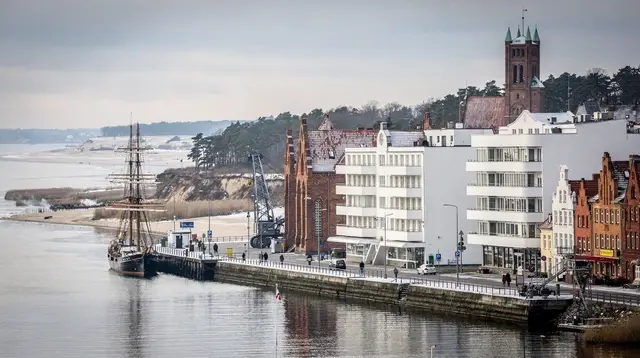
Gdynia is the youngest of the three cities by a wide margin - it grew from a small fishing village into Poland’s main seaport almost entirely within the twentieth century, which is why its architecture reads as modernist rather than historic (see Gdynia Modernism for more on that style). That relative youth tends to translate into wider streets and more regular, less cobbled pavements than Gdańsk’s medieval core, which in general terms makes central Gdynia easier going for wheelchair users.
The waterfront area, with its museum ships and open plazas, is largely flat and walkable. The Gdynia modernist walking tour guide outlines a route through the interwar architecture at street level. As with Sopot, though, “generally flatter” is a citywide impression, not a guarantee for any specific venue - museum ships in particular often involve gangways, internal stairs or tight companionways that a flat waterfront approach does not solve, so confirming access with the specific site before visiting still matters.
Gdańsk’s Old Town: where the caveats concentrate
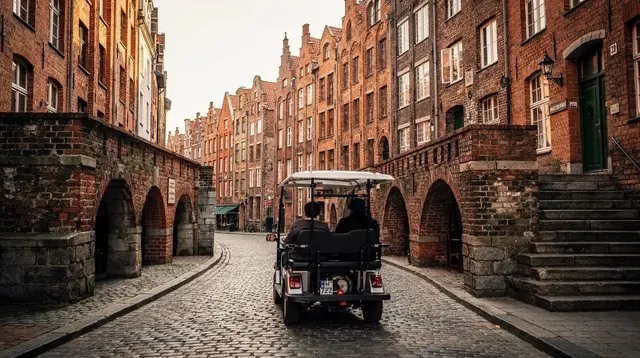
The place where this guide is most careful is Gdansk itself, and specifically the Główne Miasto - the historic core around Dlugi Targ and the Motława riverfront. This is genuinely not flat, smooth ground. Large stretches of the Old Town are paved with cobblestones and historic setts, a texture that varies from manageable to genuinely difficult depending on wheel type, chair weight and personal tolerance for vibration. It would be misleading for this guide, or any guide, to claim the historic centre is free of cobblestones - it is not, and that fact should shape route planning rather than be glossed over.
A few specific points worth knowing before setting expectations:
- St Mary’s Basilica has an accessible ground-floor nave, but its tower - reached by a long historic staircase of several hundred steps with no lift - has no confirmed accessible route to the top. This guide does not promise wheelchair access to the tower, and visitors should not plan around it being available.
- Mariacka street, the amber-dealers’ lane, is atmospheric partly because of its historic paving and ornamental porches - charming to look at, uneven underfoot.
- Riverside paths along the Motława, by contrast, tend to be flatter and more modern in their paving than the streets set back from the water, which can make a waterfront-focused route more comfortable than a deep dive into the side streets.
None of this rules out a rewarding visit to Gdańsk - it simply means the route matters more here than in Sopot or Gdynia. For a much more detailed, site-by-site breakdown of what is and is not manageable within Gdańsk specifically - museums, churches, individual streets - the Gdańsk wheelchair accessibility guide is written for exactly that purpose and goes well beyond what this Tricity-wide page attempts to cover.
A rough comparison across the three cities
| City | General terrain | Standout accessible spot | Main caveat |
|---|---|---|---|
| Gdańsk | Mixed - cobbled Old Town, flatter riverfront | Motława riverside paths | Cobblestones widespread in the historic core; basilica tower not accessible |
| Sopot | Mostly flat, resort-built | The wooden pier | Board surface can be uneven or slippery when wet |
| Gdynia | Generally flatter, twentieth-century streets | Waterfront and modernist centre | Individual venues (museum ships) still need checking |
This is a general impression built from the character of each city’s urban history, not a certified accessibility audit of every street and building. Use it to set expectations for a first visit, then verify specifics for anything a trip depends on.
Planning a Tricity day with accessibility in mind
A day that moves along the coast from Gdańsk through Sopot to Gdynia - broadly the shape of the Tricity 3 Days itinerary or a shorter single-day version - tends to work reasonably well precisely because the SKM line does the hard work of connecting three very different urban textures. A practical approach:
- Start in Gdańsk with a slower pace, sticking where possible to flatter riverside routes rather than deep cobbled side streets, and treat any specific museum or tower as something to confirm ahead rather than assume.
- Take the SKM to Sopot for an easier middle stretch - the pier and seafront promenade are among the most straightforward attractions on this coast.
- Continue to Gdynia for a flatter, more modern finish, keeping in mind that individual sights (especially anything involving a boat or ship) may still have their own access limitations.
For visitors who would rather not manage transfers and route-planning alone, a guided option removes some of that friction - a driver-guide can choose routes that avoid the worst cobbled stretches and plan stops around specific needs. The Tricity tour covering Gdańsk, Oliwa, Gdynia and Sopot takes in all three cities in a single day, while the Gdańsk and Tricity tour that also stops at Westerplatte and Sopot adds the Second World War memorial site to the same general route.
For a shorter overview, the six-hour tour covering the best of Gdańsk, Gdynia and Sopot compresses the same three cities into a half-day. None of these listings are a substitute for asking the operator directly about vehicle access, ramps or walking distances before booking - tour vehicles and stop locations vary, and this guide cannot verify accessibility features for every operator’s specific transport on a given date.
For visitors focusing on Gdańsk’s Old Town specifically rather than the wider Tricity, the Gdańsk must-see attractions walking tour covers the central sights on foot, which makes it worth asking in advance about pacing and surface conditions given the cobbled terrain discussed above.
What this guide is careful not to promise
Because accessibility claims carry real consequences for someone planning a trip around them, it is worth stating plainly what this page does not assert:
- It does not claim every SKM station and every train on the line has been verified as fully accessible - platform heights, gap widths and lift availability vary by station and are worth confirming for specific stops that matter to a given trip.
- It does not claim wheelchair access to the tower of St Mary’s Basilica - no confirmed accessible route to the top exists, and the climb involves several hundred steps with no lift.
- It does not claim the historic centre of Gdańsk is free of cobblestones - substantial stretches of the Główne Miasto are cobbled, and that is a real factor in route planning, not a minor detail.
Where a claim cannot be confirmed, the honest answer is to say so and point towards checking directly - with transport operators, venues, or tour companies - rather than to guess in either direction.
Frequently asked questions about Tricity accessibility
Is the SKM train accessible for wheelchair users?
SKM trains and platforms generally follow standard urban rail accessibility features found across European commuter networks, such as level-ish boarding at many stations and space for wheelchairs on board. Individual stations and rolling stock vary, though, and not every platform has been independently verified here, so it is worth confirming the specific station and train type before relying on it for a trip.
Can you take a wheelchair onto Sopot’s pier?
Yes - the pier is a flat wooden boardwalk with no steps along its length, which makes it one of the more straightforward attractions in the Tricity for wheelchair users. Surface texture and gaps between boards are worth a slow first pass, especially after rain.
Is Gdańsk Old Town wheelchair friendly?
Unevenly. Large sections of the Główne Miasto are cobbled or set with historic paving, which is manageable for some wheelchair users and genuinely difficult for others. It is not accurate to say the historic centre is free of cobblestones, and claiming otherwise would be misleading.
Can you go up the tower of St Mary’s Basilica in a wheelchair?
No stated accessible route to the top has been confirmed. The tower is reached by a long, narrow historic staircase with no lift, and this guide does not promise wheelchair access to it. The basilica’s ground-floor nave is a separate, more accessible space.
Is Gdynia easier to navigate than Gdańsk for wheelchair users?
Generally yes. Gdynia was built up mostly in the twentieth century, so its streets and waterfront tend to be wider, flatter and more modern than the medieval street plan of Gdańsk’s Old Town, though individual buildings and attractions still need checking on their own terms.
Are trams and buses in the Tricity low-floor and accessible?
Many trams and buses on the network are low-floor vehicles, which is standard practice on modern urban transit systems, but fleet composition varies by route and this has not been verified vehicle by vehicle for every line, so treat it as likely rather than guaranteed on any specific service.
Where can I find more detail on accessibility within Gdańsk itself?
A dedicated guide covers Gdańsk’s Old Town, museums and key sights in more depth - see the Gdańsk wheelchair accessibility guide for site-by-site detail rather than the Tricity-wide overview given here.
Should I book an accessible tour rather than plan independently?
For a first visit, a guided tour can simplify logistics considerably, since a driver-guide can choose accessible routes and avoid the worst cobbled stretches. It does not remove the need to ask the operator directly about vehicle access and mobility support before booking.
Accessible tours
Verified deep-linked GetYourGuide tours. Book through these links and we earn a small commission at no cost to you.
GetYourGuide does not provide a product photo for this activity — the image shows the meeting point, photographed by us.