Gdańsk Wheelchair Accessibility Guide: What Actually Works
Is Gdańsk wheelchair accessible?
Partly. The rebuilt Główne Miasto has mostly level streets but stretches of cobbles and uneven paving, and some landmark sights are not accessible at all — St Mary's Basilica tower has no lift and around 400 steps. Always confirm specific ramps, lifts or step-free routes directly with a venue before visiting.
Setting expectations honestly
Gdańsk is a rewarding city to visit in a wheelchair, but it is not a uniformly accessible one, and the worst thing a guide can do is pretend otherwise. This page sets out what is genuinely known about access in Gdansk and the wider region, what is not confirmed, and where the gaps are — so planning can happen around the real terrain rather than around a rosy assumption that falls apart on the ground. Nothing here is a substitute for contacting a specific venue directly; historic buildings, seasonal operators and transport providers change their facilities, and only they can confirm what is available on the day.
The short version: the reconstructed Old Town is broadly walkable and often manageable in a wheelchair on its main streets, several landmark sights are flatly inaccessible by design, and some popular add-ons — like a tower climb or a cobbled side lane — need to be planned around rather than assumed away.
The Old Town: rebuilt, mostly level, not uniformly smooth
One fact shapes everything about moving around central Gdańsk: the Glowne Miasto, the Main Town most visitors picture when they think of Gdańsk, was reduced to rubble in 1945 and rebuilt afterwards. That matters for accessibility in a specific way. Because the core was rebuilt rather than inherited unchanged from the medieval period, the street grid is broadly regular and the main thoroughfares — Dluga street and the Długi Targ square it opens onto — are wide, largely level, and generally passable in a wheelchair without major obstacles.
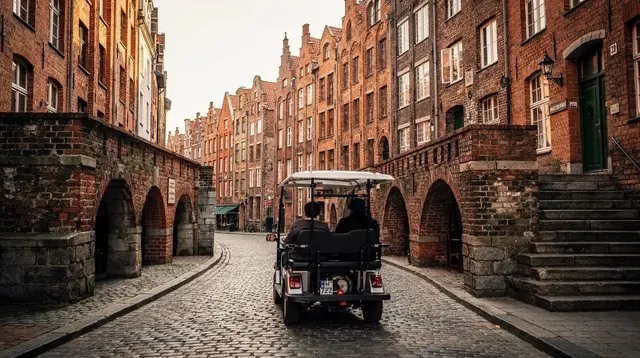
That said, “rebuilt” does not mean “flat and smooth throughout.” Reconstruction kept the historic character of the city, and that character includes cobblestones and uneven period-style paving in stretches, particularly on side streets, around church forecourts, and along parts of the Motława riverfront.
A manual wheelchair user can expect some sections to be tiring or jarring, and a scooter or powered chair will generally cope better with these surfaces than a lightweight manual chair pushed by a companion. There is no single confirmed map of which specific streets are cobbled versus smoothly paved at any given time — surfaces are periodically repaired and sections resurfaced — so the honest approach is to expect a mixed surface throughout the core rather than either extreme.
Mariacka street, the atmospheric amber-dealers’ lane running from the basilica to the river, is a good example of this mix: charming, narrow, and lined with ornamental stone porches that add character but also add uneven ground underfoot. It rewards a slow pace regardless of mobility, but it is not a street to expect perfectly smooth going.
St Mary’s Basilica: the tower is not accessible, and that needs saying plainly
St Mary’s Basilica, one of the largest brick churches in the world, is a highlight of any Gdańsk visit, and its ground floor nave — the main body of the working church — is step-free and open to visit. The tower is a different matter entirely, and it deserves to be stated without hedging: reaching the top involves climbing roughly 400 steps, with no lift. There is no wheelchair-accessible route to the summit, and there is no workaround.
If the reward of a rooftop panorama over the Old Town matters to your itinerary, it needs to be reassigned to someone else in the group, or replaced with a different view entirely, rather than planned around as if an accommodation might appear. For the fuller picture of why the climb is what it is, see the background piece on the basilica’s four-hundred-step tower.
This is worth flagging because so many Gdańsk itineraries mention the tower climb as a can’t-miss activity without noting that it simply rules out wheelchair users and many others with mobility limitations. Better to know that going in than to discover it at the foot of a very long spiral staircase.
Golf cart tours: a mobility option worth knowing about, not a guarantee
One alternative worth knowing about for covering ground in the Old Town without navigating every cobble yourself is a golf cart tour of Gdańsk’s Old Town. These small electric vehicles run set routes through the historic core and can reduce the amount of walking needed to see the main sights, which may suit visitors who find sustained wheelchair propulsion over uneven surfaces tiring, or who are travelling with a companion who cannot push a manual chair over cobbles for an extended period.
It would be misleading, however, to present this as a confirmed accessible option for every wheelchair user. Vehicle design, entry height, available transfer assistance and whether a chair can be stowed or must be left behind all vary by operator and by the specific cart in use, and none of that is standardised across providers. If a golf cart tour looks like the right fit, the right next step is a direct question to the operator about their vehicle’s specific access arrangements before booking — not an assumption that “electric cart” automatically means “wheelchair accessible.”
The same caution applies to a related idea worth considering for the coast: an electric car tour of Leba, where smaller electric vehicles are sometimes used to cover ground near the moving dunes without the multi-kilometre walk the park otherwise requires. Confirm vehicle access directly rather than assuming.
a guided electric car tour of Łeba that covers ground near the dunes without the long walk inBeyond the Old Town: Solidarity sites, Oliwa, and the waterfront
Some of Gdańsk’s most significant sights sit outside the medieval core and tend to be more straightforwardly accessible simply because they were built or substantially renovated far more recently. The European Solidarity Centre, at the historic Gate No. 2 of the Gdańsk Shipyard, occupies a modern, purpose-built structure, and modern museum buildings of this kind are generally designed with step-free routes and lifts between floors as standard practice — though as with every site in this guide, the Centre’s own visitor services are the authority on current facilities, not this page.
Oliwa, with its cathedral, organ recitals and park, is a gentler setting overall: the park paths are relatively level and the cathedral’s nave is step-free, though as with the Old Town, expect some uneven ground on older paths within the wider grounds.
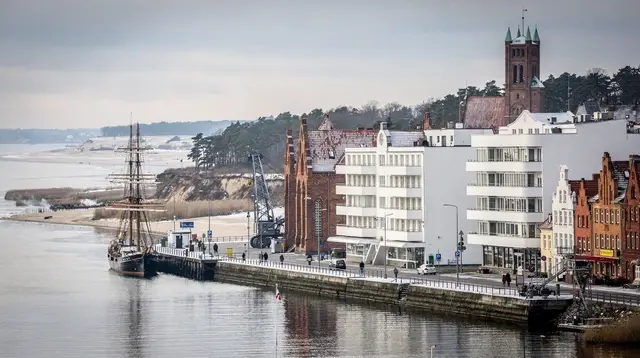
The Motława riverfront, running past the medieval crane and out toward Westerplatte, offers one of the more comfortable ways to take in Gdańsk’s waterfront history without covering ground on foot: a boat trip along the river avoids cobbles entirely, at the cost of needing to check the boarding arrangements at the pier in advance.
a private catamaran cruise along the Gdańsk and Sopot coastline and a private boat outing with music and drinks between Gdańsk and Sopot are both worth considering as a way to see the coastline while sitting rather than walking — confirm boarding access with the operator ahead of time, since dock and gangway arrangements differ by vessel and by tide.
Malbork Castle and day trips further afield
Malbork Castle, the largest brick fortress in the world, is a genuine highlight of any Pomerania itinerary, but it is also a working medieval fortress rather than a modern visitor attraction, and that distinction matters for accessibility. The High, Middle and Low Castles involve stone stairways, drawbridges, uneven courtyards and multiple changes of level across a site that was built for defence, not circulation.
Some ground-level routes and courtyards are more manageable than the upper chambers, but a fully step-free circuit of the castle should not be assumed. For the full picture of what a visit actually involves — timed entry, audioguides, and the genuine three-to-four-hour scale of the site — see the Malbork Castle visitor guide.
Travelling to Malbork by regional train from Gdańsk Glowny is straightforward in terms of the journey itself, but a guided transfer with door-to-door transport can remove some of the uncertainty around platform access and walking distances at the station end.
a guided day trip to Malbork Castle from Gdańsk with an audioguide includedLonger day trips — to Malbork and beyond it toward the Stutthof Memorial near Sztutowo — involve older buildings, memorial grounds and grass or gravel paths in places, and the same rule applies: contact the site directly for confirmed access details before planning around a specific route.
Getting around: trains, trams, and what to check before boarding
The Tricity’s SKM commuter rail network, which links Gdańsk with Sopot and Gdynia along the coast, includes newer rolling stock with low-floor, step-free boarding on many services, and modern trams in the network follow a similar low-floor design in large part. This is genuinely good news for point-to-point travel along the coast without a car.
It is not, however, a guarantee that every platform, every train set, and every tram on every route matches this standard — older vehicles and smaller stations can still present gaps, particularly away from the busiest central stops. Checking the specific line and station in advance, rather than assuming uniform accessibility across the whole network, avoids an unpleasant surprise on the day.
| Mode | General accessibility note | What to check first |
|---|---|---|
| SKM trains | Many newer trains have low-floor, step-free boarding | Confirm the specific line and station platform |
| Trams (Tricity) | Increasingly low-floor across the network | Vehicle and route can still vary |
| Golf cart tours | Can reduce walking distance in the Old Town | Vehicle access and transfer arrangements vary by operator |
| Boat and catamaran trips | Avoids walking on cobbled streets entirely | Confirm boarding/gangway access with the operator |
| Regional trains (to Malbork, Toruń) | Standard rail travel, platform access varies by station | Ask about assistance at both departure and arrival stations |
A practical way to plan around the gaps
Given how much varies by building, by operator and by season, the most useful approach to a Gdańsk trip is not to search for a single “accessible Gdańsk” itinerary, but to build a day around confirmed step-free anchors — a level stretch of Długi Targ, a boat ride along the Motława, a modern museum like the Solidarity Centre — and to treat anything historic, from a church tower to a fortress courtyard, as something to verify site by site rather than assume. A short list of direct enquiries before travelling — to the basilica about ground-floor access, to a golf cart operator about their vehicle, to Malbork Castle museum about current accessible routes — does more for a smooth trip than any general guide, this one included, ever can.
Pairing a slower-paced day with a one-day Gdańsk itinerary or a two-day Gdańsk and Sopot plan as a loose framework, then substituting boat trips, level streets and confirmed- accessible museums for anything uncertain, tends to work better than trying to follow a fixed sightseeing list built without accessibility in mind. It is also worth reading a little about why the Old Town looks the way it does — the piece on Gdańsk being rebuilt rather than original explains why the street plan is more regular than a typical untouched medieval core, which is part of why the main routes work as well as they do.
Frequently asked questions about wheelchair access in Gdańsk
Can a wheelchair user climb St Mary’s Basilica tower?
No. The tower is reached by roughly 400 steps with no lift, so it is not accessible to wheelchair users or anyone unable to manage a long stair climb. The basilica’s ground-floor nave is a separate, step-free space.
Are the streets of Gdańsk Old Town wheelchair friendly?
Mostly, but not uniformly. The Główne Miasto was rebuilt after 1945 on a broadly level street plan, and main routes like Dluga and Długi Targ are generally passable, but side streets, church approaches and stretches of historic paving include cobbles and uneven surfaces that can be tiring or difficult in a manual chair.
Do golf cart tours help wheelchair users see the Old Town?
They can be a useful option for covering ground without walking the cobbles yourself, though vehicle access and any transfer or lift arrangements vary by operator and are not guaranteed to suit every wheelchair. Confirm the specific vehicle’s accessibility with the operator before booking.
Is public transport in the Tricity accessible?
Newer SKM trains and many trams run with low-floor, step-free boarding, but not every station platform or older vehicle matches this, so it is worth checking the specific line and stop rather than assuming uniform access across the network.
Is Malbork Castle accessible by wheelchair?
Parts of the grounds and lower routes are more manageable than others, but the castle is a genuine medieval fortress with stone stairs, uneven courtyards and multiple level changes across the High, Middle and Low Castles, so full step-free access should not be assumed. Contact the castle museum directly for current accessible-route details.
Are museums in Gdańsk generally accessible?
Larger, purpose-built museums such as the European Solidarity Centre tend to have modern step-free layouts, but older buildings and historic monuments vary widely, so it is worth checking each site’s own accessibility information before visiting.
Where can I confirm accessibility details before a trip to Gdańsk?
Contact each attraction or museum directly, since official websites and visitor services can confirm current ramps, lifts and step-free routes far more reliably than general travel guides, and facilities can change between seasons.
Accessible tours
Verified deep-linked GetYourGuide tours. Book through these links and we earn a small commission at no cost to you.
GetYourGuide does not provide a product photo for this activity — the image shows the meeting point, photographed by us.