European Solidarity Centre: Visitor Guide to Gdańsk's Solidarity Museum
What is the European Solidarity Centre in Gdańsk?
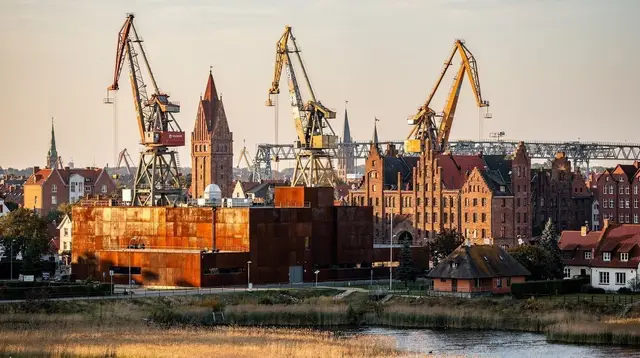
It is a museum and cultural institution built in 2014 on the site of the former Gdańsk Shipyard, telling the story of the Solidarność trade union movement that began there in 1980. Its rust-coloured corten steel building, shaped to suggest a ship's hull, stands next to the shipyard's historic Gate No. 2.
A rust-coloured building with a twentieth-century story inside
Stand at Gate No. 2 of the Gdańsk Shipyard and the first thing that registers is the building, not the history. The European Solidarity Centre is a large, angular mass of corten steel — the kind of metal that is meant to rust, forming a stable reddish-brown skin instead of flaking away — arranged in layered, overlapping panels that most visitors read as a reference to a ship’s hull or a stack of rusting steel plates from the yard around it. It opened in 2014, designed by the Polish practice Fort Architects, and it is worth saying plainly: this is a contemporary building, not a preserved relic of the communist era. The history it tells is much older than the structure that tells it.
That history is the rise of Solidarność (Solidarity), the independent trade union founded at this shipyard in August 1980, and its role in the eventual collapse of communist rule in Poland and, in time, across Eastern Europe. The Centre sits directly beside the historic gate through which striking workers passed in 1980, and it was built specifically to hold and interpret that story — the strikes, the years of martial law and underground resistance that followed, and the negotiated transition to democracy in 1989. It functions as a museum, an archive, a research institute and a venue for public events, all under one roof.
Who Lech Wałęsa actually was
No name is more attached to this building than Lech Wałęsa, and it is easy to get the basic facts slightly wrong. Wałęsa was an electrician at the Gdańsk Shipyard, not an engineer and not a manager — a detail worth holding onto, because the exhibition inside leans on exactly this: an ordinary shipyard worker becoming the public face of a movement that reshaped a continent. He emerged as the leader of the strike committee in August 1980, was a founding chairman of Solidarność, and spent parts of the 1980s detained or under surveillance as the authorities tried to suppress the movement he had come to symbolise.
In 1983 he was awarded the Nobel Peace Prize, and after the negotiated end of communist rule he became President of Poland, serving from 1990 to 1995. The Centre does not treat him as the sole story — the exhibition gives real space to the wider movement, its organisers, and the ordinary workers whose walkouts made 1980 possible — but his arc from electrician to Nobel laureate to head of state is the thread most visitors leave remembering.
What the exhibition covers
The permanent exhibition is built largely from original material: strike documents, photographs, recordings, banners, and reconstructed interiors that put visitors inside moments rather than simply describing them. Recreated spaces include something close to the shipyard gate itself and interiors evoking the strike negotiations, and the route moves chronologically from the roots of worker unrest in the Polish People’s Republic, through the August 1980 strikes and the signing of the Gdańsk Agreements, into the harsher period of martial law declared in December 1981, the underground resistance years that followed, and finally the Round Table talks and elections of 1989 that ended communist rule in Poland.
It is a genuinely international story told from a specific, local vantage point — this is the shipyard where it started, and the exhibition treats that specificity seriously rather than smoothing it into a generic Cold War overview.
Expect a lot of text, archival footage and audio testimony rather than hands-on interactive displays. That makes it a rewarding visit for anyone with some grounding in twentieth-century European history, and a heavier one for visitors expecting a light, quick pass-through.
Planning the visit
Set aside two to three hours for the permanent exhibition. It rewards a slower pace — reading the documents, watching a few of the recorded testimonies, taking in the reconstructed spaces — and visitors who try to compress it into forty-five minutes on a packed sightseeing day tend to come away feeling they rushed past the parts that mattered most.
Tickets are sold both on site and online; booking ahead is a sensible precaution on weekends and through the summer season, though it is rarely essential on a quiet weekday outside peak months. The building also houses a library, a research institute and a programme of temporary exhibitions and public events, so a return visit on a different day can turn up material the first pass did not cover.
| Aspect | What to expect |
|---|---|
| Building opened | 2014 (Fort Architects) |
| Site | Gate No. 2, Gdańsk Shipyard |
| Typical visit length | 2-3 hours for the permanent exhibition |
| Ticket booking | Sold on site and online; advance booking sensible on weekends/summer |
| Exhibition style | Original documents, recordings, reconstructed interiors |
| Nearby free viewing | Monument to the Fallen Shipyard Workers, marked shipyard paths |
One point worth being direct about: the shipyard around the Centre is still a working industrial site, not a preserved museum ground. General visitors do not walk freely through active shipyard areas — the Centre’s grounds, the marked paths, and the nearby monument are the accessible parts, and any deeper access to working shipyard areas is a separate arrangement, not something a standard museum ticket includes. Set expectations accordingly rather than assuming a combined shipyard tour is automatic.
Getting there and combining it with other sights
The Centre sits within easy walking distance of the Gdansk Old Town, close enough that many visitors pair it with a morning or afternoon in the historic core. It also sits naturally alongside two other sites tied to the same era and the same city: Westerplatte, where the Second World War began in September 1939, and the wider story of Gdańsk’s twentieth century told across the Museum of the Second World War.
A guided walking tour of Solidarity-era Gdansk can add useful context before or after a self-guided museum visit, connecting the exhibition’s exhibits to the physical streets and gates where the events actually unfolded. For a deeper read on Wałęsa’s own story, see the dedicated guide to Lech Wałęsa and the Solidarity history of Gdansk.
Several tour operators run guided visits that include the Centre, useful for anyone who wants historical context delivered on the spot rather than read off exhibition panels. A guided walk through the European Solidarity Centre and the shipyard grounds around it is the most direct option, pairing the museum with the surrounding historic site. A shorter focused tour of the Centre itself suits visitors short on time who still want a guide’s framing of the exhibition rather than a solo pass through it.
Visitors building a wider picture of the city’s twentieth century sometimes prefer a broader Solidarity-themed walking tour across the shipyard district, which connects the Centre to the surrounding streets and monuments on foot. For a more private, guided framing of the communist period specifically, a private tour covering communist-era Gdańsk alongside a visit to the Solidarity Centre museum works well for small groups or travellers who prefer a tailored pace.
Setting it in context: the Free City, the shipyard, and 1980
It helps to place the Centre’s story against the longer arc of the city itself. Between the two world wars, Gdańsk existed as the semi-autonomous Free City of Danzig, a detail the city’s own blog post on Danzig and Gdansk covers in more depth. The shipyard that later gave rise to Solidarność was built up under postwar Polish state industry, and the events of August 1980 — captured in the Gate No. 2 strike history — turned an industrial dispute over pay and working conditions into a movement whose demands extended to the right to strike and to form independent trade unions, concessions the communist authorities had never granted before.
The martial law period that followed in December 1981 drove the movement underground for much of the decade, and it was only with the Round Table negotiations of 1989 that Solidarnosc-aligned candidates could stand for election — a result that helped trigger the wider collapse of communist governments across the region that same year.
None of this is abstract at the Centre itself. Standing inside a building shaped to echo the shipyard around it, looking at strike documents signed a short walk from where you are standing, is a different experience from reading the same history in a textbook. It is one reason the Centre works well as an anchor for a longer history-focused day in Gdańsk, rather than a single stop taken in isolation.
Building a longer visit around it
For travellers weighing how the Centre fits into a broader Gdańsk itinerary, it slots naturally into a memory-and-history focused day. The Gdańsk memory trail itinerary groups the Centre with Westerplatte and the shipyard monuments into a single coherent route, useful for anyone who wants to follow the city’s twentieth-century story in roughly chronological order rather than jumping between sites.
Visitors with only a single day in the city and broader interests beyond this one theme might instead start from the general one-day Gdańsk itinerary and slot the Centre in as a two-to-three-hour block alongside the Old Town. Either way, pairing the museum with a walk through the Old Town on the same day makes efficient use of a single visit to the city, since the two are close enough to combine without a long transfer.
For a wider view of what else sits around the shipyard district — cafes, other monuments, and the practicalities of visiting the wider things to do around the Gdańsk Shipyard area, or browsing the full Solidarity and Shipyard category of guides and tours — it is worth allowing time before or after the museum itself rather than treating the Centre as a stand-alone stop squeezed between other plans.
When the Centre is quieter, and what arrival looks like
Like most major museums in the city, the European Solidarity Centre sees its heaviest footfall in the middle of the day during the summer months, when school groups and coach tours overlap with independent travellers working through a packed itinerary. Arriving close to opening, or visiting in the late afternoon, tends to mean a calmer walk through the exhibition, with more room to actually read the documents on display rather than shuffling past them in a queue of people. Outside the June-to-September peak, the building is markedly quieter on weekdays than at weekends, when local visitors and day-trippers from Sopot and Gdynia add to the numbers.
The building itself is more than a single exhibition hall. Alongside the permanent Solidarność exhibition, it houses a cafe suited to a break partway through a long visit, and a bookshop with a genuinely useful selection of English-language titles on Solidarność, martial law and Cold War Poland — worth ten minutes even for visitors who do not plan to buy anything, since the shelves double as a quick orientation to how historians have framed the period.
Cloakroom facilities near the entrance make it easy to leave coats and bags before the exhibition proper, a small but welcome detail on a visit that easily runs past two hours. As a structure completed in 2014, the building was also designed with modern accessibility in mind, with lifts and step-free routes through its main public areas — a contrast with much of Gdańsk’s older, cobbled Old Town, where accessibility is a genuine ongoing challenge.
What surprises first-time visitors
Visitors expecting a slick, high-tech interactive museum sometimes find the European Solidarity Centre more demanding than they anticipated. This is fundamentally a document-and-testimony museum: long stretches of the route ask visitors to read, watch recorded footage, or listen to audio testimony, rather than tap a touchscreen or follow a gamified trail.
That makes it a rewarding stop for anyone with a genuine interest in the period, and a slower, heavier one for visitors hoping to breeze through in under an hour. The emotional register also shifts noticeably partway through — the early rooms on the 1980 strikes carry a sense of momentum and possibility, while the martial law section that follows is deliberately starker, reflecting years of surveillance, imprisonment and suppressed dissent before the story turns again toward the Round Table talks of 1989.
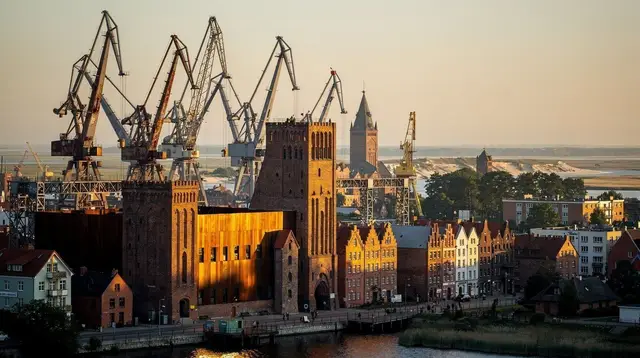
The exterior divides opinion in a way worth knowing before arrival. Some visitors find the corten steel facade a genuinely striking, appropriate echo of the rusting hulls and gantries of the working shipyard around it; others find the same building severe and industrial from the outside, with little to signal the human stories held inside until the doors are through. Either way, it is not a conventionally pretty museum building, and travellers expecting an ornate, historic facade to match the Old Town’s gabled townhouses should recalibrate before they arrive at Gate No. 2.
Is the European Solidarity Centre wheelchair accessible?
As a purpose-built 2014 structure, the building was designed with lifts and step-free routes through its main public areas, which puts it well ahead of much of Gdańsk’s older heritage architecture on accessibility. Visitors with specific mobility needs are still best placed to confirm current provisions directly with the Centre before arriving, since exhibition layouts and access routes can change.
Is there a cafe or bookshop inside the Centre?
Yes. The building includes a cafe for a break partway through the exhibition, and a bookshop stocked with titles on Solidarność, Cold War Poland and Gdańsk’s twentieth-century history, useful for visitors who want to read further after seeing the museum itself.
The essential distinctions to keep straight
A few points are easy to blur and worth restating plainly before a visit. The building is from 2014, not the 1980s — it commemorates events from decades earlier rather than having witnessed them itself. Lech Wałęsa was an electrician, a trade he trained in before the strikes, not an engineer with a formal technical degree. The European Solidarity Centre and the Gdańsk Shipyard are not interchangeable names for the same thing: the shipyard is the historic industrial site, parts of which remain active today, while the Centre is the museum built at its gate to interpret that site’s history.
And a ticket to the Centre is a ticket to the museum, not a pass into the working shipyard grounds beyond the marked, publicly accessible paths. Keeping these distinctions straight makes for a visit with the right expectations set from the start — and, for most visitors, a two-to-three-hour stop that turns out to be one of the more substantial history museums anywhere on the Baltic coast.
Solidarity tours
Verified deep-linked GetYourGuide tours. Book through these links and we earn a small commission at no cost to you.
GetYourGuide does not provide a product photo for this activity — the image shows the meeting point, photographed by us.