Gdańsk WWII History Tour: A Guide to the Sites
What are the main WWII sites in Gdańsk and can they be seen in one visit?
The core sites are the Museum of the Second World War and Westerplatte, where the war began on 1 September 1939. They can be combined in a single day, but Stutthof and the Gdańsk Shipyard's Solidarity story belong to different histories and different distances, and are best treated as separate trips.
Where the war actually started
Gdańsk carries more Second World War weight than almost any other European city, and for a specific reason: the war began here. On 1 September 1939, the German battleship Schleswig-Holstein opened fire on a small Polish military transit depot at Westerplatte, on the outskirts of the city, and the garrison held out for seven days against a much larger force. That single event, more than any other, is why visitors arrive in Gdańsk with a WWII itinerary already half-formed in their heads.
The trouble is that half-formed itineraries tend to compress four or five genuinely separate histories into one rushed afternoon. This page is a hub for sorting that out: what the WWII sites in and around Gdańsk actually are, how long each one honestly takes, how they connect to each other geographically, and — just as important — what they are not. A tour operator’s marketing copy will sometimes promise “all of WWII Gdańsk in two hours” or quietly fold in a stop that belongs to a different decade entirely. Neither claim survives contact with the actual sites.
The two anchor sites: the museum and Westerplatte
Two places form the backbone of any WWII visit to Gdańsk, and they complement rather than duplicate each other.
The Museum of the Second World War, opened in 2017, is a large, largely underground museum a short walk from the Old Town. It tells the European-wide story of the war — its causes, its course, its human cost — through original documents, recovered artefacts, and full-scale reconstructed interiors, including a bombed street and a concentration camp barrack.
It is not a Gdansk-specific museum so much as a Gdansk-hosted one: the exhibition ranges from the interwar years across the entire conflict, with the Polish and Gdańsk chapters woven into a much wider narrative. Allow two to three hours for the permanent exhibition alone; visitors who budget “a quick look” tend to leave having seen perhaps a third of it. Timed online tickets help smooth weekend and school-holiday crowds, though they are not always mandatory midweek.
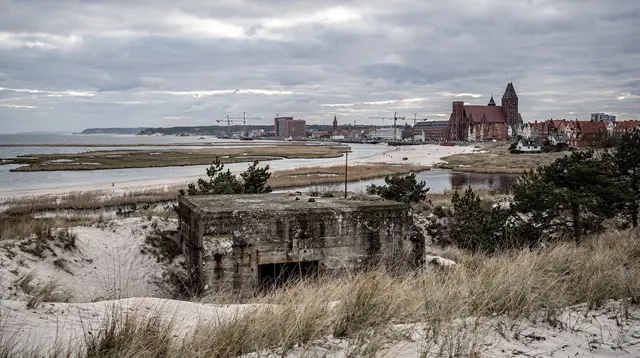
Westerplatte is the opposite kind of site: not a museum but a place, an open memorial park on a low headland where the Baltic meets the mouth of the Vistula. This is where the shooting started. Visitors walk among ruined barracks, information panels, and a hilltop monument to the Polish defenders, with no ticket required and no fixed route to follow. It is a smaller, quieter, more contemplative visit than the museum — honestly 45 to 60 minutes on foot, longer with a guide who can explain the layout of the original garrison — and it rewards being taken slowly rather than photographed and left. Read the full Westerplatte guide before going, since the site’s meaning is not obvious from the ruins alone.
Together, the museum and Westerplatte make a coherent, well-paced day: the museum for context and depth, Westerplatte for the specific place where the war for Poland began. A private guide can tie both together in one outing.
a private guided tour of the WWII Museum is worth considering if you want the exhibition’s density explained rather than read cold, and a combined itinerary is covered by a guided World War II tour that typically links the museum with Westerplatte in a single afternoon.
Getting to Westerplatte
Two options exist, and they suit different plans. A city bus reaches Westerplatte from the centre in well under 30 minutes, runs year-round, and is the practical choice outside summer or on a tight schedule. A seasonal water tram, running mainly April to October, glides out along the Motława river and through the harbour, taking 45 to 75 minutes each way depending on the operator — slower, scenic, and dependent on the season, not a shortcut. In winter the boats generally stop running altogether and the bus becomes the only route. Neither option needs advance booking for the destination itself, since the memorial site is free and open-air.
Solidarity is a different war — or rather, no war at all
The single most common confusion in Gdańsk’s WWII planning is folding in the Gdańsk Shipyard and the Solidarity story. It is an understandable mix-up: both sites sit within the same city, both carry heavy twentieth-century history, and both get grouped under “history tour” in casual conversation. But they are not the same subject.
Solidarity (Solidarność) was the independent trade union founded at the Gdańsk Shipyard in 1980, led by Lech Wałęsa, and it is credited with helping trigger the eventual collapse of communist rule across Eastern Europe. That is more than four decades after Westerplatte, a Cold War story rather than a Second World War one, and it belongs to a genuinely different chapter of the city’s past. The European Solidarity Centre at the shipyard’s historic Gate No. 2 tells that 1980 story in detail, and the shipyard itself remains a working industrial site viewed from marked paths rather than wandered freely.
If a tour or itinerary bundles Westerplatte and the shipyard together as one seamless “history of Gdańsk,” treat that as a simplification worth questioning. They are worth visiting on the same trip — Gdańsk’s twentieth century really does run from 1939 to 1980 and beyond — but they are not the same story, and conflating them flattens both.
For the shipyard and Solidarity specifically, see the shipyard Solidarity tour guide; for a single outing that deliberately covers both eras honestly, a combined WWII, Solidarity and Westerplatte history tour exists precisely to walk visitors through the distinction rather than blur it.
Stutthof: further away, and heavier, than it looks on a map
The Stutthof Memorial, near the town of Sztutowo, was a Nazi German concentration camp, one of the first established outside German territory and among the last liberated. It sits today as a memorial and museum, and it deserves to be treated with the gravity that implies rather than as a sightseeing stop slotted between lunch and a beach afternoon.
Practically, it is also further from Gdańsk than casual itineraries often suggest: around 55km, roughly an hour’s drive or organised transfer, with public transport infrequent enough that most visitors go by tour or hire car. Entry is free, the site is open daily with hours that contract in winter, and a respectful self-guided visit takes about two hours — longer with a guide.
That distance and that pacing mean Stutthof does not fit comfortably into the same day as a thorough Westerplatte-and-museum visit; treat it as its own half-day trip. The Stutthof visitor guide and a companion piece on visiting Stutthof respectfully both go into what a considered visit looks like.
It is worth being direct about one more distance: Auschwitz is not a day trip from Gdańsk. Auschwitz-Birkenau lies in southern Poland, hundreds of kilometres away and several hours by train or car, far closer to Krakow than to the Baltic coast. Confusing it with Stutthof, or assuming both are reachable on a Gdansk-based holiday, is a planning mistake worth heading off early. The Auschwitz-is-not-a-day-trip explainer lays out the geography plainly.
A wartime headquarters, much further still
For visitors drawn specifically to the military history of 1939-45, the Wolf’s Lair (Wolfsschanze), Hitler’s former field headquarters hidden in forest near Ketrzyn, is sometimes mentioned in the same breath as Gdańsk’s sites. It should not be treated as an add-on. At roughly 250km south-east of Gdańsk, it is a long day trip at best and more realistically an overnight excursion, not something to combine with a Westerplatte-and-museum morning. The Wolf’s Lair day trip guide sets realistic expectations for anyone planning to make the journey.
What the city looked like by 1945
It helps, walking through Gdańsk’s gabled Old Town today, to know what actually happened to it. The city was largely reduced to rubble in the fighting of 1945 and rebuilt afterwards; the picturesque facades along Dlugi Targ and the Motława waterfront are careful postwar reconstruction, not untouched medieval fabric.
Between the wars, Gdańsk was not simply German or Polish territory but the Free City of Danzig, a semi-autonomous city-state under League of Nations protection — part of why the city’s status became a pretext for the German attack in 1939. Background pieces on why Gdańsk was reconstructed rather than original and on Danzig not being the same city as today’s Gdansk are useful reading before or after a visit to make sense of what survived and what did not.
Suggested pacing
| Site | Time needed | Distance from central Gdańsk | Ticket |
|---|---|---|---|
| Museum of the Second World War | 2-3 hours | In the city, short walk | Timed online ticket recommended weekends |
| Westerplatte | 45-60 minutes | Bus under 30 min; boat 45-75 min (seasonal) | Free |
| Gdańsk Shipyard / Solidarity Centre | 2-3 hours | In the city | Ticketed museum |
| Stutthof Memorial | About 2 hours on site, plus travel | Around 55km, about 1 hour each way | Free |
| Wolf’s Lair | Full day or overnight | Around 250km | Ticketed site |
A realistic one-day WWII itinerary in Gdańsk itself pairs the museum with Westerplatte, using either the bus or, in season, the water tram. Stutthof and the Wolf’s Lair are each their own trip, not extensions of that day. The city’s memory trail itinerary sequences several of these stops if a structured route is useful, and the wider WWII history tours category lists guided options for each piece separately.
For visitors who prefer a guide throughout rather than self-navigating between sites, a guided walking tour of the city’s history covers the Old Town context that frames the wartime sites, while a themed option like an electric golf cart tour focused on 1945 is a lower-effort way to cover ground for visitors with limited mobility or time.
What not to expect
A few claims are worth ruling out before they shape a visit. No single site in Gdańsk summarises the whole of the Second World War; the museum, Westerplatte and Stutthof each cover a different facet, and skipping two of the three leaves real gaps. No visit under an hour can do justice to the museum or to Stutthof, whatever a rushed itinerary promises. And no combination of Gdańsk’s WWII sites with Auschwitz in a single day is realistic — the distances simply do not allow it. Treating these sites as a handful of separate, unhurried visits, rather than one compressed loop, is what actually does the history justice.
Frequently asked questions about Gdańsk’s WWII sites
What is the difference between Westerplatte and the Gdańsk Shipyard?
Westerplatte is where the Second World War began in 1939. The Gdańsk Shipyard, several kilometres away, is where the Solidarity trade union movement started in 1980, over four decades later. They are unrelated histories that happen to share a city.
Can I visit Stutthof and Westerplatte on the same day?
It is possible but not advisable as a rushed pairing. Stutthof is around 55km from Gdańsk, about an hour’s drive each way, and deserves a focused, unhurried visit rather than being squeezed alongside a city-centre itinerary.
Is Auschwitz a day trip from Gdańsk?
No. Auschwitz-Birkenau is in southern Poland, hundreds of kilometres from Gdańsk and several hours away by train or car, closer to Krakow than to the Baltic coast. It cannot be combined with Gdańsk’s WWII sites in a single day.
How long does the Museum of the Second World War take to visit properly?
Budget two to three hours for the permanent exhibition. It is one of the largest WWII museums in Europe, largely underground, and dense with original artefacts and reconstructed interiors; a rushed hour will only skim the surface.
How do I get to Westerplatte from central Gdańsk?
A city bus covers the distance in well under 30 minutes year-round. A seasonal water tram along the Motława river also runs, mainly April to October, taking 45-75 minutes each way and offering scenery rather than speed.
Is there a single site that explains the whole of WWII in Gdańsk?
No single stop covers it. The Museum of the Second World War gives the broad European context, Westerplatte marks where the war started locally, and Stutthof, further away, addresses the occupation’s darkest chapter. Each requires its own visit.
Was Gdańsk part of Germany or Poland before the war?
Neither exactly. Between the world wars, Gdańsk was the Free City of Danzig, a semi-autonomous city-state under League of Nations protection, which is part of why the city became a flashpoint in 1939.
WWII tours
Verified deep-linked GetYourGuide tours. Book through these links and we earn a small commission at no cost to you.
GetYourGuide does not provide a product photo for this activity — the image shows the meeting point, photographed by us.