Stutthof Memorial: How to Visit
Is Stutthof worth visiting from Gdańsk, and how do you get there?
Stutthof Memorial in Sztutowo is about 55 km from Gdańsk, roughly an hour by car or transfer. Entry to the grounds and museum is free, and a respectful visit takes about two hours, longer with a guide.
What Stutthof was
Stutthof was a German Nazi concentration camp, established by Nazi Germany on 2 September 1939, the day after the invasion of Poland began. It stood near the village of Sztutowo, on what was then territory annexed by Germany and is today part of Poland. That distinction matters and is worth stating plainly: Stutthof was never a Polish camp, never run by Poles, and never a Polish institution of any kind. It was a German camp, built and operated by the German state, on land that is Polish now. Calling it a “Polish concentration camp” is a serious and common error, one that Polish historians and the memorial itself have worked for years to correct, and this page will not repeat it.
Stutthof holds a specific place in the history of the camp system: it was the first concentration camp built outside the 1937 borders of Germany itself, opening within days of the war’s outbreak. Over the nearly six years it operated, it held prisoners of many nationalities, including Polish civilians, resistance members, Jewish prisoners transported from ghettos and other camps in the later years of the war, and Soviet prisoners of war. The camp was liberated in May 1945, among the last to be freed. Today the site functions as a memorial and museum, maintained with the gravity the subject demands, not as a sight to tick off a list.
Among those held at Stutthof were Jewish prisoners transported from ghettos and other camps as deportations intensified later in the war, part of a much larger history of Jewish life and persecution across the region. Travellers who want that wider context, including the prewar Jewish community in Gdańsk itself and what remains of it today, can read the Jewish heritage guide to Gdansk, which covers sites and history connected to, but distinct from, what happened at Stutthof.
This guide sets out how to visit responsibly: what the site involves, how to get there from Gdańsk, what a visit actually takes, and what tone and preparation are appropriate. It does not treat Stutthof as an attraction to be paired with something upbeat, and it will not promise an experience suited to young children or a rushed itinerary.
Getting there from Gdańsk
Sztutowo lies about 55 km east of Gdansk, on the Vistula Spit side of the bay. The most straightforward way to reach the memorial is by car or by an organised transfer, both of which take roughly an hour depending on traffic and the season. The road runs through flat, quiet countryside typical of the Żuławy lowlands, past small villages and farmland rather than anything resembling a scenic coastal drive.
Public transport exists but is limited. Regional buses connect Gdańsk with Sztutowo, but services run infrequently, particularly outside the summer season, and a return trip by public bus alone can eat most of a day even before factoring in time at the memorial itself. For this reason, most independent visitors either drive themselves or join a guided tour that includes transfer from Gdańsk, which removes the scheduling uncertainty and usually includes commentary that sets the historical context before arrival.
Travellers weighing whether it is worth hiring a car for this leg of the trip, rather than relying on transfers or tours, may find it useful to read should you rent a car in Gdansk first: Sztutowo is one of the destinations where a hire car genuinely pays off, since public transport is thin here and a tour fixes the itinerary to someone else’s schedule. Visitors arriving from the airport and planning to head toward Sztutowo on the same day should also build in time for that first leg; the Gdańsk airport transfer guide covers how long the journey from the terminal typically takes, which matters when a Stutthof visit is scheduled soon after landing.
A guided visit also has a practical advantage beyond transport: a knowledgeable guide can walk a group through the site’s history in a way that a self-directed visit, without much prior reading, sometimes misses. For visitors without a car, a tour with transfer is the more reliable option. One example is the Stutthof Museum guided tour with transfer from Gdańsk, which handles the return journey and pairs it with guided commentary on site.
What to expect at the memorial
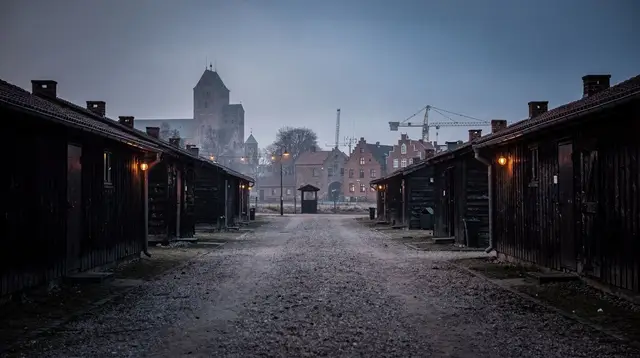
The Stutthof Memorial preserves parts of the original camp grounds along with museum buildings that house permanent exhibitions on the camp’s history, its prisoners, and the postwar reckoning with what happened there. Visitors walk through surviving structures and memorial spaces, with exhibition panels, photographs, and original artefacts presented with restraint rather than spectacle. The layout allows for a self-paced walk through both the outdoor grounds and the indoor exhibition halls.
Entry to the memorial grounds and the museum exhibitions is free of charge. There is no ticket booth to queue at and no admission fee to budget for, which is consistent with how memorial sites of this kind are typically run across Europe. Parking is available on site for visitors arriving by car.
A self-guided visit that takes in the main exhibitions and grounds at a reasonable pace takes around two hours. Visitors who want deeper context, or who join a guided tour, should expect a longer stay, often built into a half-day trip once travel time from Gdańsk is included. This is not a site to rush; a hurried half-hour walk-through does not do justice to what is being presented, and the memorial’s layout is designed for a measured pace.
Opening hours change with the season. The site keeps longer hours through the summer half of the year, roughly 8:00 to 18:00, and shorter hours in winter, when daylight and visitor numbers both drop. Because these hours shift from year to year, it is worth checking the current schedule before travelling rather than assuming last summer’s hours still apply.
Weather affects a visit here more than it might at an entirely indoor museum, since a meaningful share of the site is outdoors. Autumn and winter visits mean grey skies and a cold wind off the nearby lagoon, with some paths turning to mud after rain; summer visits are more comfortable underfoot but bring little shade across much of the open ground, so a hat and water are worth carrying between May and September. None of this should discourage a visit in any season — the memorial is open and meaningful year-round — but it is worth dressing for an outdoor site rather than assuming a purely indoor experience.
Accessibility and photography
The memorial’s outdoor grounds include gravel paths, grass, and uneven surfaces around the original camp structures, which can be difficult for wheelchair users or visitors with limited mobility; some of the indoor exhibition buildings have step-free access while others do not. Travellers who need to plan around mobility requirements more broadly across the region can check Gdańsk’s wheelchair-accessible guide, which covers step-free routes and transport options in more detail, even though Stutthof itself sits outside the city and is worth checking separately with the memorial before travelling.
Photography is permitted in most areas of the memorial, but it is treated as a matter of etiquette rather than a blanket rule. Photographing exhibition halls, personal artefacts, and memorial spaces in a restrained, documentary manner is accepted; posed or celebratory photographs are not appropriate anywhere on the grounds. Visitors who want a fuller sense of the etiquette expected at the site, beyond the practical points covered here, can read how to visit Stutthof respectfully, which goes into more depth on tone and conduct throughout the visit.
Preparing for the visit
A visit to Stutthof calls for a different kind of preparation than a typical sightseeing stop. The recommended minimum age for visitors is around 13; the subject matter, the imagery in the exhibitions, and the tone of the site are not suited to young children, and the memorial does not present itself as a family activity. Parents travelling with a mixed-age group should plan accordingly, and this is not a stop to build a day-trip itinerary around if young children are part of the group.
Dress and behaviour should be modest and quiet, in keeping with a memorial to victims of atrocity. Loud conversation, photography that treats the site as a backdrop, and a rushed pace are all out of place here. Comfortable, weather- appropriate footwear is sensible, since parts of the grounds are outdoors and uneven underfoot, especially after rain.
It is worth being direct about one more point: Stutthof should not be combined with festive or lighthearted activities on the same day. A morning at the memorial followed by an afternoon of nightlife, tastings, or amusement-park- style attractions does not sit well with what the visit is meant to convey, and most guided itineraries that include Stutthof pair it instead with quiet, low-key stops or a straightforward return to Gdańsk. Travellers planning their own day should apply the same judgment.
Visiting with a guide versus independently
Both approaches are workable, and the right choice depends on how a traveller wants to engage with the material.
| Approach | Time needed | What it offers |
|---|---|---|
| Self-guided, own car | About 2 hours on site, plus driving | Full control of pace, no fixed schedule, requires a car |
| Self-guided, public bus | Most of a day | Lowest cost, but infrequent services make timing unpredictable |
| Guided tour with transfer | Half a day, including travel | Historical context from a guide, no driving or bus planning required |
| Private guided tour | Half a day, flexible timing | Guide’s context plus a more personal pace, higher cost |
A guided tour is generally the easier route for visitors without a car, since it removes the uncertainty of bus timetables and adds context that a purely self-directed walk-through can lack. Options from Gdańsk include the daily guided Stutthof tour from Gdańsk, a small-group Stutthof tour for travellers who prefer a more intimate setting, and a private tour to Stutthof for those who want their own guide and schedule.
Visitors driving themselves should still consider joining a Stutthof museum tour from Gdańsk at least once, since the historical framing a guide provides is difficult to replace with signage alone.
Combining Stutthof with other sites
Some visitors choose to pair a trip toward Sztutowo with other stops in the same direction, since the road east from Gdańsk passes through the flat Żuławy countryside on the way toward Malbork and the wider delta region. This can make sense logistically, but it is worth choosing pairings with the same care applied to the visit itself. A quiet countryside drive or a stop in the Żuławy landscape sits more comfortably alongside Stutthof than an unrelated attraction with a festive tone.
Travellers continuing further into the delta sometimes extend the day toward the Elbląg Canal, known for the inclined planes that carry boats overland between water levels; the Elbląg Canal day trip guide and the combined Żuławy, Malbork and Elbląg Canal itinerary both lay out how that longer excursion can be linked with a stop at Sztutowo. This makes for a genuinely long day, though, and is not something to attempt alongside a slow, unhurried visit to the memorial — travellers who want to do both justice are usually better off treating them as separate outings.
Travellers planning a broader day of WWII-related history in and around Gdańsk might also look at Westerplatte, where the war began on 1 September 1939, or the Museum of the Second World War in central Gdańsk, both of which deal with related history in a comparably serious register.
The European Solidarity Centre and the story of the Gdańsk Shipyard cover a later chapter of the city’s twentieth century and are not directly connected to Stutthof, but travellers building a history-focused visit to Gdańsk sometimes combine several of these over a longer stay; see how many days in Gdansk for planning a multi-day trip that gives each of these sites the time it deserves rather than compressing them into a single rushed day.
For travellers who would rather see Stutthof as part of a structured itinerary with transport and timing already worked out, the private Gdańsk and Stutthof tour and the half-day trip to Stutthof both bundle transfer and guided context into a single half-day booking, which suits visitors without a car who want the visit handled without ambiguity about bus schedules.
What not to expect
It is worth being clear about what a visit to Stutthof is not, since a few misconceptions circulate around this site more than most.
Stutthof is not a Polish concentration camp, and no responsible account describes it that way; it was a German camp built and run by Nazi Germany on land that is part of Poland today, a distinction the memorial itself is careful to explain. It is not a stop that pairs naturally with festive or celebratory activities on the same day, and it should not be built into an itinerary that treats it as one attraction among several lighter ones.
It is not particularly suited to young children, and the recommended minimum age of around 13 should be taken seriously rather than treated as a rough guideline. Finally, it is not a quick roadside stop: a rushed visit of twenty or thirty minutes does not allow enough time to engage with what the exhibitions present, and the site is better approached with at least two hours set aside, more if travelling with a guide.
Practical summary
Stutthof Memorial, near Sztutowo, is about 55 km and roughly an hour from Gdańsk by car or transfer. Entry is free. A visit takes about two hours self-guided, longer with a guide, and the recommended minimum age is around 13. It was the first Nazi concentration camp built outside Germany’s 1937 borders, opened on 2 September 1939, and it was never a Polish institution, even though the site sits on Polish territory today. Visitors should approach it with a quiet, unhurried pace, appropriate dress and behaviour, and without pairing it against lighter, unrelated activities on the same day. For those without a car, a guided tour with transfer from Gdańsk remains the most reliable and context-rich way to visit.
Stutthof tours
Verified deep-linked GetYourGuide tours. Book through these links and we earn a small commission at no cost to you.
GetYourGuide does not provide a product photo for this activity — the image shows the meeting point, photographed by us.