Jewish Heritage in Gdańsk: A Factual Guide
What does Jewish heritage tourism in Gdańsk actually involve?
It means engaging honestly with a history of near-total destruction, not visiting a preserved prewar quarter. Gdańsk's Jewish community, once sizeable in the Free City of Danzig era, was destroyed by Nazi persecution and the Holocaust before 1945, and the most documented site of that history near Gdańsk is the Stutthof Memorial, not a surviving synagogue district in the city itself.
Approaching this history with care
Jewish heritage in Gdańsk is not a subject that lends itself to a breezy sightseeing list, and this page is written with that in mind. It sets out what is reasonably well established about the region’s history, points toward the sites and guided options that engage with it responsibly, and is deliberately cautious about anything this guide cannot verify — a specific building, an unbroken timeline of community life, an address worth turning up to unannounced. Readers looking for a lighter, more conventional city guide should start instead with first-time visitor advice for Gdansk or the overview of Gdańsk itself; this page stays narrowly on one subject and treats it seriously.
Gdańsk before the war: the Free City of Danzig
To understand Jewish history in this city at all, it helps to understand what Gdańsk was in the interwar period. From 1920 to 1939, Gdańsk existed as the Free City of Danzig, a semi-autonomous city-state placed under League of Nations protection after the First World War — neither simply part of Germany nor part of Poland, though closely tied to both by geography, trade and population.
That unusual status shaped daily life for every community within its borders, Jewish residents included, and it is a detail easy to flatten into “a German city” or “a Polish city” when neither is accurate. If this period interests you, the wider context is covered in Danzig is not Gdańsk today, which sets out how the city’s name, borders and identity shifted across the twentieth century.
This guide does not have verified detail to offer about the specific size, institutions, synagogues or neighbourhoods of Danzig’s Jewish community during this period, and it is not going to invent them. What can be said with confidence, because it is a matter of established historical record rather than local specifics, is that Jewish communities across the Free City of Danzig and the wider region were subjected to escalating persecution through the 1930s, in step with the rise of Nazi power in the surrounding territory, and that this persecution culminated in the near-total destruction of Jewish life across the region during the Second World War.
The war years and their aftermath
The Second World War itself began close to Gdańsk, at Westerplatte, on 1 September 1939, when the German battleship Schleswig-Holstein opened fire on the small Polish garrison stationed there. That opening act is well documented and easy to visit — the site today is an open memorial, described in full in the Westerplatte guide and discussed further in why the site feels empty rather than dramatic.
What followed across the region over the next six years, for Jewish residents of Danzig and the wider Pomeranian area, was catastrophic: deportation, persecution and mass murder carried out under German occupation, consistent with what happened to Jewish communities across occupied Poland as a whole.
This guide is not going to reconstruct a detailed local narrative of those years for Gdańsk specifically, because doing so responsibly requires sourced, verified research beyond what this page can offer. What it can point to, with confidence, is the single most substantial and well-documented site connected to this history within reach of the city: the Stutthof Memorial.
Stutthof: the most documented site near Gdańsk
Near the village of Sztutowo, roughly 55km from Gdańsk, stands the site of a former Nazi German concentration camp, now preserved and operated as a memorial and museum. It is described in detail, including practical visiting information, in the dedicated Stutthof Memorial visit guide, and this page will not repeat those specifics. What matters here is the plain historical fact this guide rests on: Stutthof was one of the sites where the machinery of Nazi persecution and mass murder operated in this region during the war, and it stands today as a place of memory and education rather than a conventional attraction.
It is worth being precise about what Stutthof was not, too. As the companion piece Stutthof was never a Polish camp sets out, the camp was established and operated by Nazi Germany during its occupation of Poland — a distinction that matters and is sometimes lost in loose phrasing. For anyone planning to visit, the practical and ethical groundwork is covered separately in how to visit Stutthof respectfully, which is worth reading in full before going, since this is a memorial site visited with a different posture than a castle or a pier.
This guide will not describe Stutthof as interchangeable with other, better-known camps further south in occupied Poland. Auschwitz, in particular, lies far outside this region and is not a realistic day trip from Gdańsk — a point worth keeping in mind when researching this subject, since the two sites are sometimes conflated in casual conversation despite being separate places with separate histories.
What this guide will not claim
It is worth being explicit about the limits of what follows, since vague or inflated claims are common in tourism writing about sensitive history and this page is deliberately built to avoid them.
This guide will not assert the existence, address, or current condition of a specific historic synagogue in Gdańsk, because it does not have verified information to support such a claim. It will not describe a Jewish quarter in the Old Town as something to walk through and recognise, because the Old Town itself is, as covered in Gdańsk was reconstructed, not original, a careful postwar rebuilding of a city that was largely reduced to rubble in 1945 — and this guide cannot confirm which, if any, prewar Jewish sites survive within that reconstruction or where they might have stood.
It will not claim an unbroken line of Jewish community life in Gdańsk running from before the war to the present day, since asserting continuity without evidence would be misleading on a subject where accuracy matters more than a satisfying narrative. And it will not suggest that this history can be adequately covered by ticking off a site in passing between a beach afternoon and a beer tasting — the subject deserves more deliberate treatment than that.
Guided options that treat the subject seriously
Given the limits above, the most responsible way for a visitor to engage with Jewish heritage and history connected to Gdańsk is through a guide with specific, sourced knowledge of the subject, rather than through independent guesswork. A few tours focus specifically on this history rather than treating it as an aside:
a private walking tour built specifically around Jewish heritage in the city runs at your own pace with a guide who can speak to documented sites and history directly, which matters for a subject this easy to get wrong through assumption. A related option, a guided history tour taking in a synagogue and cemetery, covers specific sites with a guide rather than leaving a visitor to locate and interpret them alone.
For those who want the fuller regional picture, including transport to sites further from the centre, a guided tour covering the tragic history of Jews in Gdańsk with transport included is built around exactly this subject rather than folding it into a general city tour.
Two further options provide useful adjacent context on the region’s wartime history more broadly, even though they are not focused specifically on Jewish heritage: a guided visit to the European Solidarity Centre with a guide, which covers the shipyard’s role in more recent Polish history, and a private guided tour of the WWII museum, which sets the wartime period in the wider context of the city and the region. Neither substitutes for a tour focused specifically on Jewish history, but both can usefully bracket a visit built around it.
Related wartime context in Gdańsk
For visitors building a fuller picture of the city’s twentieth-century history around this subject, several other documented threads are worth following. The Gdańsk Shipyard and Solidarity movement tell a later, better-documented chapter of the city’s history, and the story of Gate Two and the 1980 strikes covers events that unfolded decades after the war, at the same shipyard site.
The European Solidarity Centre guide and the account of Lech Wałęsa and the Solidarity history of Gdansk sit adjacent to this page rather than overlapping with it — worth reading for context on the city’s history broadly, without conflating that later history with the wartime and prewar periods this page focuses on.
For a structured way to include Stutthof and other wartime sites in a longer stay, the Gdańsk memory trail itinerary groups several of these locations into a single, deliberately paced route, while the WWII history tour guide and the Museum of the Second World War guide cover the city’s largest dedicated wartime museum in detail. None of these substitute for a guide focused specifically on Jewish heritage, but together they give a fuller, more honest picture of the region’s twentieth century than any single stop can.
What visitors often expect, and what they actually find
It is worth saying plainly what a visitor coming to Gdańsk specifically for this subject should not expect to find. There is no preserved prewar Jewish quarter to walk through, no surviving synagogue building this guide can point to with confidence, and no museum in the city centre dedicated specifically to Jewish history in the way that, say, the European Solidarity Centre is dedicated to the shipyard strikes of 1980. Visitors arriving with an image of a Krakow-style Kazimierz district — cafes, cultural centres and a dense cluster of restored synagogues within walking distance of each other — will not find an equivalent in Gdańsk, and this guide would rather say so directly than let that expectation go unaddressed.
What exists instead is documented regional history, most concentrated and most accessible at Stutthof, and a city whose Old Town was rebuilt from rubble in a way that makes locating specific prewar sites within it a task for specialist historians rather than a casual walk. That is not a reason to skip the subject; it is a reason to approach it through reading and guided interpretation rather than through a self-made list of addresses.
Timing a visit around this subject
Because the most substantial site connected to this history sits outside the city, at Stutthof near Sztutowo, planning matters more here than for a typical afternoon in the Old Town. The memorial’s opening hours run longer through the summer half of the year and contract in winter, when Baltic daylight is short and afternoons darken early; a visit squeezed in at the end of a short winter day risks feeling rushed in a way this subject does not suit. There is also no need to combine this with anything else on the same day.
Pairing a visit to Stutthof with a separate stop, whether a beach afternoon on the coast or a tour of an unrelated attraction, tends to compress the time available for reflection at the memorial itself, and this guide would rather recommend giving the day its own space.
For visitors building a longer stay around wartime history more broadly, the Gdańsk memory trail itinerary offers one structured way to sequence Stutthof alongside other documented sites without rushing any single stop, and the practical detail of getting there — distance, transport options, and what a self-guided visit involves — is covered fully in the dedicated Stutthof Memorial visit guide rather than repeated here.
Planning a visit
If this subject is the reason for a trip to Gdańsk, or a significant part of one, plan around it rather than squeezing it into a single afternoon. A guided tour focused specifically on Jewish heritage, paired with a separate, unhurried visit to the Stutthof Memorial on another day, makes more sense than trying to combine both into one rushed itinerary. For general planning around how long to spend in the city and where to base yourself, how many days in Gdansk and getting from Gdańsk airport to the city centre cover the logistics; neither is specific to this subject, but both are useful groundwork before building a schedule that includes it.
Is it possible to visit Jewish heritage sites around Gdańsk without a guide?
Independently, in a limited sense. Stutthof itself is open to self-guided visitors, with signage and printed material on site, and can be reached by car or organised transfer without booking a tour in advance. But this guide does not have verified information about specific unguided Jewish heritage sites within Gdańsk itself, so a self-directed visitor is better served treating the city’s role as historical context absorbed through reading and museums such as the European Solidarity Centre and the Museum of the Second World War, rather than searching for a physical trail within the city that this page cannot confirm exists.
What time of year suits a visit built around this subject?
Any season works for the underlying history, but the practicalities differ. Stutthof’s opening hours run longer in the summer half of the year and contract in winter, and a rushed, cold, half-daylight visit does the subject no favours. This guide would rather a visitor come in a season that allows an unhurried couple of hours at the memorial and a calm walk afterward, than squeeze in a version shortened by closing time or fading winter daylight.
Above all, treat this as history to be learned from documented sources and knowledgeable guides, not assembled from guesswork or a quick walk through the reconstructed Old Town. Where this guide has been uncertain, it has said so directly rather than filling the gap with something that sounds plausible — and the single strongest recommendation it can make is to start with the Stutthof Memorial visit guide for the most thoroughly documented part of this history within reach of Gdańsk.
Jewish heritage tours
Verified deep-linked GetYourGuide tours. Book through these links and we earn a small commission at no cost to you.
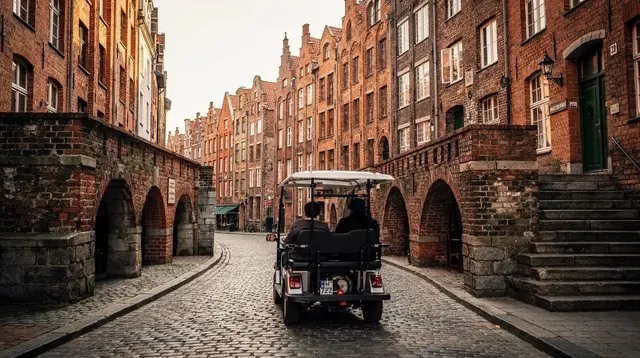
GetYourGuide does not provide a product photo for this activity — the image shows the meeting point, photographed by us.