First Time in Gdańsk: A Newcomer's Guide
What should a first-time visitor know about Gdańsk before arriving?
Gdańsk is a Baltic port city on the Motława river, its gabled Main Town rebuilt after near-total destruction in 1945. The currency is the zloty, not the euro, there is no metro, and the wider Tricity and coast reward more than a single day.
If this is the first Gdańsk page you’ve opened, it’s the right place to start. Rather than walking you through every church, museum and ticket booth, this page is meant to give you a working map of the place — where it sits, what it actually is, what it is not, and how the rest of this site is organised — before you head off to the more detailed pages on the Old Town, Solidarity history or day trips to the coast.
Where Gdańsk actually sits
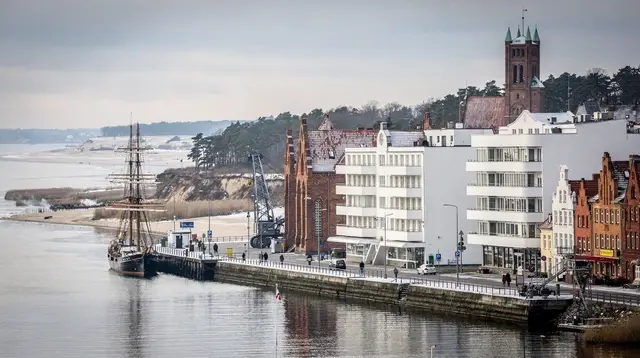
Gdańsk stands on the Motława river, at the point where it meets the Vistula’s Dead Vistula branch, right at the head of the Bay of Gdańsk on the Baltic Sea. The city is at sea level, flat and low-lying, which matters more than it sounds: there are no hills to climb for a view over the rooftops, and the geography that shaped the city — tides, shipping channels, marshland reclaimed for building — is the same geography you’ll notice as you walk the waterfront or take a boat out toward the bay.
Three scales are worth keeping straight from the start, because guides and maps use them interchangeably and it causes confusion. Gdańsk is the city itself. The Tricity (Trojmiasto) is the conurbation of Gdańsk with its two coastal neighbours, Sopot and Gdynia, strung along roughly 30km of coastline and linked by a fast commuter train. Pomerania is the wider region beyond that, taking in the rolling hills of Kashubia inland and the open coast running both directions from the Tricity. This guide sits at the Gdańsk end of that scale; the rest of the site fans out from here.
Within Gdańsk itself, the part every visitor sees first is the Main Town (Glowne Miasto), the gabled historic core around Długi Targ and the Motława riverfront. It’s compact enough to cover on foot in an afternoon, which is exactly why it’s worth slowing down rather than rushing through — our Old Town walking tour breaks it into a proper route rather than a photo-stop dash.
Getting your bearings on the ground is simpler than it sounds, even without a map open. The Motława runs along the eastern edge of the Main Town, so wherever you are among the gabled facades of Długi Targ, walking toward the water reliably brings you to the same recognisable line: the riverside promenade, the medieval crane Żuraw, and the moored ships beyond it.
Because the whole Main Town sits on reclaimed marshland at sea level, there’s no hillside to climb for an overview the way you might in a hillier European city — the closest thing to a vantage point is the tower of St Mary’s Basilica, and climbing its 400-odd steps early in a visit is a genuinely useful way to fix the street layout in your head before setting off on foot for the rest of the day.
The history that explains what you’re looking at
Two historical facts do more to explain modern Gdańsk than any date list could, and both are worth carrying with you before you start sightseeing.
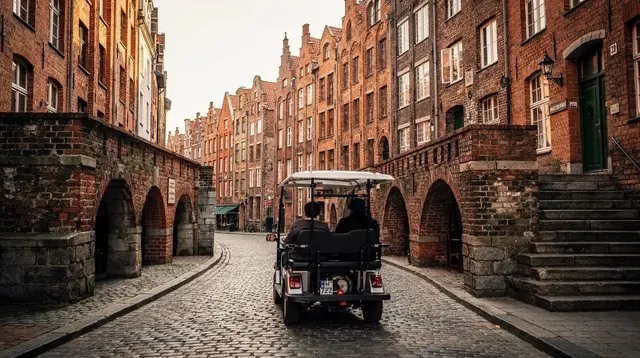
The first is that the Main Town you see today is a reconstruction, not an original. Roughly 90% of it was reduced to rubble in 1945, in the final stages of the Second World War, and the brick gables, ornamented facades and cobbled squares that look centuries old were rebuilt from photographs, paintings and surviving fragments in the decades that followed.
That doesn’t make it fake — it’s a genuinely remarkable feat of postwar reconstruction, restoring a historic street plan brick by brick — but it does mean the honest framing is “faithfully rebuilt”, not “untouched medieval city”. We go into this properly on a dedicated page if you want the full story, and it’s worth reading before you stand in Długi Targ and wonder why everything looks so crisp for something six centuries old.
The second fact bookends the twentieth century at Gdańsk from both ends. The Second World War began here, at Westerplatte, on 1 September 1939, when a German battleship opened fire on the Polish garrison at the mouth of the harbour — a quiet, open memorial site today, not a museum full of exhibits. And in 1980, at the Gdańsk Shipyard, striking workers led by Lech Wałęsa founded Solidarity (Solidarność), the independent trade union credited with helping bring down communism in Poland and, eventually, across Eastern Europe.
Between those two events, in the interwar years, Gdańsk was the semi-autonomous Free City of Danzig under League of Nations protection — worth knowing, because the city’s identity through the twentieth century was genuinely its own, not simply a German city that became Polish or vice versa. Both the Westerplatte and Shipyard stories get full treatment on their own pages, including the European Solidarity Centre that now stands at the shipyard gate.
Further back, Gdańsk’s wealth was built as a leading member of the Hanseatic League from the 14th century onward, trading grain, timber and amber across Northern Europe — the gabled merchant houses along Długi Targ and the Motława are the visible legacy of that trading wealth, rebuilt though they are.
Practicalities to settle before you land
A handful of basics will save you friction on day one.
Currency: Poland uses the zloty (PLN), not the euro — the country is not in the eurozone, and euros are not accepted as everyday payment even in tourist areas. Contactless card payments are near-universal in shops, cafes and market stalls, so you won’t need to carry much cash, but budget and think in zloty rather than converting every price back to euros. Our guide to paying in Poland covers tipping norms and card habits in more detail.
Getting around: there is no metro in Gdańsk or the Tricity. Local transport runs on the SKM, a frequent commuter rail line that hugs the coast from Gdańsk through Sopot to Gdynia and beyond, supplemented by trams and buses within the city. Tickets are sold by time validity (20, 40, 60, 90 minutes, or a 24-hour pass) rather than by number of stops, which trips up first-timers used to zone-based systems. A hire car is rarely necessary — see our getting around guide for the full picture, and the SKM/tram/bus breakdown if you’re coming straight from the airport.
Arrival: most visitors land at Gdańsk Lech Wałęsa Airport, about 12km northwest of the Old Town, with the SKM reaching Gdańsk Glowny station in roughly 25–35 minutes. Our airport transfer guide lays out every option from train to taxi.
Time and power: Gdańsk runs on Central European Time (UTC+1 in winter, UTC+2 in summer), and sockets are the standard European type C/E at 230V, so UK and non-EU visitors will need an adapter.
Language: English is widely understood among younger residents, hospitality staff and in tourist-facing businesses, though less so among older generations away from the centre — a few basic Polish courtesies go a long way, but you won’t be stuck.
What tends to catch first-time visitors off guard
A few things surprise newcomers who arrive with expectations shaped by other European city breaks, and it’s more useful to hear them now than to discover them on day one.
The first is the weather gap between a sunny Old Town and an exposed waterfront. An afternoon that feels warm and settled among Długi Targ’s tall buildings can turn sharply windy the moment you step onto the open Motława promenade or a boat out to Westerplatte, because the coast is genuinely more exposed than the sheltered streets suggest. Pack a layer even in July.
The second is how much closes on a schedule you don’t control. St Mary’s Basilica closes for services at times posted only on a noticeboard by the door, not online; Oliwa Cathedral’s organ recitals run on a similarly local timetable that thins out drastically off-season; and several of the coast’s boat trips and seasonal kiosks stop altogether outside the May-to-September window. None of this is a reason to avoid a shoulder-season visit — it just means checking specific hours on the day rather than assuming a museum-city rhythm of “open whenever.”
The third is simpler and more pleasant: how walkable the centre is compared to its reputation. Visitors who picture a sprawling Polish city are often surprised that the Main Town, the Shipyard and the European Solidarity Centre are all within a single comfortable walk of each other, with the SKM taking over cleanly the moment you want to reach Sopot or Gdynia — no car, and often no taxi, genuinely needed for a first visit.
If you only have half a day
Not every first visit allows a full day for the Main Town before moving on, and if that’s your situation, it’s worth arbitrating rather than trying to see everything at a jog. The honest priority order is: walk Długi Targ and the Motława waterfront first, since it’s the compact, photogenic core that defines Gdańsk in most people’s minds; then choose one of St Mary’s Basilica tower or the European Solidarity Centre, not both, because the tower climb and the museum’s dense exhibition each genuinely need an hour or more done properly.
Skipping Westerplatte entirely on a half-day visit is a reasonable trade-off — it’s a meaningful site, but it’s also a 45-minute round trip by bus at minimum, and it rewards a page of reading beforehand more than a rushed five-minute stop would.
What Gdańsk is not
It’s worth being upfront about a few comparisons that set the wrong expectations, because they come up often.
Gdańsk is not Warsaw and not Krakow, and it isn’t a convenient day trip from either — it sits on the Baltic coast in the far north of Poland, around two and a half to three hours from Warsaw by fast Pendolino train, and further still from Krakow. It has its own history, its own port-city rhythm and its own architecture, distinct from Poland’s better-known inland capitals, and it rewards being treated as a destination in its own right rather than a side trip.
It is also not a Mediterranean beach city, despite the sand and the summer crowds. The Baltic Sea rarely climbs past 18–20°C even in August, the water is grey-green rather than turquoise, and the coast is genuinely windy — bracing rather than balmy. And the region is flat, sitting at or near sea level throughout: if you’re picturing mountains or ski lifts, that’s a different part of Poland entirely.
Finally, Gdańsk itself is not an island. It’s a mainland port city; even the narrow Hel Peninsula further along the coast is a strip of land attached to the mainland, reachable by road, not a separate landmass.
How to think about your first few days
A realistic first visit gives Gdańsk’s Main Town and waterfront a full day on their own, then branches outward as time allows. Most first-timers settle on two to three days for the city itself — long enough to walk the Old Town properly, see the Shipyard and European Solidarity Centre, and take a boat out toward Westerplatte — before deciding whether to add Sopot and Gdynia, or a day trip further afield. Our how many days in Gdansk page walks through the trade-offs in more detail, and the one-day Gdansk and Gdańsk plus Sopot, two days itineraries give ready-made routes if you’d rather follow a plan than build one from scratch.
For many visitors, the Motława waterfront is also the easiest way into the city’s mood — a slow boat past the medieval crane and the shipyard cranes beyond gives a different sense of scale than walking alone. If that appeals, a guided kayak paddle along the Motława is a good way to see the riverfront from the water rather than the cobbles, and it pairs naturally with an evening exploring the Old Town’s bars on a daytime pub crawl with a local guide.
Once the city itself feels familiar, the most common next step is a half-day out to Sopot, home to Europe’s longest wooden pier and a short SKM ride away — a three-hour guided bike tour of Sopot is an easy way to cover the resort town’s pier, forest park and seafront without working out a route yourself.
Further out, Malbork Castle, the largest brick fortress in the world, is the single most popular day trip from Gdańsk, and because entry now runs on timed slots in high season, a guided day trip to Malbork Castle with an audioguide takes the booking logistics off your plate. Our Malbork visitor guide and getting to Malbork from Gdansk pages cover the independent route if you’d rather go it alone.
Do I need a car for a first visit to Gdańsk?
No. The Main Town, the Shipyard and the European Solidarity Centre sit within a single comfortable walk of each other, and the SKM commuter train handles Sopot and Gdynia cleanly. A hire car adds parking hassle without saving meaningful time on a first visit.
What surprises first-time visitors most about Gdańsk?
Two things, mostly. How quickly a calm, sunny afternoon in the sheltered Old Town can turn windy the moment you reach the open waterfront, and how much of what you’ll want to see — church towers, organ recitals, coastal boat trips — runs on a local, day-of schedule rather than fixed hours you can look up in advance.
Where to go from here
Treat this page as the front door, not the whole house. From here, the natural next steps are a proper walk through the Old Town, a read on how the reconstruction actually happened, and a look at where to stay before you book anything. If budget is on your mind, the Gdańsk budget travel guide is worth ten minutes before you commit to a hotel or a full day-trip itinerary — and once you’re oriented, the destination pages for Sopot, Gdynia and the wider coast are where the detail lives.
Trip planning
Verified deep-linked GetYourGuide tours. Book through these links and we earn a small commission at no cost to you.
GetYourGuide does not provide a product photo for this activity — the image shows the meeting point, photographed by us.