Malbork Castle: Visiting the World's Largest Brick Fortress
What is Malbork Castle and how do you visit it from Gdańsk?
Malbork Castle is the former headquarters of the Teutonic Knights, the largest brick castle by land area in the world, built on the Nogat river and listed as UNESCO World Heritage. It sits roughly 60km south-east of Gdańsk, reached by a 35-45 minute interurban train from Gdańsk Glowny, not by SKM or tram, and the full High, Middle and Low Castle route needs a half day rather than a quick stop.
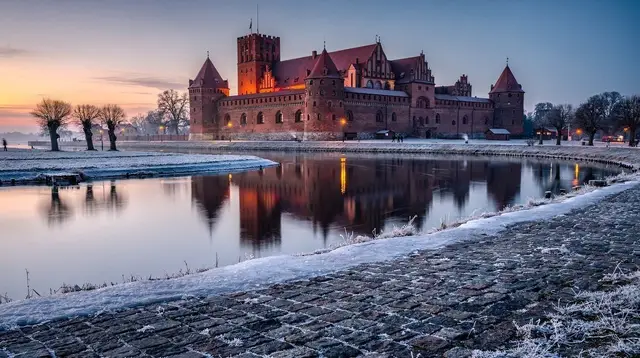
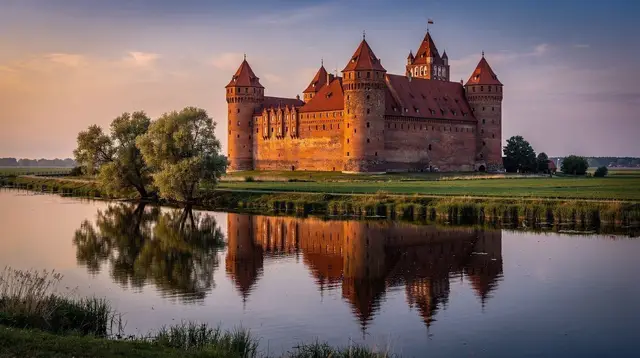
No other building on this stretch of the Baltic prepares you for the scale of Malbork. It is not a hilltop silhouette glimpsed from a distance, like many of Europe’s famous castles, but a vast red-brick complex that spreads out along the flat bank of the Nogat river, wall after wall, tower after tower, until it becomes hard to tell where the fortress ends and the town begins. This is Malbork, and its castle is recognised as the largest brick castle in the world by land area - not a fairy-tale palace but the former headquarters of a monastic military order that once governed a state stretching across Prussia and much of Pomerania.
Why Malbork Castle looks the way it does
The castle was begun in the late 13th century by the Teutonic Knights, a Catholic military order that had shifted its focus from the crusades in the Holy Land to converting and administering the pagan lands of the Baltic. As the order’s power grew, Malbork - then known by its German name, Marienburg - became its capital, and the castle expanded accordingly: not as one grand residence but as a working seat of government, a garrison, a treasury and a monastery combined, all built in the load-bearing red brick that was the practical material of a region with little building stone.
That practicality is worth holding onto, because it explains why Malbork rewards a visitor differently than a royal château built for show. The walls are thick because they needed to hold. The halls are severe because they served administrators and knights bound by monastic rule, not a court given to ornament. When the castle was badly damaged in the Second World War and later restored, that restoration aimed to recover the original Teutonic-era fabric rather than any later, softer additions - so what stands today is, deliberately, austere.
The three castles: High, Middle and Low
Malbork is not one building but three fortified zones, laid out in sequence along the river, each with a distinct role in the order’s hierarchy.
The High Castle is the oldest and most heavily defended part, and functioned as the spiritual and administrative core. It held the chapter house, where the order’s senior knights met and made decisions, the castle church, and the private quarters tied most closely to religious life. Its defences are the most complete of the three zones, with a dry moat, a drawbridge and layered gatehouses that a visitor still has to pass through in sequence.
The Middle Castle held the more public and representative functions: the Grand Master’s Palace, with its grand refectories used for receiving guests and dignitaries, and later the buildings that housed visiting knights and officials. This is where the order’s power was displayed rather than merely defended, and the halls here are noticeably taller and better lit than the High Castle’s more monastic rooms.
The Low Castle was the working zone - stables, workshops, granaries, an infirmary and other economic buildings that kept the castle and its garrison self-sufficient. It is the least visited of the three by tourists moving quickly, but it is where the everyday logistics of running a fortress this size become visible: forges, storerooms, the sheer infrastructure a self-contained medieval state required.
Walking the three in sequence - Low to Middle to High, or the reverse depending on the route in use - is what gives Malbork its scale. Seeing only one section, which some rushed itineraries effectively do, misses the point of the place: it is a whole administrative capital in miniature, not a single grand hall.
Getting there from Gdańsk
Malbork sits roughly 60km south-east of Gdansk, and the honest way to describe the journey is a regional or intercity train from Gdańsk Glowny station, taking somewhere in the range of 35 to 50 minutes depending on the service. This is a genuinely useful detail to get right, because it is easy to assume the Tricity’s commuter rail reaches everywhere nearby: it does not.
The SKM, the frequent urban line that links Gdańsk, Sopot and Gdynia, does not run to Malbork, and neither does any tram. Malbork is reached by PKP’s regional and intercity network, a different ticketing system and a different set of platforms at Gdańsk Glowny, and it is worth checking the departure board rather than assuming continuity with city transport.
From the station in Malbork, the castle is a short walk, well signposted and easy to find without a map. For visitors who prefer not to manage tickets and timetables themselves, an organised day trip from Gdańsk that includes return transport and an audioguide removes that layer of planning entirely, and pairs naturally with the fact that the castle itself is large enough to occupy the rest of the day.
For travellers weighing up how to combine this with the rest of a Gdańsk trip, see the dedicated guide to getting to Malbork Castle from Gdansk and the broader Malbork day trip itinerary, which lays out a full day around the visit rather than treating it as a quick stop.
How long the visit actually takes
It is tempting, looking at a map, to treat Malbork as a two-hour stop bolted onto a longer day - and some day-tour marketing encourages exactly that expectation. In practice, the full route through the High, Middle and Low Castle, read at a pace that takes in the chapter house, the Grand Master’s Palace, the armoury displays and the amber collection housed within the complex, runs closer to three to four hours.
Rushing it undersells both the site and the ticket price, and visitors who try to combine Malbork with another full destination on the same day, such as Torun or the Elbląg Canal, often find they have to shortchange one or the other. Malbork on its own, treated as the day’s main event, is the more satisfying plan; those who do want to combine sites should look at how a Malbork versus Toruń day trip actually compares before committing to both in one day.
A private guide changes the pace rather than the scale of the site: a private tour of the castle with a dedicated guide can move faster through less essential rooms and linger longer in the chapter house and the Grand Master’s Palace, but it does not shrink a three-castle complex down to an hour, and no legitimate visit does.
If you genuinely only have half a day
Some itineraries force the issue: a traveller with a single half-day window between trains, or squeezing Malbork in alongside another commitment in Gdańsk, still needs an honest answer rather than a compressed promise. If that is the constraint, the High Castle is the section to prioritise - it holds the chapter house, the castle church and the most complete defensive sequence, and it is the part of the complex that actually explains why the Teutonic Order built the way it did. The Low Castle’s workshops and stores are the most skippable in a genuine time crunch, interesting but not essential to grasping the site.
Even trimmed this way, budget close to two hours inside the walls plus the walk from the station, and accept that a half-day visit means choosing depth over completeness, not seeing everything faster. Anyone weighing whether this trade-off is worth making at all, versus giving the castle a full day and saving another site for a separate trip, is better served by reading the Malbork day trip itinerary before travelling than by deciding at the gate.
What sets Malbork apart from other European castles
Malbork is frequently compared to other famous European castles, and it is worth being precise about what that comparison actually means. By footprint, Malbork is the largest brick castle in the world, which is a genuinely unusual distinction - most of Europe’s largest castles by area are stone hilltop fortresses or sprawling royal complexes, not river-plain brick structures built by a monastic order. That scale comes from function: Malbork was built as the seat of government for a state, not as one dynasty’s residence, so it grew outward as an administrative machine rather than upward as a display of wealth.
That does not make it automatically “better” than every other castle in Europe, and a fair guide should resist the easy claim that it is. What it does mean is that Malbork is a different kind of building from, say, a Loire Valley château or a Bavarian romantic-revival palace: it rewards visitors interested in medieval logistics, monastic-military order and Gothic brick engineering more than those looking for gilded state rooms. Anyone weighing a guided visit against exploring independently can compare the trade-offs in guided tour versus DIY day trips from Gdansk.
Who ran Malbork, and why it matters
Understanding Malbork properly means understanding the Teutonic Knights themselves: a religious military order, bound by vows like monks, but organised for conquest and administration across the Baltic region. From Malbork, the Grand Master governed a network of castles and commanderies that at its height covered a large part of what is now northern Poland and the Baltic states, collecting tribute, minting coin and waging campaigns that shaped the region for centuries.
The order’s decline came later, through military defeat and shifting alliances, and the castle eventually passed to Polish and then Prussian control before its 20th-century restoration. For the fuller history behind the walls, the dedicated guide to Malbork Castle’s history under the Teutonic Knights goes into the order’s rise and fall in more depth than a single-day visitor guide can.
The connection to Gdańsk itself runs deeper than geography: the Teutonic Order also controlled Gdańsk for part of its history, and the tension between the order’s rule and the region’s merchant cities is part of the same story told from the port city’s side in Gdańsk’s Second World War and wider history guides.
Practical notes for the day
A few points are worth planning around rather than discovering on arrival. Malbork Castle’s opening pattern and any timed-entry arrangements change with the season, and this guide deliberately does not quote specific hours or prices, since both shift year to year - check the current schedule before travelling rather than relying on a fixed figure printed elsewhere. What stays constant is the shape of the day: an early train out, a genuine half-day at the castle, and a return journey that leaves the evening free back in Gdańsk.
Comfortable shoes matter more than most visitors expect - the route covers uneven brick paving, courtyards and staircases across all three castle zones, and there is a lot of ground between the Low Castle gate and the High Castle’s inner chambers. Photography is generally welcomed in the courtyards and along the river walk outside the walls, where the classic view of the castle reflected in the Nogat is best taken from the far bank, a short walk from the entrance.
Crowds and mobility
Malbork is not a quiet secret. In peak summer, coach parties arrive in waves through the morning and early afternoon, and the queuing points at the High Castle’s stepped gatehouses are where that pressure shows most, since the sequence of drawbridges and narrow passages was built for defence, not for moving crowds efficiently. Travelling on the earliest practical train from Gdańsk Glowny and starting the route soon after opening avoids the worst of it; arriving mid-afternoon in July or August often means real queuing at the entrance sequence rather than the castle interior.
Mobility is a separate consideration from crowding: the Low and Middle Castle courtyards sit on relatively level ground and are manageable for visitors with limited mobility or a wheelchair, but the High Castle’s original defensive design - drawbridges, raised thresholds and stepped approaches - was never built with step-free access in mind, and some upper-floor rooms are reached only by stairs. Anyone travelling with mobility needs is better off confirming the current state of ramps and lifts before the trip than assuming the whole complex is reachable.
Those who want the castle explained rather than self-navigated can compare a standard group tour from Gdańsk against a half-day private tour with a dedicated guide, depending on whether a fixed schedule or a flexible pace matters more. Either way, the castle’s scale means the choice is really about pacing and depth of explanation, not about how much of the site gets seen.
Malbork in context
Malbork is the standout single-site day trip from Gdańsk, but it is not the only one worth planning around. Travellers building out a longer stay can browse the full range of day trips from Gdansk, or look at how a Malbork day fits into a longer route through the region via the one week Pomerania itinerary or the more compact Gdańsk to Malbork four-day itinerary. For a broader sense of how this brick fortress fits the region’s wider architectural story, the Malbork largest brick castle claim piece looks at exactly what that superlative does and does not mean.
Whatever the itinerary around it, Malbork itself asks for one thing above all: enough time in the day to walk all three castles rather than one. Given that, it is one of the most complete pieces of medieval history on this coast - a working capital in brick, still standing on its river, largely unchanged in outline since the Teutonic Knights built it to govern from.
Malbork Castle tours
Verified deep-linked GetYourGuide tours. Book through these links and we earn a small commission at no cost to you.
GetYourGuide does not provide a product photo for this activity — the image shows the meeting point, photographed by us.