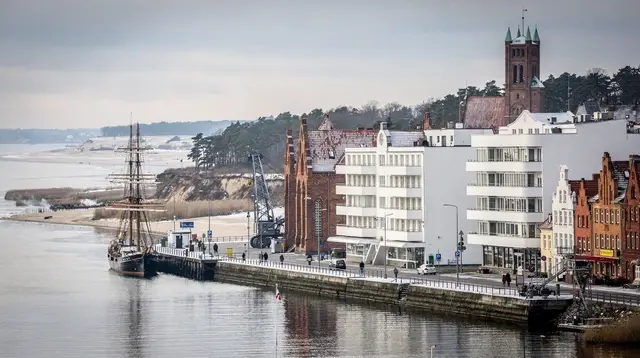
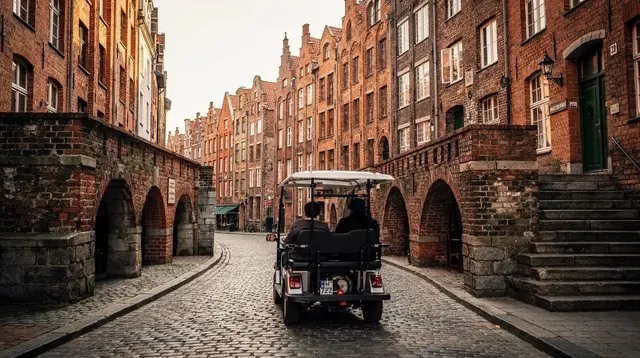
Toruń sits about 170 kilometres south of Gdańsk, on the Vistula, and it holds something Gdańsk’s own old town cannot claim: its Gothic core was never destroyed. While the gabled facades around Dlugi Targ are careful postwar reconstruction, rebuilt from rubble after 1945, Toruń’s brick churches, town hall and burgher houses are the real, unbroken thing - medieval fabric that has simply stood there since the 13th and 14th centuries. That difference is the whole reason to make the trip, and it is also why Toruń deserves more than a rushed afternoon squeezed between two train rides.
Why Toruń and Gdańsk are often paired, and why that pairing misleads
Guidebooks and day-tour operators like to bracket Toruń with Gdańsk as a “twin city” excursion, and there is a real logic to it: both were major members of the Hanseatic League, both built their wealth on the Vistula trade route, and both display the red-brick Gothic style typical of the Teutonic lands. But the comparison invites a false equivalence.
Gdańsk’s Old Town is a brilliant reconstruction - convincing, lovingly detailed, and worth every visit - but it is a reconstruction, rebuilt largely from photographs and surviving fragments after the devastation of 1945. Toruń escaped that fate almost entirely; it saw little fighting in either world war, and its old town is consequently one of the best-preserved medieval urban cores in Central Europe, which is precisely why UNESCO inscribed it as a World Heritage Site in 1997.
Standing in Toruń’s market square, in front of the 14th-century town hall, is therefore a genuinely different experience from standing in front of St Mary’s Basilica in Gdańsk. Both are moving in their own way, but only one lets you touch brick that has never been rebuilt.
Visitors who want to see the contrast for themselves rather than take it on faith should walk both old towns with that history in mind: a guided walk through Gdańsk’s Old Town makes the postwar reconstruction visible in a way a guidebook description cannot, pointing out where photographs and surviving fragments guided the rebuilding, before or after a Toruń visit shows the unbroken alternative standing a few hours south.
Copernicus’s city
Nicolaus Copernicus was born in Toruń in 1473, in a merchant house that still stands on Kopernika street and today operates as a museum devoted to his life and to Renaissance-era astronomy. The city has never let anyone forget this connection - his statue stands in the market square, his name is on the university, and his portrait appears on packets of the local gingerbread. It would be easy to dismiss this as small-town boosterism, but the claim holds up: Copernicus genuinely grew up here before leaving to study in Krakow and Italy, and Toruń’s old town looks today much as it would have looked to him as a boy, brick tower for brick tower.
The Copernicus House museum is modest in scale but well presented, with reconstructed period interiors and exhibits on his heliocentric theory and its reception. An hour is enough for most visitors, longer for anyone with a genuine interest in the history of astronomy.
Gingerbread, seriously
Toruń’s other defining export is piernik, spiced gingerbread, baked here since at least the 14th century and still central to the city’s identity and economy. This is not a novelty souvenir stand - Toruń’s gingerbread tradition is old enough and specific enough that it has its own dedicated museums and workshops, and the city treats the craft with the same seriousness Gdańsk brings to amber. The Museum of Toruń Gingerbread runs hands-on sessions where visitors mix, shape and bake their own piernik using historic recipes and tools, and it is a genuinely good activity for families or anyone who wants a souvenir they made themselves rather than bought.
A guided walk through the old town that weaves in this history - the guild rules, the spice trade that made it possible, the shapes and moulds still used today - is a good way to link the food tradition to the wider city rather than treating it as a separate stop. One option worth booking ahead: a walking tour built around Toruń’s gingerbread tradition, which pairs the old town’s history with tastings along the way.
The old town itself
Toruń’s UNESCO-listed core is compact but dense with things worth stopping for. The Old Town Market Square (Rynek Staromiejski) is anchored by the Old Town Hall, one of the largest and best-preserved Gothic town halls in Europe, with a tower that can be climbed for a view over the red rooftops to the Vistula. Around the square, merchant houses in brick Gothic and later Mannerist and Baroque styles line up in a way that rewards slow walking rather than a checklist pace.
The city’s church architecture is a particular strength: the Cathedral of St John, the Church of St Mary, and the Church of St James all display the confident brick Gothic that defined this whole region in the 14th century, each with different quirks - leaning towers, oversized naves, surviving medieval frescoes - that a guide can point out but a rushed itinerary will miss. The city’s defensive walls and the Leaning Tower, a genuine medieval curiosity tilting several degrees off vertical, round out a day of wandering.
For visitors who want the history explained rather than self-guided, a private tour covers the ground efficiently without losing the detail: a three-hour private city tour of Toruń’s old town takes in the market square, the churches and the Copernicus sites with a local guide setting the context.
In the evening, the Vistula riverfront offers a different pace entirely - the old town’s brick towers and walls lit up and reflected in the water. An evening cruise along the Vistula is a relaxed way to see the old town from the water after a day on foot, and a natural way to close out a longer stay.
Getting there from Gdańsk, honestly
Toruń is reachable from Gdańsk Glowny by direct train, with a journey time of roughly two and a half hours each way on the faster services; slower regional connections or those requiring a change can take notably longer. This is not a short hop. A same-day round trip means committing five hours or more to rail travel alone, before any time in the old town itself - and that arithmetic should shape how a visit is planned, not be discovered on the platform.
Treating Toruń as a same-day bolt-on is one of the more common planning mistakes travellers make with this region, and it’s worth reading common Gdańsk tourist mistakes to avoid before finalising an itinerary - rushing Toruń into a single exhausting day, on top of an already full Gdańsk schedule, is exactly the kind of overreach that guide warns against. Travellers determined to attempt the single long day anyway should at minimum check the return train’s departure time before leaving Gdańsk in the morning: the last convenient direct service back is earlier than many expect, and missing it means either an unplanned night’s stay or a slower, multi-change journey home late at night.
It is possible to do Toruń in a single very long day from Gdańsk: an early train out, a full day on foot in the old town, and a late train back. Travellers who do this typically see the market square, the town hall, one or two churches and the Copernicus House, and leave feeling they have skimmed a city that deserved more. The more honest approach, and the one this guide recommends, is either to treat the trip as a proper full-day excursion with no other stops attached, or - better still - to build in one night in Toruń. An overnight turns a rushed transit day into an unhurried one: an afternoon and evening on arrival, a full second day exploring at a relaxed pace, and a return journey that doesn’t feel like the day’s main event.
Combining Toruń with another destination on the same day - Malbork, say, or a Tricity outing - is not realistic given the distances and rail schedules involved; Toruń earns its own day, not a slot within someone else’s.
Anyone weighing up whether the extra night is worth arranging should read why Toruń deserves a night, not just a day - it makes the case for staying over in more detail than a single section here can, and it is the argument this guide leans on when recommending a full day minimum rather than a rushed round trip. For travellers who want that overnight built into a ready-made plan rather than assembled from scratch, a dedicated Toruń heritage itinerary sequences the old town, the gingerbread workshops and an evening on the Vistula across a proper two-day visit.
| Option | Time commitment | What you’ll realistically see |
|---|---|---|
| Same-day round trip | 5+ hours travel, plus sightseeing | Market square, town hall, Copernicus House, one church |
| Full day, one way then back late | Full day dedicated to Toruń | The above, plus the Leaning Tower, city walls, gingerbread museum |
| One night in Toruń | Arrival afternoon + full next day | Everything above at an unhurried pace, plus an evening river walk |
Practical notes
Toruń’s old town is compact and walkable, with most sights within a 15-20 minute walk of the market square, so once you arrive, getting around rarely requires transport. Cafes and restaurants around the square cater well to visitors, and prices run somewhat lower than in Gdańsk’s tourist core. Poland’s currency is the zloty (PLN), not the euro, and card payments are widely accepted throughout the old town.
One detail that trips up first-time visitors: Toruń Glowny railway station sits on the far bank of the Vistula, roughly 2km from the old town’s market square, not adjacent to it as in many smaller Polish towns. A local bus or a short taxi ride covers the gap in ten minutes or so, but travellers expecting to step straight from the platform into the Gothic core should budget that extra leg, especially with luggage in tow on the way to an overnight stay.
Toruń also holds its own Christmas market in December, considerably smaller and quieter than the stalls that fill Dlugi Targ in Gdańsk, but atmospheric against the same red-brick backdrop. A winter visit trades the summer crowds around the market square for short daylight hours and chillier riverside walks, so it suits travellers who have already seen Toruń once in the warmer months and want a different mood, rather than a first visit.
Anyone weighing Toruń against a different day trip from Gdańsk - Malbork Castle, for instance - should note that the two destinations solve different problems: Malbork is a single vast fortress reachable in well under an hour by train, genuinely manageable as a half-day or day trip; Toruń is a whole historic town further away, better suited to travellers with an extra day to spend. For a wider view of how Toruń fits alongside other excursions, see the best day trips from Gdansk and a direct comparison in Malbork versus Toruń as a day trip.
Travellers building a longer Pomerania itinerary sometimes fold Toruń in as a final stop before heading south towards Warsaw, since the city sits on that rail corridor; for those staying within the Gdańsk region, pairing Toruń with Malbork on separate days of the same trip, rather than attempting both in one day, keeps each visit unrushed. See how many days to plan for Gdańsk and the surrounding region for how Toruń might fit into a longer stay.
For visitors who want the contrast made explicit, it’s worth reading about why Gdańsk’s old town is a reconstruction, not an original before or after a Toruń visit - the two facts illuminate each other, and seeing both cities makes the distinction concrete rather than academic.
Toruń questions answered
Is Toruń worth visiting from Gdańsk?
Yes. Toruń’s old town is a UNESCO World Heritage Site precisely because it survived intact through both world wars, making it one of the best-preserved medieval town centres in Central Europe - a genuinely different experience from Gdańsk’s reconstructed core.
How far is Toruń from Gdańsk?
Toruń is about 170 kilometres south of Gdańsk. The direct train covers this in roughly two and a half hours each way, making a round trip a five-hour rail commitment before sightseeing.
Can I visit Toruń as a day trip from Gdańsk?
It’s possible but demanding: a same-day round trip means over five hours on trains. Given the size and richness of the old town, a full dedicated day or an overnight stay is a more realistic way to see it properly.
Why is Toruń’s old town different from Gdańsk’s?
Gdańsk’s Old Town was largely destroyed in 1945 and rebuilt afterwards, so its gabled facades are postwar reconstruction. Toruń’s old town avoided major wartime destruction, so its Gothic buildings are original medieval and Renaissance fabric, which is why it holds UNESCO World Heritage status.
What is Toruń famous for?
Toruń is best known as the birthplace of astronomer Nicolaus Copernicus, born there in 1473, and for its centuries-old gingerbread (piernik) tradition, alongside its intact brick Gothic old town.
Is Toruń better than Malbork for a day trip?
They serve different purposes. Malbork Castle is a single site reachable in under an hour by train and suits a half-day or day trip well. Toruń is an entire historic town further away, better suited to a full day or an overnight stay.
Do I need a guide in Toruń?
No, the old town is walkable and manageable independently, but a guided walk or private tour helps surface details - which church has the leaning tower, which house is Copernicus’s actual birthplace - that are easy to miss on a self-guided walk.
What currency is used in Toruń?
Toruń uses the Polish zloty (PLN), the same currency as the rest of Poland. Card payments are widely accepted in the old town’s cafes, restaurants and shops.