Gdańsk Tourist Mistakes to Avoid
What are the most common mistakes tourists make in Gdańsk?
Visitors often assume the Old Town is original medieval fabric, mix up 1980 and 1989 in Solidarity history, try to pay in euros, and think one transport ticket covers SKM trains, trams and buses alike. Malbork and Toruń also get treated as closer or quicker than they are.
A short list, on purpose
Gdańsk rewards visitors who arrive with a few facts straightened out in advance, and punishes nobody who arrives without them — this is not a city that traps tourists in scams at every corner. What actually happens is smaller and more common: a wrong assumption carried over from another European trip, applied here where it does not quite fit.
This page collects the handful of mix-ups that come up again and again, the kind worth clearing up once rather than discovering mid-trip. It is not an exhaustive catalogue of everything that could conceivably go wrong, and it will not throw numbers at you about how often tourists get scammed — those figures are not solid enough to print. Think of it as a quick corrective pass before you read the destination pages themselves, at Gdansk and beyond.
Mistake 1: assuming the Old Town is original medieval fabric
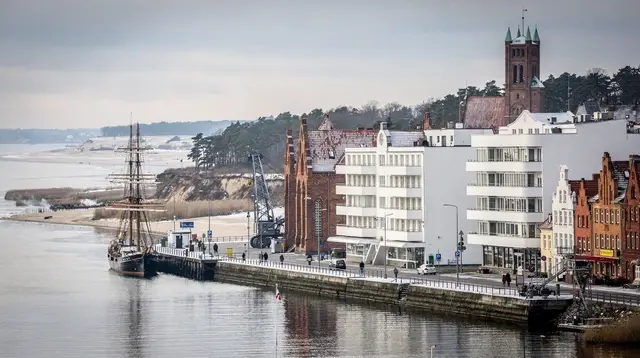
The single most common misconception about Gdańsk is architectural. Walk down Dlugi Targ or along the Motława waterfront and the gabled Hanseatic facades, the ornate porches of Mariacka street, the brickwork of St Mary’s Basilica all read as centuries-old survivors. They are not, in the sense most visitors assume.
In 1945, as the front line passed through the city, the Główne Miasto (Main Town) was reduced to rubble — estimates for the historic core run to the vast majority of buildings destroyed. What stands today is a careful postwar reconstruction, rebuilt from photographs, paintings and surviving fragments over decades, using historical designs as a template rather than starting from a blank slate. The layout is faithful, the proportions are faithful, and in places original stones or fittings were reincorporated — but the buildings themselves are largely mid-to-late 20th century construction wearing a medieval face.
This is not a reason for disappointment. It is, if anything, one of the more striking stories in the city: a deliberate act of civic memory, choosing to rebuild a lost skyline rather than replace it with something modern. Knowing it in advance just changes what you are looking at — not a preserved relic, but a monument to the decision to preserve one. For the fuller version of this story, see the guide on why Gdańsk was reconstructed rather than left original.
Mistake 2: confusing 1980 and 1989
Gdańsk’s 20th-century history is dense, and two dates get blurred together often enough that it is worth separating them clearly before you visit the shipyard or the European Solidarity Centre.
1980 is the year of the strikes at the Gdańsk Shipyard, centred on the famous Gate No. 2, which led directly to the founding of Solidarność (Solidarity), the Eastern Bloc’s first independent trade union, under the leadership of an electrician named Lech Wałęsa. It was a labour movement first — a fight over wages, working conditions and the right to organise — that grew into something with much wider political weight.
1989 is a different, later moment: the round table talks and the semi-free elections that followed, which opened the door to the end of communist rule in Poland and, in the following months, across the wider Eastern Bloc. Solidarity’s candidates swept the seats they were permitted to contest, and the political system began to unravel from there.
The two dates are connected — 1980 is the beginning of the story that 1989 brings to a head — but they are separated by nearly a decade of martial law, suppression and a banned union operating underground. Treating them as interchangeable, or assuming the shipyard strikes themselves brought down the government overnight, flattens a story that is more interesting told in the right order. The Gate No. 2 and 1980 strikes piece and the Lech Wałęsa and Solidarity history guide both walk through the sequence properly.
Mistake 3: expecting to pay in euros
Poland is a member of the European Union but not of the eurozone, and Gdańsk runs entirely on the Polish zloty (PLN). This surprises a fair number of visitors arriving from countries where the euro is standard, particularly on a Baltic itinerary that also touches genuinely euro-using countries nearby.
In practice this rarely causes a real problem — contactless card payment is close to universal in shops, cafes, restaurants and even market stalls, so most visitors barely handle cash at all. The trap is smaller and more specific: a few tourist-facing stalls near the Old Town’s busiest corners will accept euros if pushed, but at an unfavourable, informally set exchange rate, and ATMs, transport ticket machines and ordinary shops simply will not take euro coins or notes at all. Budgeting mentally in zloty, not converting every price in your head from euros, avoids both the friction and the bad exchange rate. The full picture, including tipping norms, is in how to pay in Poland: zloty and cards.
Mistake 4: assuming one ticket covers SKM, trams and buses
The Tricity’s public transport is genuinely good, but it is not one seamless system, and treating it as such is an easy way to end up with an unvalidated ticket at the wrong moment. SKM (Szybka Kolej Miejska) is the commuter rail line running along the coast through Gdańsk, Sopot and Gdynia; PKM (Pomorska Kolej Metropolitalna) is a separate, newer rail line extending further south; and the trams and buses within Gdańsk and the wider Tricity operate on their own ticketing, sold by time validity — 20, 40, 60 or 90 minutes, or 24-hour passes — rather than by number of stops.
A ticket bought for an SKM journey does not automatically double as a tram or bus ticket, and the reverse is also true. The safest habit is to buy the ticket that matches the specific mode you are about to board, check whether a given fare says SKM, ZTM (the Tricity transport authority) or both, and validate it on boarding where a machine calls for it. For the practical mechanics, including where to buy tickets and how the day-pass options compare, see getting around the Tricity: SKM, tram and bus.
Mistake 5: underestimating the distance to Toruń
Toruń’s brick-Gothic old town and Copernicus connections make it a tempting line on a Gdańsk itinerary, and it is genuinely worth the trip — but it is not a short one. Toruń sits well inland on the Vistula, and reaching it by train or car realistically takes upwards of two hours each way, more depending on the route and connections.
Squeezed in as a half-day add-on alongside Gdańsk sightseeing, it becomes mostly transit time with an exhausted hour or two on the ground at the end. Treated instead as a proper day trip — or better, paired with an overnight stay — it delivers what it promises: a second, separate UNESCO-listed old town, distinct from Gdańsk’s own, plus the gingerbread tradition and Copernicus sites that make the detour worthwhile. The Toruń day trip from Gdansk guide lays out realistic timings, and Toruń deserves a night makes the case for staying over rather than rushing back.
The same distance-creep problem applies, in a different direction, to the Wolf’s Lair near Ketrzyn — around 250km southeast of Gdańsk, genuinely a long day trip or overnight, not a stop on a coastal itinerary. See the Wolf’s Lair is a full day trip for why it does not compress well.
Mistake 6: believing amber comes from a mine
Amber is everywhere in Gdańsk — Mariacka street’s ornamental porches are lined with dealers, and the Amber Museum in the medieval Foregate covers its history in depth — but the word “mine” comes up often enough among visitors that it is worth correcting directly.
Baltic amber is fossilised tree resin, formed tens of millions of years ago in ancient forests and gradually concentrated by geological processes along this coast, which holds one of the world’s largest deposits of it. It is gathered, not extracted the way ore or coal is: historically by beachcombing after storms, by dredging shallow coastal sediment, and in some inland areas by shallow open excavation of the amber-bearing layer — but there is no deep mine shaft involved, and it is not a mineral in the geological sense.
For a longer treatment of what “gold of the Baltic” actually means, see amber is not a mined gem and how to spot real amber for buying it without being sold plastic.
Mistake 7: treating Malbork Castle as a quick photo stop
Malbork gets bundled into day-trip itineraries with promises of a two-hour visit, and the castle’s scale makes that promise hard to keep. It is the largest brick fortress in the world by area, and the full circuit through the High, Middle and Low Castles genuinely takes three to four hours for anyone actually reading the exhibits rather than power-walking the route.
The bigger practical trap, though, is arrival planning rather than duration. Since the museum introduced timed entry slots, visitors need to book a date and a specific 30-minute window on the official calendar, especially in July and August, when walk-up queues can push past an hour. Arriving without a booking in high season and expecting to walk straight in is the mistake; arriving with a slot already reserved and a half-day set aside is what the castle actually needs. Full logistics are in the Malbork Castle visitor guide and getting to Malbork from Gdansk.
Mistake 8: mixing up Gdańsk, the Tricity and Hel’s geography
A smaller cluster of mistakes comes from scale and geography rather than history. Gdańsk, the Tricity and Pomerania are three different sizes of the same nesting doll, not interchangeable names: Gdańsk is one city; the Tricity (Trojmiasto) is the conurbation of Gdańsk, Sopot and Gdynia strung along the coast; Pomerania is the wider region that also takes in Kashubia and the coastline beyond. Referring to all three as simply “Gdańsk” causes confusion when planning where to actually stay or how to get between them.
Separately, the Hel Peninsula is not an island, despite how it looks on a map — a narrow, roughly 35km sand spit attached to the mainland near Władysławowo, reachable by road as well as by the more scenic seasonal boat. And Gdańsk itself sits on the coast but is not an island either; it is a mainland port city at the mouth of the Motława and the Vistula’s Dead Vistula branch. None of this changes how you plan a visit much, but it clears up some genuinely common confusion before you look at a map and wonder why the ferry times don’t match what you expected. The comparison guide Gdańsk vs Sopot vs Gdynia sorts out which is which in more detail.
Corrected, not exhaustive
None of these eight points are scandalous, and none of them will ruin a trip to Gdańsk on their own — they are the kind of small factual resets that make the rest of a visit click into place a little faster. This page will not pretend to have covered every possible misstep a visitor could make, and it deliberately avoids quoting scam statistics that are not solid enough to stand behind. For a broader first-timer’s orientation, start with the first time in Gdańsk guide, and for a more focused look at safety and common overcharging tactics specifically, see Gdańsk safety and tourist scams.
If you are weighing whether to see the Old Town on foot or from the water, the Motława river cruise or a relaxed cruise along the Motława with food and drink on board is a pleasant way to see the reconstructed skyline from a different angle once the history is straight in your head.
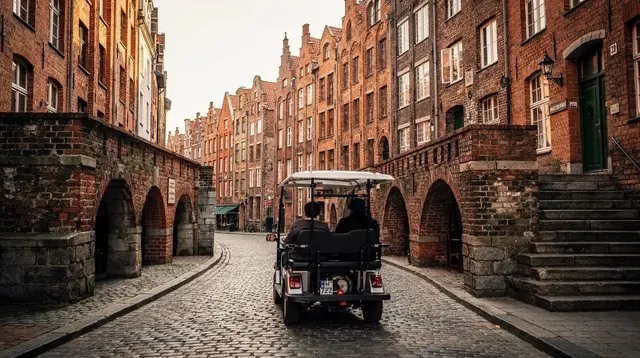
For getting oriented across the Old Town and the shipyard district without walking every step, a golf cart sightseeing tour of Gdańsk’s old town and key sites covers ground efficiently, and pairing sightseeing with a local brewery stop works well on an unlimited beer city tour by golf cart.
Anyone focused specifically on the 1980 history can go straight to the shipyard on a golf cart tour combining the Gdańsk Shipyard with Gradowa Hill, which puts Mistake 2 above in its proper physical setting.
Trip planning
Verified deep-linked GetYourGuide tours. Book through these links and we earn a small commission at no cost to you.
GetYourGuide does not provide a product photo for this activity — the image shows the meeting point, photographed by us.