Amber Is Not a Mined Gem
The first time I walked down Mariacka, I did what most people do: I stopped at a window full of honey-coloured stones and thought, out loud, “so this is where they mine the amber.” A shopkeeper standing in her doorway heard me and laughed, not unkindly. “Nobody mines it here,” she said. “The sea gives it to us.” I have thought about that sentence more than almost anything else I heard in Gdańsk, because it quietly rearranges what you are actually looking at in every one of those cabinets. The street itself, porches and all, gets a fuller walkthrough in our Mariacka street amber-shopping guide if you want the practical side before or after the history.
What amber actually is
Amber is not a stone. It is not a mineral, and strictly speaking it is not a gemstone either, even though jewellers use that word for convenience. It is fossil resin - sap that oozed out of coniferous trees somewhere around 40 million years ago, in forests that no longer exist, and that slowly hardened, buried itself, and survived. Under a loupe you can sometimes see the proof: a trapped air bubble, a fragment of bark, once in a great while an insect that wandered into the resin and never left. That is not decoration. That is the fossil record, sitting in a jewellery box. The Amber Museum guide walks through real specimens and inclusions like these in far more detail than a shop window ever can.
Calling it a mineral is the single most common mistake I heard from other visitors that week, and I understood why - amber looks and feels like a polished stone, cool and smooth, sold in cases next to actual gemstones in some shops. But a mineral forms through geological processes, crystal by crystal, over time and under pressure inside rock. Amber formed inside a living tree. That distinction is not pedantry. It is the whole reason the object in your hand means something different than a cut gemstone does.
Why this distinction matters more than it sounds like it should
A mined stone is extracted - it is pulled out of the earth industrially, cut, and polished. Its story starts with a drill or a pickaxe. Amber’s story starts with a tree, in a forest, tens of millions of years before Gdańsk existed, before the Baltic Sea existed in its current shape. What you are holding, when you buy a piece on Mariacka, is not a manufactured commodity. It is a fragment of a vanished ecosystem that the sea has been patiently recycling and handing back to the shore ever since.
I found that oddly moving, standing in a shop weighing a pendant in my palm. A ring cut from a mined stone tells you about a mine. A piece of amber tells you about a forest that stood on land the sea later swallowed, and about waves that have been quietly working since. That is not marketing language - it is just what the material is, and once you know it, the whole street reads differently. You are not browsing a row of extracted minerals.
You are browsing washed-up pieces of deep time, some barely worked, some carved into rings and pendants - the kind of carving you can try yourself at a hands-on amber jewellery-making workshop, all of it collected rather than mined. Our amber jewellery workshop guide covers what a typical session actually involves if you want to know before booking.
Why Gdańsk, specifically
This is also the answer to a question I had not thought to ask before I arrived: why here? Why does this one stretch of northern European coast have an entire street, plus a dedicated museum, built around a single material?
The Baltic Sea sits on top of ancient amber-bearing deposits, and storms - especially after autumn and winter gales - regularly churn pieces loose from the seabed and wash them onto beaches along this coast. That churn is one more reminder that the Baltic is not the Mediterranean: a cold, working sea that reshapes its own shoreline rather than a calm backdrop for a suntan. Fishermen and beachcombers have been collecting it here for thousands of years, and it has been dredged from shallow coastal waters for almost as long.
There are very few places on Earth where amber occurs naturally in this kind of concentration, and the Baltic coast is the largest of them by a wide margin - pieces wash up well beyond Gdańsk too, including along the dune coast near Leba. Gdańsk, sitting at the mouth of the Motława and the Vistula right on that coast, became the natural trading point for it centuries ago, long before it was famous for anything else, and neighbouring Sopot sits on the same amber-rich shoreline.
That is the origin of the so-called Amber Road, the ancient trade network that once carried Baltic amber south toward the Mediterranean and Rome, in exchange for goods travelling the other way - a route that also passed inland through towns like Torun on its way south. Gdańsk’s wealth as a Hanseatic port was never only about grain and timber; amber moved through this city for a very long time, and Mariacka
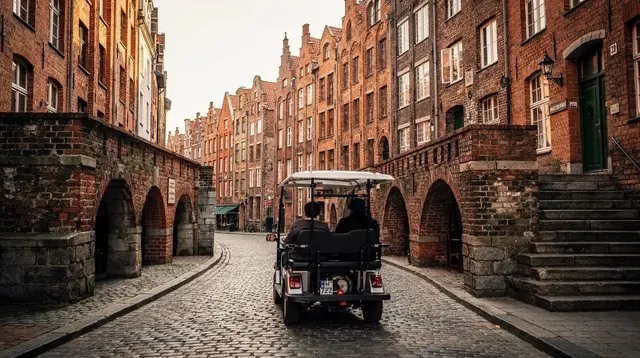
- the street running from St Mary’s Basilica down to the old riverfront, lined with ornamental stone porches - grew into the amber-dealers’ street precisely because that is where the material and the trade routes met.
The Amber Museum, a short walk away inside the medieval Foregate, exists to tell that longer story properly, with real specimens, insect inclusions, and an explanation of how the resin actually formed - worth pairing with a wander through the surrounding lanes on a private Old Town tour that takes in the Amber Museum, or on your own using our Old Town walking tour guide.
Getting the vocabulary right before you buy
None of this is only trivia. Getting the vocabulary right changes how you shop. Ask for “fossil resin” or “Baltic amber,” not “the mineral” or “the stone,” and a reputable dealer will immediately register that you know what you are looking at. Reputable sellers on and around Mariacka will offer a certificate of authenticity with a piece of any real value, because synthetic and reconstructed amber does circulate, and telling them apart by eye alone is genuinely hard even for people who have handled the real thing for years - our guide to spotting real amber goes through the practical tests dealers actually use.
It is the same instinct worth applying anywhere in the Old Town, alongside the broader precautions in our Gdańsk tourist scams guide. Smaller stalls often price more casually and expect a bit of negotiation; that is normal here and nothing to feel awkward about, and it is covered alongside other money-saving habits in our Gdańsk budget travel guide.
If you want the fuller context before you buy - how to tell real amber from imitation, and what the certificate should actually say - it is worth reading before you shop rather than after. It also helps to see the material’s actual age and origin laid out properly rather than picking it up secondhand from another tourist on the street, the way I first did.
I left Gdańsk with a small amber pendant, and I will admit the price was not what sold me on it. It was the forest. Forty million years is a strange thing to hold between two fingers on a street corner in Gdansk, and it is worth knowing that is exactly what you are doing.
Amber in Gdańsk: frequently asked questions
Is Baltic amber a gemstone or a mineral?
Neither, strictly speaking. Amber is fossilised tree resin - an organic material, not a mineral formed through geological crystallisation. Jewellers commonly call it a gemstone for convenience, but geologically it belongs in its own category as a fossil.
How old is the amber sold in Gdańsk?
Most Baltic amber is estimated at around 40 million years old, dating back to forests that grew in a much warmer northern Europe long before the Baltic Sea took its current shape.
Is amber mined in Gdańsk or nearby?
No mining happens on Mariacka or in the city itself. Amber is collected from beaches after storms wash it ashore, and it is also dredged commercially from shallow areas of the Baltic Sea. Some inland extraction does occur elsewhere in the wider region, but the material sold in Gdańsk’s shops is overwhelmingly sea-sourced.
Why is Gdańsk historically associated with amber?
The Baltic coast holds one of the world’s largest natural concentrations of amber, and Gdańsk’s position at the mouth of the Motława and Vistula made it the region’s natural trading hub. The city anchored the historic Amber Road, a trade route that carried Baltic amber south toward the Mediterranean for centuries.
How can I tell real amber from a fake on Mariacka?
Look for a dealer offering a certificate of authenticity, be wary of prices that seem too low for the piece’s size, and ask directly whether it is natural, pressed, or reconstructed amber - reputable sellers will answer plainly. A dedicated guide to spotting real amber is worth reading before you shop.
What is the Amber Road?
The Amber Road was an ancient trade network moving Baltic amber south toward the Mediterranean and Rome in exchange for other goods. Gdańsk’s position on the coast made it a key point along that route, and the trade helped shape the city’s early wealth - a good detour to pair with an Old Town day plan if Mariacka and the Amber Museum are both on your list.
Is Mariacka street the only place to buy amber in Gdańsk?
It is the most historic and best-known, with ornamental stone porches lined with amber stalls and small galleries, but amber shops and workshops are found elsewhere in the Old Town too, and the Amber Museum in the Foregate offers context rather than sales.
Does amber ever contain trapped insects or plant matter?
Occasionally, yes. Because amber is fossilised resin, some pieces preserve air bubbles, plant fragments, or, rarely, small insects that were caught in the resin while it was still liquid millions of years ago. These inclusions are part of what makes each piece genuinely unique, and it is often the detail that makes amber shopping land well with children too - see our Gdańsk with kids guide for how families tend to enjoy the Amber Museum’s specimens.
tours.Explainer
Verified deep-linked GetYourGuide tours. Book through these links and we earn a small commission at no cost to you.
GetYourGuide does not provide a product photo for this activity — the image shows the meeting point, photographed by us.