The Baltic Is Not the Mediterranean, and That's Fine
What I actually got wrong before my first trip
I’ll admit it: the first time I looked at a map of Gdansk and saw the Baltic coast running alongside it, some lazy part of my brain filed it under “beach holiday.” Sand, sea, a few weeks of summer heat, towels lined up on loungers. I’d seen photos of Sopot’s pier stretching out over blue-grey water and assumed it was a northern cousin of the Cote d’Azur. It isn’t, and the sooner a visitor drops that comparison, the better their trip goes.
The Baltic Sea off Gdańsk, Sopot and Gdynia is a cold, brackish, tide-light northern sea. Even in the warmest stretch of August, water temperatures typically sit around 17-20 degrees Celsius, and that’s on a calm day. Let the wind pick up, which it does often on this coast, and the number drops within hours as colder water churns up from below. I’ve waded in on a bright, genuinely hot afternoon in July and come out again inside three minutes, skin tingling, entirely satisfied with the experience but under no illusion that I’d just had a Mediterranean swim.
The comparison that keeps setting visitors up to fail
I understand why the comparison happens. Beach, pier, sand, “seaside town” — the vocabulary overlaps with the Adriatic or the south of France, so the brain reaches for the nearest template. But the template is wrong, and importing it wholesale is exactly what leads to disappointed reviews about a “cold, grey beach holiday.” Read enough of them and a pattern emerges: people who came expecting the Cote d’Azur and got the Baltic instead, rating the destination down for not being something it never promised to be. Sopot is not Saint-Tropez, and treating it as an inferior version of a warm-water resort misses what it’s actually good at.
What it’s good at is different, not lesser. The sand along this coast is some of the finest and widest I’ve walked on anywhere in Europe, and it’s backed by pine forest rather than a wall of hotels and sun loungers. Walking the beach path between Sopot and Gdynia with pine needles underfoot and that resinous smell in the air is a completely different sensory experience from a Mediterranean promenade lined with palms and parasols. The beach here is a place for a long walk, a windswept picnic, a genuinely cold and bracing dip, and then a coffee somewhere warm — not a place to lie still for six hours.
The thing nobody mentions: the light
Here’s what actually won me over, and it has nothing to do with water temperature. This far north, June evenings barely end. The sun is up before 4:30am and doesn’t properly set until well past 9pm, so a dinner on the Motława riverfront or a walk out along Sopot’s pier happens in that long, soft, golden hour that in southern Europe lasts twenty minutes and here seems to last most of the evening.
I sat on the beach near Sopot at 8:45pm in June, fully expecting dusk, and the sun was still well above the horizon, throwing long shadows across the sand. It changes the whole rhythm of a summer visit — dinners start later, walks happen after what would be bedtime further south, and the days feel enormous. That light, not the sea temperature, is the real seasonal gift of this coast.
What the sea is actually for here
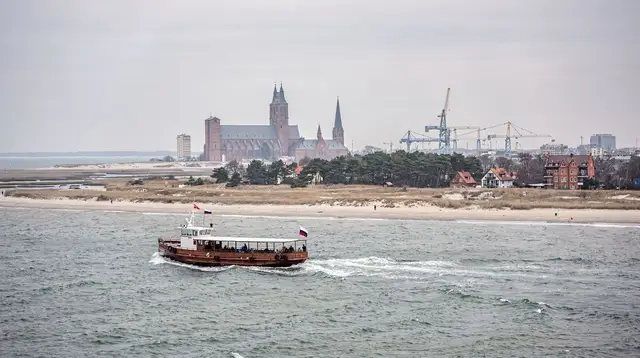
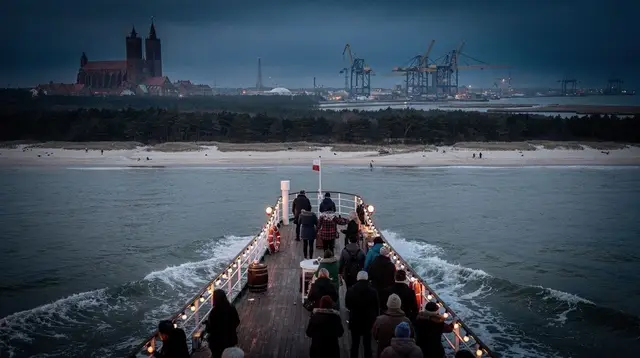
I’ve come to think of the Baltic in Gdańsk less as a destination in itself and more as a backdrop and a stage for other things. It’s a backdrop for the Old Town’s red-brick gables reflected in the Motława. It’s the reason a short boat cruise out toward the Baltic Sea is worth doing, gliding past Westerplatte with the wind in your face rather than swimming laps offshore. On a catamaran breakfast cruise out of Gdańsk or Sopot, watching the coastline slide past over coffee, the sea reads as scenery and transport, not immersion.
a short cruise from Gdańsk out onto the Baltic Sea gave me exactly that: an hour of wind, gulls, and a proper look at the coastline from the water, no swimsuit required. If you want something faster and punchier, a high-speed boat ride on Gdańsk Bay, departing from Sopot turns the same stretch of water into thirty minutes of genuine adrenaline rather than a leisurely float.
And for a slower morning on the water, a breakfast cruise by catamaran out of Gdańsk or Sopot is the version where the sea is company for a meal, not the main event.
So what should you actually come for
Come for the architecture: a city centre that was flattened in 1945 and rebuilt gable by gable, a reconstruction so careful it fools most visitors into thinking it’s untouched medieval fabric — it isn’t, and that story is worth reading before you arrive. Come for the twentieth century laid bare, from the shipyard gates where Solidarity began to Westerplatte where the Second World War started.
Come for Gdynia’s startling run of 1930s modernist buildings, a whole city built almost from nothing between the wars. Come for the pier walks, the pine-backed sand, and those long June evenings. Don’t come expecting to spend a week horizontal on a beach chair working on a tan, because that holiday isn’t on offer here and never was.
If you do want a proper look at the coastline itself, I’d pair a short cruise with a walk rather than treating either as a full day. A morning on Sopot’s beach, an afternoon boat out toward the bay, and an evening back in the Old Town for dinner in that endless June light is a better shape for a day here than anything modelled on a Mediterranean itinerary. The Hel Peninsula stretches the same logic further along the coast if you have time for it.
The one-line version
The Baltic isn’t a lesser Mediterranean, it’s a different sea entirely, and Gdańsk isn’t a beach resort that happens to have some history attached — it’s a history-dense, light-drenched northern city that happens to sit on a genuinely beautiful, genuinely cold sea. Come for what’s actually here, and skip the disappointment of chasing what isn’t.
FAQ: swimming, weather and beaches on the Baltic near Gdańsk
Is the Baltic Sea near Gdańsk warm enough to swim in during summer?
Yes, but expect a bracing dip rather than a warm bath. Water temperatures peak around 17-20 degrees Celsius in August, and a windy afternoon can pull that down further within hours.
When are the beaches near Gdańsk at their busiest?
June through August, with a peak in July and August when schools are out and daytime temperatures are highest, even though the sea itself stays cool throughout.
Why does it stay light so late in Gdańsk in summer?
Gdańsk sits at a fairly high northern latitude, so around the June solstice the sun rises before 4:30am and doesn’t set until after 9pm, giving evenings far longer daylight than most of southern Europe.
Is Sopot’s beach sandy or rocky?
Sandy, and quite wide and fine by European standards, backed by pine forest rather than a built-up hotel strip.
Should I plan a beach holiday around Gdańsk instead of a city trip?
Treat the beach as one element of a broader visit rather than the whole point. Most visitors get more from combining a couple of beach walks with the Old Town, the shipyard history and a boat trip than from a pure sun-and-sand week.
Is the Baltic coast colder than the Adriatic or the Mediterranean?
Considerably. Mediterranean and Adriatic waters commonly reach the mid-to-high 20s Celsius in summer, while the Baltic off Gdańsk rarely climbs past 20 degrees even at its warmest.
What’s the best way to see the sea without swimming in it?
A short boat cruise out of Gdańsk or Sopot, a walk along Sopot’s wooden pier, or a fast boat ride on Gdańsk Bay all let you experience the water without needing it to be warm.
Hel peninsula cruises
Verified deep-linked GetYourGuide tours. Book through these links and we earn a small commission at no cost to you.
GetYourGuide does not provide a product photo for this activity — the image shows the meeting point, photographed by us.