Sopot Is Not Saint-Tropez, and That's the Point
I first heard someone call Sopot “the Polish Saint-Tropez” in a taxi from Gdańsk airport, and I have been quietly annoyed about it ever since. The driver meant it as a compliment, and I understood the impulse: a seaside town with a promenade, some money, some yachts, some sunbathing. But the comparison does something sneaky. It doesn’t just describe Sopot badly.
It replaces what actually makes the town interesting with a picture borrowed from somewhere else, and once that picture is in your head, you stop looking for the real one. Anyone weighing the three towns of the Tricity against each other will get a straighter answer from a proper Gdańsk vs Sopot vs Gdynia comparison than from a borrowed French label.
A spa town, not a resort town
The difference between a resort and a spa town isn’t cosmetic, it’s the reason the place exists at all. Saint-Tropez grew as a fishing village that got discovered by artists and then by yachts; its whole identity is built around leisure arriving from outside. Sopot’s origins are the opposite. It grew up around saline springs and a 19th-century belief, common across Central Europe, that sea air and salt water could cure what ailed you. The first bathing establishment opened in the early 1820s, founded by a French army surgeon named Jean Georges Haffner who had served under Napoleon and settled on this stretch of Baltic coast. That is a spa-town origin story, the same lineage as Karlovy Vary or Baden-Baden, not a glamour-resort one.
You can still feel that history if you know to look for it. The grand villas set back from the front, the emphasis on promenading rather than performing, the spa park behind the pier, all of it reads as Mitteleuropa health culture dressed in seaside clothes. Sopot earned its identity through mineral water and sea bathing prescribed by doctors, decades before anyone thought to compare it to the Cote d’Azur.
Treating it as a Baltic stand-in for the French Riviera erases that entire lineage and leaves you looking at a shallower town than the one that’s actually there. Just up the coast, Gdynia went the opposite way, building an entire interwar port city from scratch rather than growing out of a spa tradition, which makes the contrast between the two towns worth seeing in person.
The pier is the giveaway
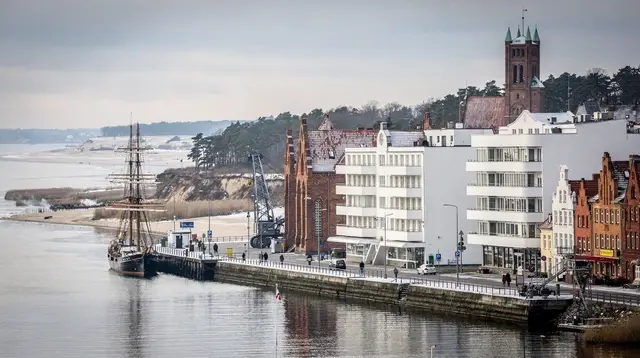
Nothing makes the Saint-Tropez comparison collapse faster than the pier. Sopot’s molo stretches 511.5 metres out into the bay, and it is routinely, correctly, described as the longest wooden pier in Europe. Not the world, and that distinction matters, because I’ve heard “longest in the world” repeated confidently by guides who should know better. The record is European. Longer wooden piers exist elsewhere, but within Europe this one stands alone, and that’s already a striking enough fact without inflating it.
More to the point: a wooden pier built for walking, not a marina built for mooring superyachts, tells you what kind of place this is. You buy a small ticket, you walk out over the water, you watch other people walk out over the water, and on a clear evening you can see the Hel Peninsula curving away to the north. It’s the same stretch of coastline you pass on a private cruise from Gdańsk to Sopot with free time, for anyone who’d rather arrive by water than by taxi. That’s a spa-town ritual, unhurried and communal, closer to a Blackpool or a Brighton than to a Riviera harbour lined with hulls worth more than most houses.
Monciak, and what it actually is
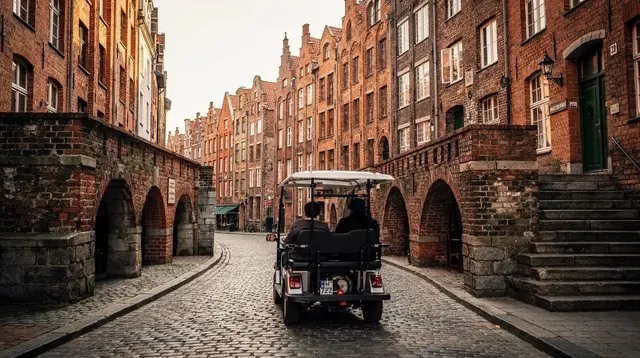
Ulica Bohaterow Monte Cassino, universally shortened to “Monciak” by anyone who actually lives here, is the pedestrian spine running from the train station down to the pier. It gets restaurants, ice cream, street performers, the occasional stag party, and yes, some genuine glitz in high season. I won’t pretend it’s austere. But calling it a Riviera strip misreads what’s happening on it.
Monciak is dense with interwar and postwar architecture, including the building that causes most of the confusion I’m about to untangle, and its energy comes from a very Polish mix of seaside kitsch and inherited elegance, not imported glamour. A slower walk down the street is exactly what a proper Sopot walking tour is built around, and after dark the street shifts into the scene covered by the Sopot nightlife guide.
The crooked house everyone misattributes
This is the part I actually sat down to write about. The Krzywy Domek, the “crooked house” on Monciak with its rippling, melted-looking facade, is Sopot’s most photographed building and its most misattributed one. I have lost count of how many articles, captions and casual conversations credit it to Antoni Gaudi. It did not happen. Gaudi died in 1926. The building opened in 2004, designed by Polish architects Szotynscy and Zaleski, and its visual language draws specifically on the whimsical, fairy-tale illustrations of Jan Marcin Szancer, a Polish artist and book illustrator whose drawings shaped the imagination of generations of Polish children.
I understand where the Gaudi instinct comes from. His work in Barcelona also avoids straight lines and plays with organic, dripping forms, so the visual family resemblance is real. But resemblance isn’t ancestry, and pinning the building to a famous Spaniard does something quietly unfair: it erases a specifically Polish creative reference in favour of a more internationally recognisable name. Szancer’s illustrations are the actual source, and that detail is worth getting right, both because it’s true and because it’s more interesting than the shortcut.
What gets lost in the shorthand
None of this is really about correcting a factual error for its own sake, though I do think 511.5 versus “longest in the world,” and Szancer versus Gaudi, are worth getting straight. The bigger issue is what the Saint-Tropez label does to how people experience the town.
If you arrive expecting a Baltic Riviera, you’ll spend your visit measuring Sopot against a beach it was never trying to be, and Baltic water that tops out around 18 to 20 degrees Celsius even in August will feel like a letdown rather than what it is: a bracing, genuinely northern sea. It’s worth reading why the Baltic coast is not the Mediterranean before setting expectations, and a look at a proper Baltic swimming guide helps too.
Arrive instead expecting a Central European spa town with its own 200-year history, a record-holding wooden pier, a lively pedestrian street with real architectural range, and one very good, very misunderstood crooked building, and Sopot has nothing to apologise for. It doesn’t need to borrow glamour from the south of France. It has its own. Anyone building a trip around it can pair Gdańsk and Sopot over a couple of days with this Gdansk-Sopot two-day itinerary, and a look at where to base yourself, covered in where to stay in Gdansk, makes the choice easier before booking anything.
Sopot, Saint-Tropez and the crooked house: questions I keep getting asked
Is the Sopot pier really the longest in Europe?
Yes. At 511.5 metres, Sopot’s wooden pier is widely recognised as the longest wooden pier in Europe. It is not the longest wooden pier in the world, a distinction sometimes wrongly attached to it.
Did Antoni Gaudi design the Krzywy Domek?
No. Gaudi died in 1926, decades before the building existed. The Krzywy Domek opened in 2004, designed by Polish architects Szotynscy and Zaleski, inspired by the illustrations of Polish artist Jan Marcin Szancer.
Why is Sopot sometimes compared to Saint-Tropez?
The comparison usually points to Sopot’s beach, its promenade culture and some upscale bars and restaurants along Monciak. The comparison overlooks that Sopot developed as a 19th-century saline spa town, not a Riviera resort built around yachting and celebrity culture.
What does “Monciak” mean?
“Monciak” is the local nickname for ulica Bohaterow Monte Cassino, Sopot’s main pedestrian street running from the train station to the pier, lined with restaurants, bars and shops.
Is the Baltic Sea at Sopot warm like the Mediterranean?
No. Baltic water off Sopot typically peaks around 18 to 20 degrees Celsius in August, noticeably cooler than the Mediterranean even at the height of summer.
Do you have to pay to walk on the pier?
Yes, a small entry fee applies in season, though it is often reduced or unenforced outside the summer months. There is no need to book in advance.
What makes Sopot a spa town rather than a beach resort?
Sopot grew up around 19th-century saline springs and sea-bathing treatments, founded by French army surgeon Jean Georges Haffner in the 1820s. That health-focused origin, closer to Baden-Baden or Karlovy Vary, shaped its parks, villas and promenade culture long before mass tourism arrived.
Is Sopot part of Gdańsk?
No. Sopot is its own city, sitting between Gdańsk and Gdynia as part of the Tricity conurbation along the Baltic coast, connected to both by frequent commuter trains, and the fastest way to move between the three is the SKM line covered in this guide to getting around the Tricity.
tours.Opinion
Verified deep-linked GetYourGuide tours. Book through these links and we earn a small commission at no cost to you.
GetYourGuide does not provide a product photo for this activity — the image shows the meeting point, photographed by us.