Gdańsk Safety and Tourist Scams: A Practical Guide
Is Gdańsk safe for tourists?
Gdańsk is a major European tourist destination and carries the same general precautions as any busy city centre — watch belongings in crowds, use official taxis or ride-hailing apps, and validate the correct transport ticket. There is no unusual danger specific to Gdańsk beyond ordinary urban common sense.
Most travellers arrive in Gdańsk asking a fairly ordinary question: is this city safe, and what should I actually watch out for? The honest answer is that Gdańsk is a large, well-established European tourist destination with all the usual big-city common sense required and nothing more unusual than that. This guide sets out the practical precautions worth knowing, the handful of tourist pitfalls that do come up, and one geographic detail that catches out a surprising number of visitors: the nearby Russian exclave of Kaliningrad, which is not the casual side trip it might look like on a map.
The general picture
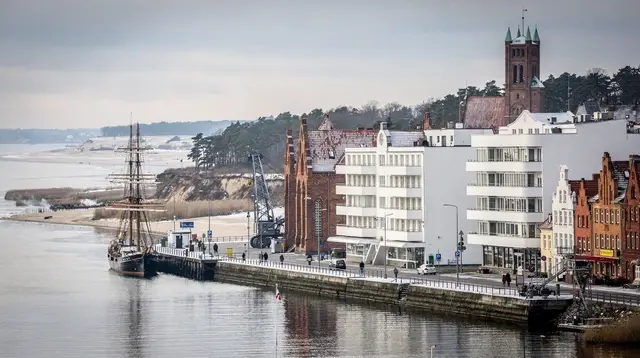
Gdańsk, together with Sopot and Gdynia in the wider Tricity, functions as any major Northern European city does: a historic core built around Dlugi Targ and the Motlawa riverfront that draws heavy foot traffic year-round, a modern public transport network, and a hospitality industry well used to international visitors.
There is no reliable basis in the sources behind this guide for citing crime statistics, and this page deliberately does not invent any — travellers looking for hard numbers should consult their own government’s travel advisory for Poland, which is updated more often than any guidebook page can be. What follows instead is the kind of practical, common-sense advice that applies to Gdańsk specifically, based on how the city actually works.
The core rule that covers most situations: treat Gdańsk with the same baseline awareness you would bring to any busy European city centre. Keep bags zipped and in view on crowded streets and public transport, don’t leave phones or wallets unattended on cafe tables, and use a card or contactless payment where possible rather than carrying large amounts of cash — card payments are near-universal in Gdańsk shops, restaurants and even market stalls.
It is also worth being honest about what this page is not. It is not a substitute for an official government travel advisory, which is updated in real time and reflects diplomatic and consular information no travel guide has access to. It is a description of the ordinary, everyday friction a visitor is actually likely to encounter — ticketing confusion, an overpriced taxi, an amber stall cutting corners — rather than an assessment of geopolitical risk. Anyone planning a trip close to travel-advisory season, or with specific concerns about the wider region, should check that advisory directly rather than relying on any single article.
Where crowds concentrate, stay alert
Pickpocketing risk anywhere in the world tracks foot traffic and distraction, not any particular danger in the destination itself. In Gdańsk, that means the places worth a little extra attention are exactly the places every visitor wants to be: Dlugi Targ at midday, the amber stalls along Mariacka street, the Motława waterfront near the Żuraw crane, and the queues outside St Mary’s Basilica tower.
During St Dominic’s Fair in August, when the Old Town fills with stalls and dense crowds for around three weeks, the same logic applies at a larger scale — a bag worn across the body and a hand on valuables in tight crowds is a reasonable habit, not paranoia.
Nightlife areas in the Old Town and in Sopot get busy and loud late in the evening, particularly in summer. As in any city, it’s sensible to know how you’re getting home before a night out gets going, to keep track of drinks, and to be a bit more cautious walking through quieter side streets once the main strips have emptied out.
Restaurant and bar bills around the busiest tourist streets deserve a quick glance before paying, as they do in any heavily visited city centre. It is not a widespread problem in Gdańsk specifically, but a menu without visible prices, a cover charge added without being mentioned up front, or a bill that does not match what was ordered are all reasons to ask for an itemised receipt before paying — a request no legitimate business will refuse. Most restaurants in the Old Town and along the Motława are straightforward and well used to tourist footfall, and this is a minor precaution rather than a common complaint.
Transport: the ticket confusion that actually happens
The one genuinely Gdansk-specific pitfall worth flagging isn’t a scam at all — it’s a ticketing structure that trips up first-time visitors. The Tricity’s public transport runs on more than one system, and they are not interchangeable:
| System | What it covers | Ticket notes |
|---|---|---|
| SKM (Szybka Kolej Miejska) | Commuter rail along the coast: Gdańsk, Sopot, Gdynia and beyond | Sold at station machines and apps; time-validity based |
| PKM (Pomorska Kolej Metropolitalna) | Newer rail line extending further south of the Tricity | Separate network from SKM |
| Trams and buses | City routes within Gdańsk, Sopot and Gdynia | Sold by time validity (20/40/60/90 min, or 24-hour passes), not by number of stops |
An SKM train ticket does not automatically cover a tram or bus, and vice versa, even though some combined tickets exist for certain zones — always check what a machine or app is actually selling before boarding, and validate the ticket as instructed. Riding without a valid, validated ticket for the specific system you’re on is treated as fare evasion and can mean an on-the-spot fine from an inspector, regardless of whether the mistake was genuine confusion. The safest habit for visitors relying on public transport across getting around the Tricity is to buy the ticket type that matches the specific leg of the journey, every time, rather than assuming one ticket does everything.
Ticket inspectors on SKM trains and Tricity trams do carry out routine, regular checks, and it is worth knowing what a genuine inspector looks like: they carry a visible identification badge and, on request, will show it before asking to see a ticket. This is standard, unremarkable practice, not a sign that something has gone wrong — the only real risk is boarding without a validated ticket in the first place, which a moment spent at the machine before departure avoids entirely.
Unlicensed taxis waiting outside Gdańsk Lech Wałęsa Airport or at Gdańsk Glowny station are the other recurring complaint, usually in the form of inflated flat fares quoted before the meter runs, or no meter at all. Licensed taxis and mainstream ride-hailing apps are the straightforward alternative, and both are widely used in Gdańsk.
A related, and genuinely useful, precaution: Poland is not in the eurozone, and currency is worth handling before it becomes a problem rather than after. ATMs attached to recognised Polish banks near the Old Town, the airport and Gdańsk Glowny station are the reliable option; standalone currency machines in heavily touristed spots sometimes offer a “guaranteed rate” in a home currency that is quietly worse than simply letting the card network convert at the interbank rate. The practical rule is simple and works everywhere in Poland: when a card terminal or ATM asks whether to charge in zloty or in a home currency, choosing zloty avoids the markup built into the alternative.
Amber: a real product worth buying carefully
Amber is Gdańsk’s signature product, and Mariacka street is its historic trading lane, but the fact that it’s a genuine natural material with real market value is exactly why it’s worth a little care when buying. Reputable dealers and the shops clustered around the Amber Museum in the medieval Foregate provide a certificate of authenticity with anything sold as genuine Baltic amber. Extremely cheap pieces at informal stalls, sellers unwilling to explain what you’re buying, or pressure to decide quickly are all reasons to slow down — negotiate at smaller stalls if you like, but ask questions first.
It is also worth knowing that amber, as fossilised tree resin rather than a mined gemstone, has genuine variation in colour, clarity and inclusions that affects price honestly — a piece with visible insects or plant matter trapped inside, for instance, commands a premium precisely because it is rarer, not because it has been marked up arbitrarily. A dealer who can explain why one piece costs more than another, in terms of the material itself, is generally a more trustworthy one than a stall offering a flat price for anything on the table.
The Kaliningrad question
Anyone looking at a map of the region notices it quickly: Gdańsk sits roughly 130km from Kaliningrad, a Russian exclave wedged between Poland and Lithuania on the Baltic coast. It can look, at a glance, like an easy add-on to a Baltic coast trip. It is not, and this is worth stating plainly rather than glossing over.
Kaliningrad lies outside the Schengen area and outside the European Union entirely — it is Russian territory, administratively separate from the rest of Russia, but subject to full Russian entry rules. Travelling there requires a Russian visa arranged in advance through the normal channels; there is no visa-free arrangement, no simple border-crossing card, and no way to treat a Kaliningrad visit as a casual day trip the way a traveller might treat a hop between two Schengen countries.
Visa processing, current entry requirements and the broader state of relations around this particular border all change, sometimes quickly, so anyone seriously considering the trip should check their own country’s current travel advisory and Russian visa requirements directly rather than relying on any single guide, this one included. For the large majority of visitors to Gdańsk, Kaliningrad is worth knowing about as a fact on the map — not as a realistic addition to the itinerary.
Distance on a map is also a poor guide to travel time here. Even setting the visa question aside entirely, there is no direct road or rail crossing designed for casual tourist traffic between Poland and Kaliningrad Oblast at present, and any legitimate route involves formal border procedure on both sides.
This page will not describe a route, a crossing point or a workaround, because none exists that a tourist without a Russian visa can use — the honest answer to “how do I get to Kaliningrad from Gdańsk” is that, for most visitors, the trip is not currently practical to plan at all, and this guide would rather say so plainly than gesture vaguely at a border that functions very differently from the open Schengen crossings elsewhere in the region.
Is it possible to see Kaliningrad from Gdańsk without crossing the border?
No — Kaliningrad Oblast is not visible from Gdańsk or the Tricity coastline, and there is no viewpoint, boat trip or coastal lookout on the Polish side that offers a glimpse of Russian territory. The exclave lies well beyond the horizon up the coast, past the Hel Peninsula and the Polish-Russian land and sea border itself; travellers curious about the region are better served by reading about it than by expecting any visual payoff from Gdańsk, Sopot, Gdynia or even Hel.
What should I do if I lose my passport or have it stolen in Gdańsk?
Report the loss to the nearest police station first, since a police report is generally required for a replacement travel document and may be needed for insurance claims as well. Then contact your country’s nearest consulate or embassy — most EU citizens can typically get an emergency travel document relatively quickly, while non-EU visitors should expect the process to take longer and should contact their embassy as early as possible. Keeping a photo or photocopy of the passport’s information page, stored separately from the original, makes this process considerably faster regardless of nationality.
Practical basics worth knowing
A few small, verifiable facts round out the picture and prevent avoidable friction:
- The emergency number throughout Poland, including Gdańsk, is 112.
- Tap water in Gdańsk and the Tricity is generally considered safe to drink.
- Sockets are standard European type C/E at 230V, so UK and non-European visitors need an adapter.
- Poland uses the zloty (PLN), not the euro — see how to pay in Poland for the practical detail, since assuming euros are accepted is itself a common and avoidable mistake.
- English is widely understood among younger residents, hospitality staff and in tourist-facing businesses, less so among older generations away from the centre — a translation app is a reasonable backup, not a necessity.
- Poland’s road rules apply to pedestrians too: jaywalking away from a marked crossing is technically an offence and can, in principle, draw a fine, though enforcement against tourists is not a notable issue — it is simply worth using marked crossings out of habit, particularly around tram lines where a silent-approaching tram is easy to miss.
- Pharmacies (apteka) are widely available in the centre and clearly marked with a green cross; a rotating night pharmacy stays open after normal hours in most areas, with the current one usually listed on the door of the nearest daytime pharmacy.
Seasonal timing changes the picture slightly too. In the height of summer, when St Dominic’s Fair and beach crowds in Sopot and along the coast bring the year’s densest foot traffic, the ordinary crowd-awareness advice above matters most.
In the depths of winter, the practical risk shifts from crowds to weather: icy pavements on cobbled Old Town streets, shorter daylight hours meaning more of the day is spent walking in the dark, and reduced service on some seasonal boat and coastal transport options. Neither season changes the underlying picture that Gdańsk is a low-risk, well-organised destination — but dressing for the weather and allowing a little more time for icy or crowded stretches is sensible in either extreme.
Seeing the city without the guesswork
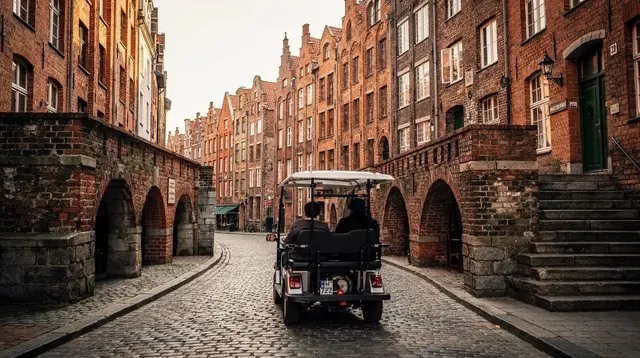
For visitors who would rather have a fixed itinerary and a guide handling logistics than navigate Old Town crowds and ticket machines solo, a structured tour removes most of the friction covered above in one go. A golf cart sightseeing tour of the Old Town covers the historic centre with a local driver handling the route, while an Old Town golf cart tour paired with unlimited beer adds a relaxed social element for those less worried about navigating independently.
On the water, a Motława river cruise with optional food and drink is a low-effort way to see the waterfront from a different angle, and travellers wanting to combine Gdańsk with Sopot can look at a private catamaran cruise between Gdańsk and Sopot for a guided, scheduled alternative to figuring out transport connections alone.
The bottom line
Gdańsk does not require special precautions beyond what any experienced traveller already applies to a busy European city: watch belongings in crowds, use licensed transport, buy the right ticket for the system you’re riding, and buy amber from dealers who can back up what they’re selling. The one detail genuinely specific to this corner of the map is Kaliningrad — a striking, close-looking Russian exclave that is, in practical terms, much further away than 130km suggests once Schengen borders and visa requirements are factored in. Treat it as a fact worth knowing, not a plan to make on the day, and the rest of a Gdańsk trip is exactly as straightforward as the city’s reputation suggests.
Trip planning
Verified deep-linked GetYourGuide tours. Book through these links and we earn a small commission at no cost to you.
GetYourGuide does not provide a product photo for this activity — the image shows the meeting point, photographed by us.