How to Spot Real Amber in Gdańsk
How can I tell if amber sold in Gdańsk is real?
No single home test is foolproof, but genuine Baltic amber is noticeably light for its size, feels slightly warm rather than cold to the touch, and is sold with a certificate by an established Mariacka street or Old Town shop rather than an unnamed street stall. Combine several signs and buy from a seller who explains what you are looking at, rather than trusting one trick alone.
What you are actually buying
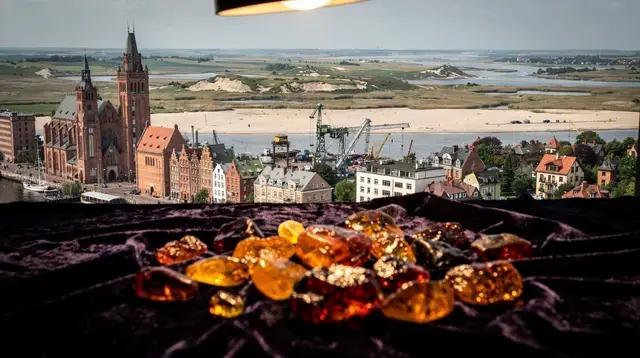
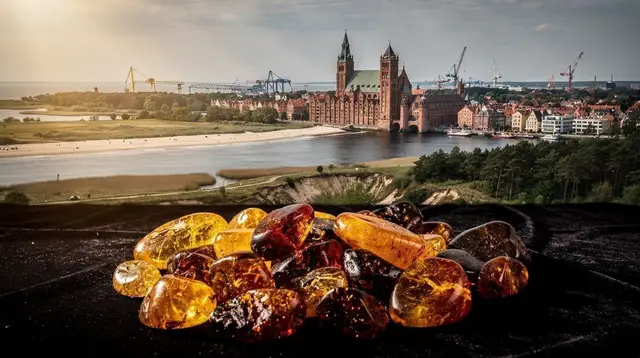
Amber sold along Mariacka street and in the Old Town’s workshops is not a mined gemstone. It is fossilised tree resin, formed roughly 40 million years ago when conifer forests around the Baltic oozed sap that trapped air, bark, the occasional insect, and slowly hardened over geological time into the material now dug, dredged and beachcombed from the region’s coasts and shallow deposits.
That distinction matters for a buyer for a simple reason: amber behaves nothing like the glass or crystalline gems most people are used to judging by eye, and the synthetic and plastic imitations flooding souvenir shelves across Europe are made to mimic its colour and shine, not its underlying physical properties. No trick in this guide is a guarantee. Used together, and paired with buying from a shop that can stand behind what it sells, they meaningfully improve the odds of walking away from Mariacka street with the real thing.
This guide sets out what genuine Baltic amber tends to look, feel and weigh like, what questions to ask a seller, and why where you buy matters as much as what you inspect. It does not promise a foolproof method. Full certainty about a piece of amber generally requires laboratory testing — infrared spectroscopy is the standard technique conservators and gemmologists use — which is well beyond what any visitor can do standing at a counter. What follows is practical, general-sense guidance, the kind a careful shopper can actually use in the ten minutes before deciding whether to buy.
Why it is not a mined gemstone
It is worth repeating because the phrase “amber mine” gets used loosely and misleadingly. Diamonds, gold and most gemstones sold as jewellery are extracted from rock through mining, a process of digging into mineral deposits formed by geological heat and pressure. Amber is different at a basic level: it started as a liquid resin secreted by ancient trees, and became amber through a slow chemical hardening process — polymerisation — as it was buried, not through the mineral crystallisation that produces a diamond or a sapphire.
Some Baltic amber today does come from licensed extraction operations that dig into amber-bearing sediment layers, and calling that “mining” in the loosest sense is not entirely wrong, but it is a fundamentally different process from digging ore, and a good deal of the region’s amber historically, and still today, is collected from beaches after storms churn up deposits from the seabed. The Amber Museum, housed in the medieval Foregate near St Mary’s Basilica, covers this formation and history in detail and is worth an hour before or after a shopping trip on Mariacka, since it makes the checks below easier to apply with some context.
The checks a shopper can actually make
None of these is a scientific test, and none should be relied on alone. Taken together, and combined with buying from a seller willing to talk you through a piece, they are the closest thing to a practical field method a visitor has.
| Check | What genuine amber typically does | What that does not prove |
|---|---|---|
| Weight in hand | Feels distinctly light for its size, lighter than glass and most plastics | A very light plastic bead can still feel light; weight alone is not conclusive |
| Warmth to touch | Warms quickly against skin rather than staying cold | Many materials warm up with contact; this is a weak signal on its own |
| Surface and shine | A slightly resinous, warm lustre rather than a hard, glassy sparkle | Polished plastic can be shined to a similar gloss by a skilled seller |
| Colour range | Genuine pieces span pale lemon through honey, cognac and deep cherry, often with natural variation within one piece | Uniform, perfectly even colour across a whole strand can be a flag, but dyed real amber also exists |
| Cracks and crazing | Small natural surface cracks or a slightly uneven finish are common and not a defect | Their absence does not mean fake; well-finished amber can look very clean |
| Tooling marks | Handmade settings and slightly irregular shapes suggest workshop production | Machine-perfect uniformity across a large batch is more typical of mass-produced imitations |
| Certificate offered | An established seller offers or has ready a certificate of authenticity | A printed certificate from an unknown source is not proof by itself — the seller’s standing behind it is what matters |
Weight is the single most useful everyday check, because it is the hardest property for a cheap imitation to fake convincingly and the easiest for a buyer to judge without any tools: a pendant or a strand of beads that feels heavier than its size suggests is worth a second look. Warmth is a softer signal — real amber tends to feel slightly warm rather than cold within seconds of skin contact, where glass and some plastics stay cool longer — but it works best as a tie-breaker alongside weight, not as a test on its own.
None of these checks amounts to a chemical or laboratory test, and this guide deliberately does not describe one: several traditional “tests” involve heat, flame or solvents applied directly to a piece a buyer does not yet own, which risk damaging genuine amber and are not something to attempt on somebody else’s stock in a shop.
Where to buy matters as much as what you inspect
The single most effective thing a visitor can do to improve their odds is choose where to buy, not just what to inspect once there. Mariacka street, running from the basilica down to the Motława riverfront, is lined with amber workshops set back behind ornamental stone porches — it has been the city’s amber-dealers’ street for generations, and the concentration of long-established, named businesses there is exactly what makes it a safer starting point than an anonymous stall.
A shop with a fixed address, a business name, and staff willing to explain a piece’s origin, grade and price is accountable in a way an improvised table set up for a weekend market is not. If something turns out to be misrepresented, a real shop can be found again; a stall that packs up and moves on cannot.
This applies as much around Długi Targ and the wider Old Town as it does on Mariacka itself — several jewellers with decades of trading history operate away from the amber street specifically, and the same standard applies wherever you shop: a certificate, a name on the door, and a seller who answers questions rather than deflecting them.
It is also worth building amber shopping into a slower visit rather than a rushed final-day dash — a first visit to Gdansk benefits from allowing at least an afternoon to browse several shops and compare pieces, rather than making a single hurried purchase on the way to the train. For visitors who would rather understand the craft before buying, several amber jewellery workshops around the Old Town let you watch or try the setting process firsthand, which is a genuinely useful way to calibrate your eye before spending on a finished piece.
Combining a shopping stop with expert context works well as a single outing: a private Old Town walk that includes dinner and a guided stop at the Amber Museum puts the history and formation of amber in front of you before you are standing at a counter making a decision, which is a useful order to do things in.
A similar option, a private Amber Museum and Old Town tour with tickets included, covers the same ground for visitors who would rather skip the meal and focus on the museum and walking route. Neither tour is a substitute for the buying advice above, but both make the museum’s context easier to absorb than a solo visit squeezed between shops.
What a good seller should be able to tell you
An established shop should be willing to discuss, without hesitation, where a piece’s amber broadly originated, roughly how it was worked, and what grade or clarity it is being sold as. That openness is itself a useful signal, separate from anything about the piece’s physical properties: a seller who answers questions plainly is behaving differently from one who deflects or rushes a sale.
Ask whether a certificate is included, and if the piece is set in silver, ask whether the silver is stamped — genuine sterling silver settings usually carry a hallmark, and their absence on a piece otherwise described as silver is worth asking about directly rather than assuming. None of this is a test of the amber itself, but a shop’s willingness to be specific, rather than vague, tends to track with how much they stand behind what they sell.
It is also reasonable to ask to see a few pieces side by side and compare weight and colour directly — a shop confident in its stock will not mind, and doing this across two or three shops on the same afternoon is often more informative than any single check performed once. This is also a good moment to be aware of common tourist mistakes in Gdansk more broadly, since rushed, pressured buying decisions are as much a risk in an amber shop as anywhere else in the Old Town, and a seller pushing hard for an immediate decision is a signal worth noticing on its own.
On price: there is no universal figure
Resist any claim, from a seller or otherwise, of a fixed reference price for amber “per gram” or per piece that applies across the board. Genuine amber’s price depends on size, clarity, colour rarity (deep cherry and certain milky or butterscotch tones command more than pale honey), the complexity of the setting, and whether it is handmade or mass-produced — the same weight of amber can sell for very different sums depending on these factors, and none of that variation says anything by itself about authenticity.
A price that looks surprisingly low for a large, clean, well-set piece is a reason to ask more questions about where it came from and what it is graded as, not a rule that a lower price automatically means fake, nor that a higher one guarantees real. If budgeting for a purchase, it helps to think in terms of what you are comfortable spending overall rather than chasing a specific number — the budget guide to Gdansk and the general guide to paying in zloty and by card are useful background for planning a visit that includes a meaningful amber purchase, since most established shops take cards as readily as cash.
Common imitations, in plain terms
The two materials most often sold as amber when they are not are glass and various plastics, including some resins specifically formulated to mimic amber’s colour and internal texture. Pressed or reconstituted amber — small genuine fragments melted and reformed under heat and pressure into a larger piece — sits in a grey area: it typically does contain real amber material, but is usually priced and sold differently from natural, unpressed pieces, and a reputable shop should say clearly which one you are looking at rather than letting the distinction go unmentioned.
Copal, a younger and softer natural resin that has not fully fossilised, is sometimes sold as amber too; it can look similar at a glance but is chemically and physically different, softer and generally worth less. None of these imitations are dangerous or illegal to sell as long as they are described honestly — the issue is only when something other than natural Baltic amber is sold using the word “amber” without qualification.
Building a shop stop into a wider visit
Amber shopping sits naturally alongside a walk through the rest of the Old Town. Many visitors pair it with the Old Town walking route that runs from Długi Targ down to the Motława waterfront, since Mariacka opens directly off that route between the basilica and the river.
If amber is a priority rather than an afterthought, it is worth allowing time for it specifically when planning how many days to spend in Gdansk, rather than assuming it will fit into the margins of a packed sightseeing day, and worth thinking about where to stay within easy walking distance of the Old Town if unhurried browsing matters to you. A single day covering the Old Town’s highlights, including time for shopping, is realistic on the one-day Gdańsk itinerary, though a more relaxed pace suits amber shopping better than a tightly timed schedule.
For visitors who want the fuller context of amber’s place in the city’s history and economy, the wider background is covered in a companion piece on why amber is not a mined gem, and the amber museums category page lists further options for museum visits and workshop experiences around Gdańsk. General safety guidance for shopping and avoiding overpriced or misrepresented goods in tourist areas is covered in the broader scams and safety guide, which applies to amber exactly as it does to any other souvenir purchase in a busy tourist street.
Frequently asked questions about buying amber in Gdańsk
Is amber a mineral or a gemstone?
Neither, strictly speaking. Amber is fossilised tree resin, roughly 40 million years old in the Baltic region, hardened over geological time rather than crystallised underground. It is organic, not mineral, which is part of why it behaves differently from stones like quartz or garnet in weight and warmth.
Is amber mined like other gems?
No. Baltic amber is not extracted from mines in the way diamonds or gold are. It is collected from marine and coastal deposits, from beaches after storms, from shallow open-pit workings in a few areas of the region, and increasingly from licensed extraction sites, but there is no single “amber mine” behind a piece bought in Gdańsk.
What is the easiest first check for real amber?
Weight is the most reliable everyday clue. Genuine amber is markedly lighter than glass or many plastics of the same size, so a piece that feels heavy for how big it looks is worth a second look. This is a helpful indicator, not a guarantee, and it works best alongside the other checks in this guide.
Does real amber always contain insects or bubbles?
No. Most genuine Baltic amber sold as jewellery has no visible insect inclusions at all; pieces with trapped insects are a small, sought-after minority and priced accordingly. Clarity or cloudiness alone says little about authenticity, since both real and fake amber can be clear, cloudy or bubbled.
Is there a fixed price for real amber in Gdańsk?
No, and be wary of anyone who quotes one. Prices vary hugely by piece size, clarity, colour, craftsmanship and whether it is set in silver, so there is no single reference figure in zloty that separates real from fake. A price that seems unusually low for a substantial, well-set piece is a reason to ask more questions, not a rule that can be applied on its own.
Should I buy amber from a street stall or a shop?
An established shop with a fixed address, on Mariacka street or elsewhere in the Old Town, is the safer choice, because it can issue a certificate, stands behind what it sells and is easy to find again if a problem comes up. An improvised stall with no fixed location offers none of that accountability, whatever the seller claims about the piece.
Can a jeweller confirm amber is real on the spot?
A reputable jeweller can offer an informed opinion based on weight, feel, colour and tooling marks, and many will discuss a piece openly before a customer buys. Full certainty, though, usually needs laboratory testing (infrared spectroscopy is the standard method), which is beyond what any shop visit can deliver — treat a confident in-store opinion as a strong indicator, not a certificate of proof.
Is Mariacka street the only place to buy amber in Gdańsk?
It is the most famous and the most concentrated, lined with amber workshops behind ornamental stone porches, but it is not the only option. The Amber Museum shop, several long-established jewellers around Dlugi Targ, and shops attached to workshops elsewhere in the Old Town all sell amber with the same expectation of a certificate and a traceable business behind the sale.
Amber museum tours
Verified deep-linked GetYourGuide tours. Book through these links and we earn a small commission at no cost to you.
GetYourGuide does not provide a product photo for this activity — the image shows the meeting point, photographed by us.