Lech Wałęsa and Solidarity: The History Behind Gdańsk Shipyard
What is the connection between Lech Wałęsa and Gdańsk?
Wałęsa was an electrician at the Gdańsk Shipyard who led the August 1980 strikes that forced the communist government to legalise Solidarity, the first independent trade union in the Soviet bloc. He won the 1983 Nobel Peace Prize and later served as Poland's president from 1990 to 1995.
An electrician who changed a region
Most visitors arrive at the Gdańsk Shipyard already knowing the outline of the story: a strike, a famous fence, a Nobel Prize. Fewer arrive knowing which parts happened in 1980 and which happened years later, or why that distinction matters. This page sets out the history in order, anchored to the actual places in Gdańsk where it unfolded, so that a walk past Gate No. 2 or an afternoon at the European Solidarity Centre means something more specific than “this is where Solidarity happened.”
Lech Wałęsa is the person most associated with this history, and for good reason, but he was one figure within a much larger movement built by shipyard workers, committee members and ordinary residents of the Tricity. Understanding him means understanding the movement, and understanding the movement means keeping its dates straight.
Before the shipyard gates: Wałęsa’s early years
Lech Wałęsa was born in 1943 in the Kujawy region, well inland from the Baltic coast, and trained as an electrician. He arrived in Gdańsk in the late 1960s and began working at the Gdańsk Shipyard, known at the time under its communist-era name, the Lenin Shipyard, in 1967. He was present, though not yet a leading figure, during the workers’ protests of December 1970, when strikes over food price increases spread along the coast and were met with lethal force by security forces in Gdańsk and Gdynia. That earlier, bloodier episode is a separate chapter from 1980, but it shaped the generation of shipyard workers, Wałęsa among them, who organised a decade later.
Wałęsa’s union activity through the 1970s cost him his job: he was dismissed from the shipyard in 1976 and spent the following years moving between short-term jobs, under surveillance, while staying connected to underground worker organising on the coast. This history matters because it explains why, when the strike began in August 1980, Wałęsa was not on the payroll and had to reach the striking workers from outside.
August 1980: the strike and the fence
On 14 August 1980, workers at the Gdańsk Shipyard walked out, triggered partly by the dismissal of a crane operator, Anna Walentynowicz, close to her pension and respected on the shop floor. Wałęsa, no longer employed there, famously climbed over the shipyard fence to join the strikers and was quickly accepted as a leader of the action.
Within days, the strike had spread well beyond one workplace. Delegates from enterprises across the Tricity and the wider region formed an Inter-Factory Strike Committee, meeting inside the shipyard, and issued a list of 21 demands that went beyond pay and conditions to include the right to form independent trade unions, a demand with no precedent anywhere in the Soviet bloc.
Negotiations with government representatives took place over more than two weeks, watched by international media and, increasingly, by workers in other Polish cities who staged solidarity strikes of their own. The talks concluded at what is now preserved as Gate No. 2 of the shipyard, where, on 31 August 1980, the Gdańsk Agreement was signed. The agreement recognised the right to independent, self-governing trade unions, along with the right to strike and a set of civil concessions. Solidarity, the union that grew directly out of the strike committee, was formally registered later that autumn, becoming the first independent trade union permitted in a Soviet-bloc country.
It is worth being precise about what the Gdańsk Agreement was not: it was not a change of government, not an election, and not the end of communist rule in Poland. It was a labour agreement, remarkable for its content, won at a specific negotiating table that visitors can still see today.
Martial law and the underground years
Solidarity’s legal existence was short-lived. Tensions between the union, which grew to roughly ten million members within a year, and the state continued to build, and on 13 December 1981 the government imposed martial law across Poland. Solidarity was banned, its leaders and thousands of activists were interned, and Wałęsa spent close to a year in detention, held away from Gdańsk at several locations before his release in late 1982.
Through the rest of the 1980s, Solidarity continued as an underground movement: illegal newspapers, clandestine meetings, strikes that were smaller and riskier than 1980’s open action. Wałęsa returned to shipyard work intermittently and remained the movement’s most recognisable figure, watched closely by the security services, while day-to-day organising was carried out by a wide network of activists whose names are far less known outside Poland. This underground decade is the part of the story most easily skipped over by a rushed visit, yet it explains why nine years separate the strike from the political change that followed.
The Nobel Peace Prize, 1983
In 1983, while Solidarity remained banned and Wałęsa was under close state surveillance in Poland, he was awarded the Nobel Peace Prize for his leadership of the movement’s non-violent struggle for workers’ rights. Concerned that leaving the country might mean not being allowed back, Wałęsa did not travel to Oslo to receive the prize himself; his wife, Danuta Wałęsa, accepted it on his behalf. The award brought international attention back to Solidarity at a low point for the movement inside Poland, years before the union would operate openly again.
1989: the Round Table and semi-free elections
By 1989, economic strain and years of underground pressure had brought the government to the negotiating table with Solidarity’s leadership. The resulting Round Table talks, held in Warsaw between February and April 1989, produced an agreement to legalise Solidarity again and to hold elections with a defined share of seats open to non-communist candidates, alongside some seats reserved for the ruling party and its allies.
Those elections took place on 4 June 1989. Solidarity-endorsed candidates won almost every contested seat, a result that stunned the government and set in motion the formation of a non-communist-led coalition government later that summer, the first of its kind in the Soviet bloc. This is the milestone that belongs to 1989, distinct from the 1980 strike and distinct again from Wałęsa’s presidency the following year. Conflating “1980” and “1989” is the single most common error in casual retellings of this history, and it is worth holding the two apart: 1980 won the right to organise; 1989 won a share of political power.
President of Poland, 1990-1995
In December 1990, Poland held its first fully free presidential election, and Lech Wałęsa won it, becoming President of the Republic of Poland. His presidency ran for one term, from 1990 to 1995, spanning a period of major economic reform and the early reorientation of Poland’s foreign policy toward Western Europe and NATO. He stood for re-election in 1995 and lost, narrowly, to Aleksander Kwasniewski, a former communist-era official turned social democrat, and left office peacefully.
Wałęsa’s political career after 1995 continued at a much lower profile, and he has remained a public figure in Poland and internationally in the decades since, including occasional appearances at commemorative events in Gdańsk. There is no regular arrangement for visitors to meet him, and any guide, driver or agency that implies a meeting is part of a standard itinerary is overselling the experience.
Where this history lives in Gdańsk today
Three places in Gdańsk carry this history directly, and each rewards a different kind of visit.
Gate No. 2 of the Gdańsk Shipyard is where the Gdańsk Agreement was signed on 31 August 1980, and the gate itself, along with the Monument to the Fallen Shipyard Workers nearby, remains a working memorial site rather than a staffed exhibition. It is best appreciated with some background already in hand, which is part of what a guided walk adds.
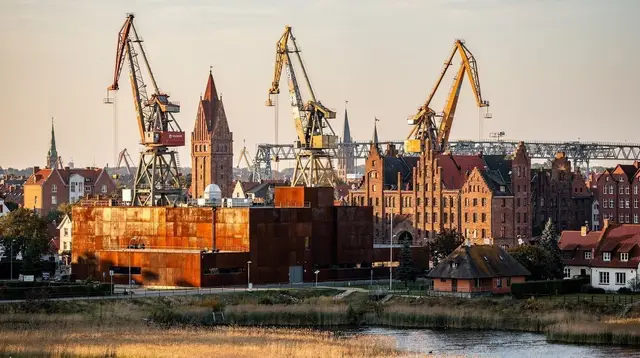
The European Solidarity Centre, built directly beside Gate No. 2, is the proper museum for this story: a dense, well-documented permanent exhibition covering the 1970 protests, the 1980 strike, the underground 1980s and the 1989 transition, built around original artefacts, recordings and recreated interiors. Two to three hours is a realistic visit, not an add-on to a longer day. The building’s design deliberately evokes a ship’s rusted hull, a detail worth noticing on the way in.
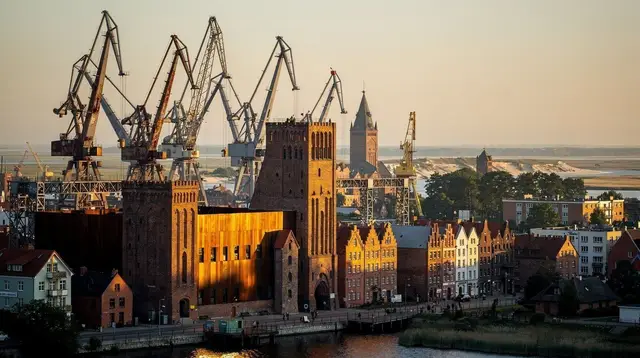
The wider shipyard grounds around both sites remain partly industrial, so visitors follow marked paths rather than wandering freely; this is still, in part, a working yard, not a preserved historical district in its entirety.
Seeing it with a guide
A guide adds most value here precisely because the story spans two full decades and several distinct turning points that are easy to compress into one vague narrative. A structured walk through the shipyard and Gate No. 2, paired with context before or after a visit to the European Solidarity Centre, tends to leave visitors with the 1980/1989 distinction clear rather than blurred.
For a walk that covers the shipyard, Gate No. 2 and the surrounding memorial sites with a local guide, consider the Gdańsk Solidarity Tour, which is built specifically around this history. Visitors who want the museum handled for them, with entry arranged and a guide to walk the exhibition’s dense timeline in a logical order, can book the European Solidarity Centre guided visit.
A version that pairs a guided reading of the museum with a smaller group and a closer look at the exhibits is offered as the European Solidarity Centre small-group tour. For those who want the story told by someone with a direct family connection to it, the Solidarity tour led by Lech Wałęsa’s grandson is a private option worth knowing about, though it should not be mistaken for a chance to meet Wałęsa himself.
A short, honest timeline
| Date | Event | What it was not |
|---|---|---|
| December 1970 | Coastal price protests, met with lethal force in Gdańsk and Gdynia | Not the founding of Solidarity |
| 1976 | Wałęsa dismissed from the shipyard for union activity | Not yet a national movement |
| 14-31 August 1980 | Shipyard strike; Gdańsk Agreement signed at Gate No. 2 | Not a change of government |
| Autumn 1980 | Solidarity formally registered as an independent union | Not political power |
| 13 December 1981 | Martial law declared; Solidarity banned; Wałęsa interned | Not the end of the movement |
| 1983 | Wałęsa awarded the Nobel Peace Prize, received by his wife | Not a return to legal status for Solidarity |
| February-April 1989 | Round Table talks in Warsaw | Not held in Gdańsk |
| 4 June 1989 | Semi-free elections; Solidarity wins nearly every contested seat | Not the same event as 1980 |
| December 1990 | Wałęsa elected President of Poland | Start of his term, not its end |
| 1990-1995 | Wałęsa’s presidency | A single five-year term |
Planning the visit
Pairing this history with the shipyard’s wartime backdrop makes for a fuller picture of twentieth-century Gdańsk; the combined WWII, Westerplatte and shipyard history tour covers both threads in one outing for visitors short on time. For a deeper, behind-the-scenes look that includes the Solidarity Centre alongside other communist-era sites in the city, the private communism history tour is a longer option built for that purpose.
Most visitors combine a stop at Gate No. 2 and the European Solidarity Centre with the rest of the Gdańsk Shipyard precinct in a single half-day, then continue into the Old Town or out toward Westerplatte for the earlier, 1939 chapter of the city’s history. For a fuller itinerary that sequences these sites sensibly, see the best day trips from Gdansk and the one-day Gdańsk itinerary.
Those wanting the museum context without the walking tour can also read the dedicated European Solidarity Centre guide and the broader Gdańsk shipyard Solidarity tour guide before setting out. A visit to the Museum of the Second World War rounds out the twentieth-century picture, and travellers curious about the man behind the movement should not expect a personal encounter, only a rigorously documented one, at the Lech Walesa sites described above.
Solidarity tours
Verified deep-linked GetYourGuide tours. Book through these links and we earn a small commission at no cost to you.
GetYourGuide does not provide a product photo for this activity — the image shows the meeting point, photographed by us.