Malbork Castle: The Teutonic Knights and Their Baltic Stronghold
Why did the Teutonic Knights build Malbork Castle?
Malbork Castle became the Teutonic Order's capital and the seat of its Grand Master, replacing an earlier base further south. As the largest brick fortress the order ever built, it functioned as an administrative, military and religious headquarters for the order's rule over Prussia and its dealings with Pomerania and Gdańsk.
A fortress built to govern, not just to defend
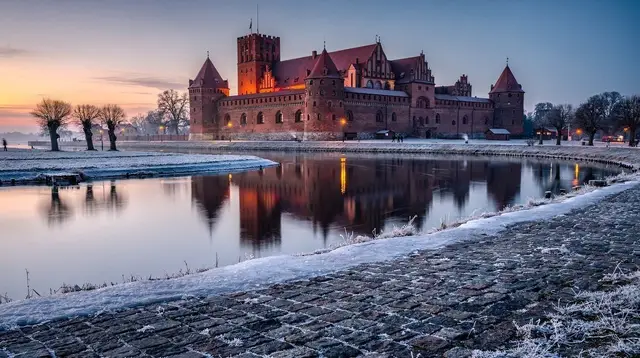
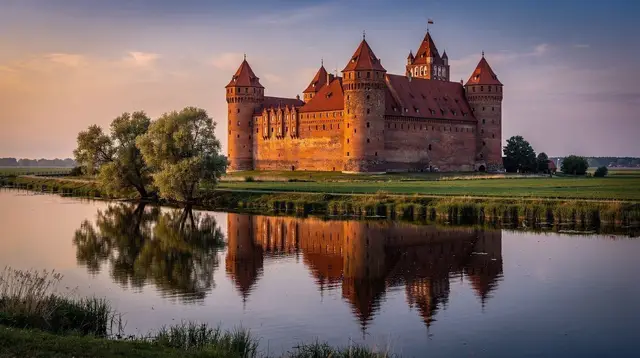
Most visitors arrive at Malbork already knowing it is big — the largest brick castle in the world by land area, a UNESCO World Heritage Site, a red-brick skyline rising over the Nogat river. What that scale actually represents gets less attention: Malbork was not a noble’s residence or a single defensive outpost. It was the administrative capital of a religious-military order that, for a period of the Middle Ages, governed a large stretch of the southern Baltic coast, including territory bordering Gdansk and the wider Pomeranian region this site covers. Understanding Malbork means understanding the order that built it, and the kind of power it wielded.
This page sets out that history — who the Teutonic Knights were, why they built their headquarters where they did, and how their rule shaped the region around modern-day Gdańsk. It stays deliberately separate from the practical logistics of visiting (opening hours, tickets, timed entry), which are covered in the Malbork Castle visitor guide, and it does not draw any line to the Second World War, a completely different period covered elsewhere on this site in guides like the Gdańsk WWII history tour. Mixing those two chapters together is one of the easiest ways to misread this part of Poland’s past, and this page avoids it.
Who the Teutonic Knights were
The Teutonic Order began as one of several religious-military orders that emerged from the Crusading movement in the Holy Land, alongside better-known counterparts like the Knights Templar and the Knights Hospitaller. Its members combined the structure of a monastic community — vows, a hierarchy, communal life — with active military service. Knights of the order were, in effect, soldier-monks: bound by religious discipline but organised and equipped for war.
By the early 13th century, the order’s attention had shifted decisively away from the eastern Mediterranean and toward the Baltic. Invited into the region to help subdue and convert Prussian tribes who had resisted earlier missionary efforts, the order found in the Baltic coast an opportunity to build something it had never had further south: a contiguous territory it could govern directly, rather than a scattered network of commanderies supporting crusades elsewhere. Over the following decades, the order built a chain of castles across Prussia, gradually extending its authority along the coast and inland, with Pomerania and the lower Vistula region — the territory this site covers — sitting at the western edge of that expansion.
This is the context in which Malbork rose to prominence. It was not the order’s first Baltic stronghold, but it became its most important one.
Why Malbork became the order’s capital
In the early 14th century, the Teutonic Order relocated the seat of its Grand Master — the order’s supreme leader — from Venice to Malbork. The move mattered. Venice had suited an order still oriented, at least in name, toward the Mediterranean and the Crusader states. Malbork put the Grand Master where the order’s actual territory and administrative business now lay: in Prussia, on the Baltic coast, within reach of the lands it governed day to day.
The site itself offered practical advantages. Malbork sits on the Nogat river, a branch of the Vistula delta system, giving the castle water access that supported both defence and the movement of goods and people through the order’s territory. The surrounding land was flat and low-lying, typical of the region covered across this site’s Zulawy and Elbląg Canal areas, but the river position gave Malbork a natural line of communication rather than isolation.
Once established as the capital, Malbork grew to match its new role. The original core — what visitors today know as the High Castle — had been built earlier as a more conventional order fortress: a defensible base with a chapter house, chapel and living quarters for the knights stationed there.
As Malbork’s responsibilities expanded to cover the administration of an entire territory, the order added the Middle Castle around it, with grander halls suited to receiving guests, conducting the order’s business and housing the Grand Master’s own quarters. Outer walls, granaries, and defensive works followed. The castle that stands today is the accumulated result of that growth: a headquarters that kept being built outward as the institution it served kept being built up.
An administrative and religious centre, not a palace
It is worth being precise about what kind of building this was. Malbork was never designed as a display of dynastic wealth in the way a royal palace might be — the order’s members were, at least formally, bound by monastic vows including poverty, and the castle’s architecture reflects a functional, almost austere character even at its grandest. Its great halls were built for administration and ceremony tied to governing a territory, not for the kind of courtly life associated with contemporary royal residences elsewhere in Europe.
That combination — military installation, monastic community and seat of territorial government, all under one roof — is what made Malbork distinctive. The Grand Master presided over both the order’s religious life and its secular administration of Prussia from the same complex. Officials responsible for taxation, justice and the management of the order’s lands worked out of Malbork alongside knights who held distinctly military roles.
Chapels within the complex, including a chapter house used for meetings and the election of leadership, sat within the same walls as armouries and defensive galleries. Visitors who go expecting a fairy-tale royal residence, complete with ornamental flourishes, tend to be surprised by how functional the interior feels; that austerity is itself part of the history, not a gap in the restoration.
Malbork and the wider Pomeranian region
The Teutonic Order’s territory bordered, and at various points overlapped with, the lands associated with Gdańsk and Pomerania. This is a genuinely important thread for understanding the region this site covers: the medieval history of the Baltic coast around Gdańsk is not simply a story of Polish or Hanseatic development in isolation — it unfolded alongside, and sometimes in direct relation to, the order’s presence at Malbork.
Gdańsk itself experienced periods under the order’s influence and control during the medieval era, a chapter in the city’s history that predates its rise as a major Hanseatic trading centre. The city’s medieval development — its early fortifications, its administrative structures, its position on Baltic trade routes — took shape against the backdrop of this shifting regional power, in which Malbork, as the order’s capital, was the dominant institutional presence for a significant stretch of time.
Readers who want the fuller picture of how Gdańsk’s Old Town came to look the way it does, including the later centuries this order-focused page does not cover, will find that context in guides like Gdańsk reconstructed, not original, which deals with a much later period of the city’s history.
It is also worth placing Malbork within the broader landscape of religious-military orders active in medieval Europe. The Teutonic Order was one expression of a pattern seen across the continent during the Crusading era, in which orders combining religious vows with military organisation carved out territories they governed directly. In the Baltic, this produced something unusual: an institution that was, in effect, a sovereign territorial power, with Malbork as its capital, rather than simply a landholder answering to a distant king. That distinctiveness is part of why the castle earned UNESCO recognition — not only for its architectural scale but as a rare surviving example of this kind of order-state headquarters.
The order’s eventual decline in the region
The Teutonic Order’s dominant position in Prussia and its bordering territories did not last indefinitely. Over the course of the 15th century, its territorial power in the region declined, shaped by prolonged conflict with the Kingdom of Poland and by shifting alliances among the towns and nobility within the order’s own territory, some of which grew resistant to its rule. Malbork itself eventually passed out of the order’s direct control, and the Grand Master’s seat moved elsewhere. The order’s role as the region’s dominant religious-military power effectively ended well before the modern era, though the Teutonic Order as an institution continued to exist in much-reduced form long afterward.
This page does not attempt to narrate the detailed military and political events of that decline — battle dates and troop numbers belong to more specialised military-history sources, and given how often popular accounts get specifics wrong, they are deliberately left out here rather than repeated without a reliable source. What matters for understanding Malbork today is the broader arc: a religious-military order built a territorial headquarters unmatched in scale in the region, held power from it for roughly two centuries, and then saw that power recede, leaving behind the fortress itself as the clearest physical record of what that rule looked like.
A separate chapter from the 20th century
One thing this page will not do is draw a straight line from the Teutonic Order’s medieval rule to the events of 1939–1945. It is tempting, given that both involve German institutions exercising power over Polish and Prussian territory, to fold them into a single narrative of “German control of the region.” That would be a mistake.
The Teutonic Order’s Malbork was a medieval religious-military institution operating under the frameworks of Crusading-era Christendom, centuries before the modern nation-states, ideologies and catastrophic violence of the Second World War existed. The order’s decline in the 15th century and the outbreak of war at Westerplatte in 1939 are separated by nearly five hundred years of subsequent history, including the rise and fall of other states, the partitions of Poland, and the transformation of the entire political map of Europe.
Visitors interested in the 20th-century history of the region — the Free City of Danzig, the outbreak of war, the Gdańsk Shipyard and Solidarity movement — will find that covered thoroughly elsewhere on this site, in guides such as the European Solidarity Centre guide and Westerplatte guide. Keeping that history distinct from the Teutonic Order’s medieval rule is not a stylistic choice; it reflects two genuinely separate periods with different actors, different causes and different consequences, and conflating them does a disservice to both.
Malbork’s legacy as a monument
What survives today is the physical legacy of that medieval institution rather than the institution itself. The castle passed through various hands after the order’s decline, was used for other administrative and military purposes over subsequent centuries, suffered serious damage during the Second World War, and was substantially restored in the decades that followed — a restoration history that is itself part of why the site is recognised for both its authenticity and the scale of the conservation effort behind it.
What visitors walk through now is the best-preserved expression anywhere of what a Teutonic Order headquarters looked like at the height of its power: the scale of the Middle Castle’s halls, the defensive logic of the High Castle’s older core, and the sheer footprint of a complex built to run a territory rather than shelter a single household.
For travellers based in Gdansk or elsewhere in the Tricity, a visit to Malbork is as much a history lesson in regional power as it is a piece of architecture. The order’s rise, its choice of Malbork as a capital, and its eventual decline all sit within the same broader Pomeranian story that shaped Gdańsk’s own medieval development — a story distinct from, and centuries removed from, the modern history for which the region is also well known.
Seeing it in context
A single-castle visit gives a strong sense of the order’s scale, but the history reads more clearly alongside the surrounding region it once governed. The flat, river-threaded land of Zulawy that Malbork sits within, and the broader sweep of Pomeranian towns and coastline, help place the order’s territory in perspective rather than treating the castle as an isolated monument.
a full-day guided visit from Gdańsk with an audioguide covering the castle’s history is the most common way to take in that context without having to piece it together alone. Travellers who prefer a smaller group and more time for questions on the order’s history often choose a private guided tour of the castle, while those short on time but still wanting the historical framing intact can look at a five-hour trip focused on the Teutonic Knights’ brick fortress.
For a longer, more immersive day that folds in the medieval heritage angle alongside the practicalities of transport, a full-day Malbork Castle and medieval heritage tour is worth considering.
For the practical side of planning — tickets, timed entry, opening hours and how long to budget — the Malbork Castle visitor guide and getting to Malbork Castle from Gdansk cover that ground. Those planning a broader day trip can also check the Malbork day trip itinerary or the best day trips from Gdansk for how Malbork fits alongside other destinations like Torun and the Kashubian Switzerland region.
Malbork Castle tours
Verified deep-linked GetYourGuide tours. Book through these links and we earn a small commission at no cost to you.
GetYourGuide does not provide a product photo for this activity — the image shows the meeting point, photographed by us.