St Mary's Church Tower: Four Hundred Steps, No Lift
I paid for the tower ticket at St Mary’s Basilica before I’d properly looked at what I was buying, and I got about a hundred steps up a narrow brick spiral before I understood my mistake. There is no lift. There never was going to be one. By the time I reached the top, legs shaking, shirt stuck to my back, I’d counted enough landings to believe the “around 400 steps” figure printed on the ticket, and I wished someone had told me, plainly, before I’d started.
What the climb actually involves
St Mary’s Basilica, known locally as Kosciol Mariacki, is one of the largest brick churches on earth, and its tower is the highest vantage point over the old town. The church itself is free to enter and needs no ticket at all. The tower is a separate transaction, paid at a small door around the side, and it is a genuinely different proposition: a narrow, enclosed brick staircase that spirals up in tight turns, with almost no natural light for long stretches and no landings wide enough to let faster visitors overtake slower ones easily. There is nowhere to sit. There is no lift, no escalator, no assisted route of any kind. You climb it on your own legs or you don’t climb it.
Four hundred steps sounds abstract until you’re on step two hundred, breathing harder than expected, with a queue of people behind you and no way to turn back without squeezing past everyone coming up. That’s the part nobody mentions at the ticket window. It isn’t a scenic staircase with a view halfway up to break the effort. It’s a long, plain, physical climb, and the reward only arrives at the very end.
This is not a maintenance failure
It would be easy to assume the absence of a lift is an oversight, something the church just hasn’t gotten around to fixing. It isn’t. St Mary’s is a Gothic brick structure dating back to the 14th and 15th centuries, and its tower was built as a functional part of a medieval church, not as a modern viewing platform.
Retrofitting a shaft for a lift into solid medieval brickwork would mean cutting through load-bearing walls in a protected historic monument, and that’s simply not how conservation works here. Compare it with somewhere like the reconstructed halls of the European Solidarity Centre, a 20th-century building designed from the outset with accessibility in mind, and the difference makes sense immediately: one building was engineered for modern visitors, the other has stood since before the printing press.
So when a visitor reaches the base of the tower expecting the kind of gentle, assisted ascent common at newer attractions, they’re really expecting the wrong building. The steps are not a gap in the experience. They are the experience, inherited unchanged from a structure that predates the concept of visitor access altogether.
Why this belongs in the planning stage, not the discovery stage
I don’t think the issue is the climb itself. Plenty of people, myself included eventually, are glad they did it. The issue is finding out about it at the ticket window, or worse, a third of the way up, rather than the night before over a map and a coffee. A 400-step spiral staircase with no rest points and no way out except up or down is not something to decide on impulse.
It rules out anyone with a knee problem, anyone pushing a stroller, anyone travelling with small children who tire fast, and anyone who simply isn’t prepared for twenty-plus minutes of sustained climbing in a warm, enclosed space. None of that is a criticism of the tower. It’s a description of what it demands, and it deserves to be weighed in advance like any other physically demanding activity, not stumbled into as a surprise.
If you know this beforehand, the decision becomes simple and entirely reasonable either way. Skip the tower and spend that time properly inside the basilica at ground level, which is vast, free, and worth a slow half hour on its own. Or commit to the climb knowing exactly what it costs, wear proper shoes, go early before the staircase fills up with tour groups, and treat it as the workout it is rather than a quick photo stop wedged between lunch and the next item on a list.
Where the tower sits in the wider old town
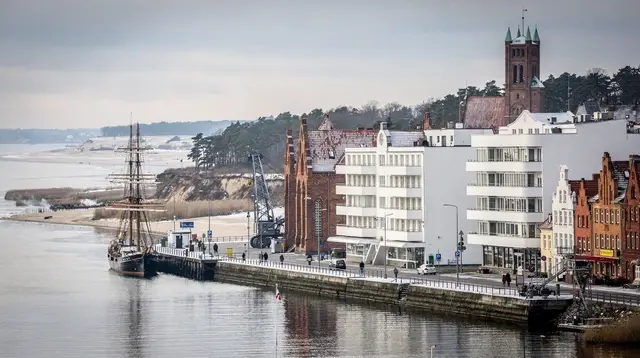
St Mary’s stands at the heart of the reconstructed Główne Miasto, the Main Town that was almost entirely levelled in 1945 and rebuilt from the ground up in the decades after. That context matters here too: the gabled facades along Długi Targ look centuries old because the rebuilding was painstaking, but the tower’s steps are a genuine, unreconstructed physical challenge inside a genuinely enormous structure. Climbing it is not a five-minute detour on the way to somewhere else. It’s a real chunk of a morning, both in the queueing and in the climbing, and it deserves to be budgeted as such alongside the rest of the old town rather than squeezed in as an afterthought.
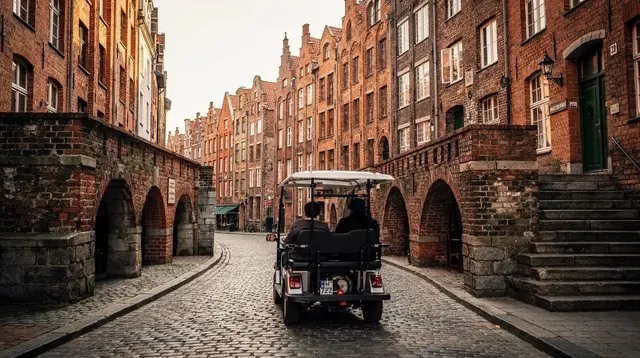
For a gentler way to take in the same skyline and the same brick church exteriors without the stairs, a golf cart tour past Gdańsk’s historic churches with a live audio guide covers a lot of the same ground from street level. Visitors who’d rather have someone explain the building’s history while they decide whether to climb it can also look at a private city tour of Gdańsk, which can be paced around exactly this kind of physical decision.
If you do want a view over the old town without the internal staircase, the river itself offers one: a breakfast cruise on a catamaran out of Gdańsk or Sopot puts the Motława waterfront and the church’s silhouette in front of you from the water instead. And for visitors tracing family history through the old town’s churches and records, a guided session on understanding Polish ancestors in Gdańsk is a very different but equally physical-free way to spend time around the same buildings.
Whichever way you go, plan the tower the way you’d plan any strenuous climb: check it before you queue for it. It’s worth reading up more broadly with a first-time visitor’s guide to Gdansk or a rundown of common tourist mistakes in Gdansk before you commit a morning to the old town.
A proper walking tour of the Old Town will take you past the tower’s base regardless of whether you climb it, and pairing that with a stroll down Mariacka street for amber shopping makes for a full, satisfying loop either way. If you’re still working out your schedule, how many days you need in Gdansk is worth reading before you arrive, and the destination page for Gdansk itself has the wider picture of what else sits around the Motława riverfront and the Old Town.
For visitors weighing accessibility more broadly across the city, it’s worth checking the wheelchair-accessible guide to Gdansk and the wider accessible attractions guide for the Tricity, since the tower is very much the exception that proves the rule in a city that’s otherwise fairly walkable.
If the old town’s museums interest you more than a workout, the European Solidarity Centre guide and the Amber Museum guide are both step-light alternatives nearby, and planning your visit around St Dominic’s Fair or Gdańsk’s summer season will tell you how crowded that staircase is likely to be when you go.
FAQ: climbing St Mary’s Basilica tower
How many steps are there to the top of St Mary’s tower?
The climb is generally counted at around 400 steps, spiralling up a narrow brick staircase with no landings wide enough to rest comfortably along the way.
Is there a lift or elevator to the top?
No. St Mary’s is a medieval brick structure, and no lift has been installed; the only way up or down is the original stone and brick staircase.
Do I need a separate ticket for the tower?
Yes. Entry to the basilica itself is free, but the tower climb is ticketed separately at a small booth, usually near the tower’s own entrance rather than the main church door.
How long does the climb take?
Most visitors take somewhere between fifteen and twenty-five minutes each way, depending on fitness, how busy the staircase is, and how many pauses they need along the narrow turns.
Is the tower suitable for children or older visitors?
It depends entirely on stamina and confidence on stairs. There are no rest points, no handrail breaks and no way to summon assistance partway up, so anyone unsure should think carefully before starting.
What’s the view like from the top?
A wide panorama over the red rooftops of the reconstructed Old Town, the Motława riverfront and the wider silhouette of Gdańsk, generally considered worth the climb by those who make it.
Can I skip the tower and still see the church properly?
Absolutely. The basilica’s ground floor is enormous, free to enter, and holds most of the historical and architectural interest on its own, without any stairs at all.
Is the staircase safe?
It’s well maintained but narrow, uneven in places, and can feel crowded when tour groups overlap going up and down, so sturdy shoes and a bit of patience matter more than any special equipment.
tours.Practical
Verified deep-linked GetYourGuide tours. Book through these links and we earn a small commission at no cost to you.
GetYourGuide does not provide a product photo for this activity — the image shows the meeting point, photographed by us.