Accessible Transport in Gdańsk and the Tricity
Is public transport in Gdańsk and the Tricity accessible for wheelchair users or limited mobility?
Partly, and it needs planning rather than assumptions. Newer SKM trains and most Gdańsk trams run low-floor stock with ramps, but older units still appear on some runs without warning, and the SKM ticket is a separate purchase from the tram and bus ticket. The Old Town's cobbled streets remain a physical obstacle regardless of the vehicle used to get there.
Planning a route, not just picking a ticket
Getting around Gdańsk and the Tricity with limited mobility is less a question of which vehicle is accessible and more a question of anticipating the whole journey before it starts. The region’s public transport is genuinely workable for many wheelchair users, people with limited stamina, and travellers pushing a buggy or a walker — but it rewards planning and punishes assumptions.
The two things that trip people up most often are the same two things that trip up nobody else: a rolling-stock lottery on the trains, and a ticketing system split across two separate networks. Neither is disclosed clearly at the point of booking, so this page sets both out plainly, along with the golf-cart alternative for the Old Town’s cobbled streets, before touching on airport transfers and day-trip logistics.
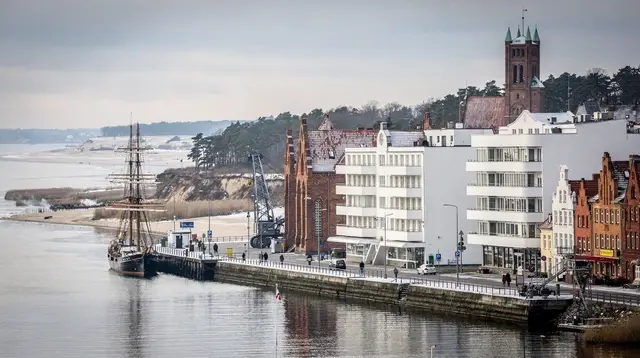
Nothing here promises a fully barrier-free city. Gdańsk is a working, six-century old port city rebuilt on medieval foundations, and some of its charm — the brick paving of Mariacka street, the uneven stone approach to St Mary’s Basilica — is also its physical obstacle. The honest goal is to reduce the number of surprises, not to pretend they do not exist.
SKM trains: mostly low-floor, but not guaranteed
The SKM (Szybka Kolej Miejska) is the commuter rail spine of the Tricity, running along the coast from Gdańsk through Sopot to Gdynia and on to Reda, with trains every 10 to 20 minutes at peak times. Much of the current fleet is modern, low-floor stock with level or near-level boarding at most platforms and a ramp available on request from staff or the driver.
The honest caveat is that not every SKM service on a given line is guaranteed to be low-floor. Older rolling stock still rotates through parts of the timetable, particularly outside peak hours, and there is no publicly available tool that lets a passenger check which specific unit will arrive on a specific departure before it pulls in.
In practice this means building in slack: arrive on the platform a few minutes early, watch the train as it approaches, and if it looks like older stock, ask platform staff whether a ramp is available or whether the next service is a better bet. This is a genuinely different experience from systems that publish accessible-departure data in real time, and it is worth setting that expectation before the day of travel rather than during it.
Stations themselves are a mixed picture too. Central stops such as Gdańsk Glowny and Sopot have lifts or ramps to the platforms, but some smaller halts along the line rely on stairs only, so checking the specific station pair for a planned trip is worth the two minutes it takes.
Further along the SKM line the picture keeps changing rather than settling into one standard. Gdynia Glowny, the terminus most visitors use for the modernist centre, has step-free access between the concourse and platforms, but some of the smaller halts between Sopot and Gdynia — stops serving quiet residential stretches rather than tourist sites — were built decades ago and still rely on steep stairways with no lift retrofit planned in the near term.
Reda, further out again, is a smaller station with more limited staffing outside peak hours, so a passenger who needs a ramp deployed there should expect to wait longer for someone to bring one than at a central Tricity stop. None of this rules out travelling the full length of the line with a mobility aid; it simply means treating each station pair on a planned route as its own small check rather than assuming that because Gdańsk Glowny is step-free, every stop along the coast will be too.
Trams and buses: a separate network, a separate fare
Gdańsk’s tram network is largely low-floor on its modern fleet, with a fold-out ramp the driver can extend at the door, and this stock is now standard on most central routes through the city. Buses are more mixed: many run low-floor vehicles, but older buses without ramps still appear on some routes, so it is worth checking the operator’s vehicle notes for a specific line rather than assuming uniformity across the network.
The detail that catches nearly every reduced-mobility visitor by surprise is this: the SKM train ticket and the ZTM tram and bus ticket are two entirely separate products, sold through different machines and different apps, and neither covers the other. A journey that starts with a train from Gdańsk Glowny and finishes with a tram to a specific neighbourhood needs two tickets bought separately, not one combined fare.
For a traveller who is already managing a wheelchair, a companion, or simply a body that tires with each transfer, this is the kind of detail that turns a simple two-leg trip into three purchasing decisions if it is not planned in advance. Buying both tickets — or checking whether a combined day pass covering both networks is available at the station you are starting from — before boarding the first vehicle removes one layer of friction from a trip that may already have several.
| Ticket type | Covers | Typical validity | Buy separately from |
|---|---|---|---|
| SKM ticket | Commuter rail (Gdańsk–Sopot–Gdynia–Reda) | Single journey or time-based | Tram/bus ticket |
| ZTM tram/bus ticket | Trams and buses across the Tricity | 20, 40, 60, 90 min, or 24-hour | SKM ticket |
| Combined day pass (where available) | Both networks on some passes | 24 hours | — |
Always confirm current pass options at the ticket machine or station counter, since combined coverage varies by pass type and can change.
The Old Town: cobbles, thresholds, and where the golf cart helps
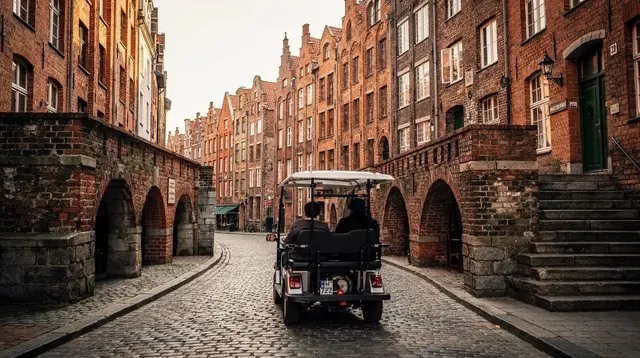
No amount of accessible rolling stock changes the fact that the historic core of Gdansk — the streets around Długi Targ and Mariacka street, and much of the Motława riverfront — is paved in cobblestones and old brick. This is slow, jarring terrain for wheelchairs, rollators, and even a well-sprung pushchair, and several church and museum entrances add a raised threshold or a short flight of steps on top of the paving itself. There is no honest way to describe the Old Town as flat and smooth; it is not, and no operator or guide should promise otherwise.
This is where a golf-cart tour becomes a genuinely useful, rather than merely novel, option. Seated at street level in an open-sided cart, passengers cover the same ground — the Old Town lanes, the riverfront, and further sites such as the shipyard district — without walking the cobbles themselves.
One option pairs a city tour by golf cart with a local beer stop, worth considering for a relaxed first look at the centre: a golf-cart city tour with a beer stop. A second route extends further out to the shipyard and Gradowa Hill, useful for covering ground that would otherwise mean a long, uneven walk: a golf-cart tour to Gdańsk Shipyard and Gradowa Hill.
Neither tour eliminates every obstacle — passengers still transfer in and out of the cart at stops, and some stops may involve a short walk on uneven ground to reach a viewpoint or entrance — but it removes the bulk of the walking distance that makes the Old Town tiring for many visitors with limited mobility or stamina.
A boat is another way to see the waterfront without walking it. A cruise along the Motlawa passes the medieval crane and the riverfront facades from the water rather than the towpath: a Motława river cruise with an optional food and drink option. Boarding a boat has its own physical demands, including a step or gangway at the dock, so it is worth checking boarding arrangements with the operator directly rather than assuming step-free access.
Getting from the airport into the city
Gdańsk airport is modern and step-free throughout the terminal, so the accessibility question is really about the leg into town. The SKM train reaches Gdańsk Glowny in roughly 25 to 35 minutes and is the cheapest option, but it carries the same rolling-stock uncertainty described above, plus the logistics of managing luggage and a mobility aid on a platform that may or may not have a lift at every point along the route.
A pre-booked private transfer or taxi removes that variable entirely: door-to-door service, no platform transfer, and a vehicle that can be specified in advance if particular space or ramp requirements apply. For a first arrival, or for anyone travelling with heavier equipment, paying for the certainty of a transfer is often the more practical choice, even where the train is cheaper on paper.
Booking assistance in advance, rather than hoping for it on the day
For journeys longer than a short hop across the Tricity, it is worth knowing that Poland’s rail operators run a formal passenger-assistance service, separate from simply asking a conductor for help. Requests are typically made online or by phone at least a day ahead of travel, sometimes longer for smaller stations, and cover help boarding, alighting, and moving between platforms at stations including Gdańsk Glowny.
This matters most for the legs that fall outside the dense SKM network — a regional train toward Malbork, or an intercity service toward Toruń or further afield — where staffing on the platform cannot be assumed the way it often can be assumed at a busy central Tricity stop. Booking ahead does not guarantee a specific vehicle type, since rolling stock still varies by service, but it does put a named member of staff on notice to meet a specific train, which is a meaningfully different experience from arriving unannounced and hoping someone is free.
The ZTM network that runs Gdańsk’s trams and buses does not offer an equivalent pre-booking system for individual journeys, since the low-floor fleet is meant to be usable without advance notice. In practice this means the two networks ask for opposite approaches: plan and book ahead for the regional and long-distance train legs of a trip, but expect to simply turn up and adapt on the day for trams and buses within the Tricity itself.
Parking and drop-off near the Old Town
Visitors arriving by hire car, taxi, or private transfer sometimes assume a vehicle can pull up directly outside a specific sight in the historic core. It generally cannot: much of the Główne Miasto is closed to general traffic, and what looks like a short street on a map is often a pedestrianised lane with bollards at each end.
The realistic approach is a drop-off on one of the streets bordering the Old Town — near the main gates or along the Motława embankment — followed by either a short walk or a golf-cart transfer for the final stretch, rather than expecting kerbside access to a specific church or museum entrance. Drivers unfamiliar with the restrictions sometimes circle for several minutes looking for a way in that does not exist, so it is worth building that extra time into a schedule rather than treating the drop-off as instantaneous.
Day trips: fewer guarantees further out
Several of the region’s best-known sites sit outside the Tricity’s dense rail and tram coverage, and accessibility thins out accordingly the further a trip goes. Malbork Castle is reached by regional train from Gdańsk Glowny, but the castle itself is a vast, multi-level brick fortress with stone stairs and uneven floors in many of its original chambers — modern lifts exist in parts of the route, but not throughout, so checking the current accessible-route map before visiting is worthwhile.
Stutthof memorial, near Sztutowo, is mostly flat gravel and grass paths across the memorial grounds, walkable for many but still uneven underfoot; public transport there is infrequent, and most visitors go by organised transfer or hire car rather than public transit, which also means the accessibility of the journey depends heavily on the specific transfer booked. A private tour of Stutthof with transport removes the public-transit uncertainty from that particular day trip: a private Stutthof memorial tour with transport included.
For families weighing up a step-lighter outing closer to the city, Oliwa with its cathedral, park and zoo can be reached with private transport laid on rather than relying on public transit and a walk from the nearest stop: a private-transport visit to Oliwa Zoo with tickets included.
A few more questions before you go
Is there accessible parking or a drop-off point near the Gdańsk Old Town?
There is no dedicated accessible car park inside the pedestrianised core, since much of the historic centre is closed to general traffic. The practical approach is a short drop-off on one of the streets bordering the Old Town, followed by a shorter walk or a golf-cart transfer for the final stretch, rather than expecting a vehicle to reach the doorstep of a specific sight.
Can I book mobility assistance in advance for regional or long-distance trains from Gdańsk?
Yes. Poland’s national rail operators run a passenger-assistance service that can be booked ahead of a journey, typically requesting at least a day’s notice, to arrange help boarding, alighting, and transferring at stations including Gdańsk Glowny. It is worth booking this for longer regional or intercity legs, such as a day trip toward Malbork or Toruń, rather than relying on staff being available on the day without notice.
A realistic checklist before setting out
- Buy the SKM ticket and the tram/bus ticket separately for any trip combining both networks — never assume one covers the other.
- Arrive at the platform a few minutes early and check the approaching train; ask staff about ramp availability if the stock looks older.
- Expect cobbles and thresholds in the Old Town regardless of how you arrive there, and plan a golf-cart or boat option if walking distance is a concern.
- Book airport transfers in advance if platform transfers or luggage handling on the SKM would be difficult.
- For day trips to Malbork or Stutthof, check current accessible-route information for the specific site rather than assuming full coverage.
- Treat any single-ticket promise covering both SKM and ZTM networks as something to verify locally, not something to assume from past visits or general Tricity guides.
Planning around these points does not make Gdańsk a barrier-free city, and no guide should claim it is. What it does is turn a scattering of small, avoidable surprises — a ticket machine that will not accept the wrong fare, a train that turns out to have no ramp, a cobbled street that was never mentioned — into things anticipated well before the day of travel, leaving more energy for the part of the trip that matters: seeing the city.
Accessible tours
Verified deep-linked GetYourGuide tours. Book through these links and we earn a small commission at no cost to you.
GetYourGuide does not provide a product photo for this activity — the image shows the meeting point, photographed by us.