Vodka Tasting in Gdańsk: A Practical Guide
Is vodka a Gdańsk specialty, and how does a tasting work?
Vodka is a national Polish tradition rather than something unique to Gdańsk, but the city has plenty of guided tastings that walk visitors through several styles side by side, usually with food pairings and a short explanation of production methods. A typical session runs one to two hours and compares clear and flavoured vodkas rather than promoting a single brand.
Vodka in Gdańsk, in context
Ask a bartender in Gdansk about vodka and the answer will usually come with a small correction: vodka is not a Gdańsk thing, it is a Polish thing. The spirit has been distilled across the country for centuries, tied to no single city, and Poland’s claim to some of the world’s oldest documented vodka production long predates any particular Baltic port. Visitors who arrive expecting a “Gdańsk vodka” in the way Cognac belongs to Cognac will be looking for something that does not quite exist.
What Gdańsk does have, and what genuinely is local, is Goldwasser — a separate herbal liqueur flecked with gold leaf, first made in the city in 1598, and worth understanding as its own subject rather than folding it into a vodka story. This guide covers the vodka side: how tastings are structured, what to expect from a flight, and where vodka fits into an evening in the Old Town.
The confusion is understandable, because the two often turn up on the same bar shelf and sometimes the same tasting menu. But they are different drinks with different histories, and treating them as interchangeable does a disservice to both. Vodka in Gdańsk is best understood as an expression of a national tradition, delivered well, rather than a hidden local specialty.
What a vodka tasting actually is
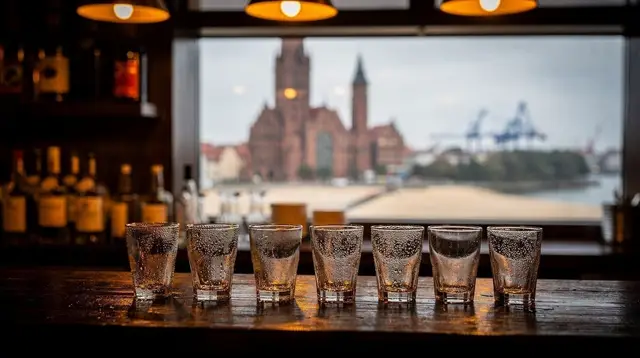
A guided vodka tasting is not a bar crawl and not a distillery tour in the way whisky tourism sometimes works in Scotland — Poland’s vodka production is largely industrial and not built around visitor centres in the same way. What Gdańsk offers instead is the tasting format: a host, usually working from a bar, restaurant, or dedicated tasting room in or near the Old Town, walks a small group through a curated flight of several vodkas, explaining differences in grain versus potato base, filtration, and the country’s various flavoured and infused styles along the way.
The format tends to follow a similar shape wherever it is run. A host introduces each pour before it is tasted, rather than lining up every glass at once, which keeps the session paced and gives people a chance to ask questions. Between vodkas, small bites of traditional Polish food are typically offered — pickles, rye bread, cured meats, sometimes a hot dish — both as a customary pairing and as a practical way to reset the palate. Sessions commonly run one to two hours, occasionally longer when food pairings are more substantial or a short walk is folded in.
What a reputable tasting will not do is promise a fixed roster of exact brands or a guaranteed price without confirming with the operator directly, since menus and offerings do shift. It is worth checking those specifics — and any age or identification requirements — with whichever operator is booked, rather than assuming a figure in advance.
a three-hour guided vodka tasting session in Gdańsk is one way to structure the evening for visitors who would rather have a host narrate the differences than work through a bar menu solo.
Vodka styles worth knowing before a tasting
Polish vodka broadly splits into clear, unflavoured styles and a wide range of flavoured or infused versions, and a well-run tasting will usually include examples of both so the contrast is clear rather than theoretical.
| Style | What it is | What to expect in a tasting |
|---|---|---|
| Clear grain vodka | Distilled from rye or wheat, filtered for a neutral, clean profile | Usually the baseline pour, tasted first to set a reference point |
| Clear potato vodka | Distilled from potatoes rather than grain, often slightly rounder or oilier in texture | Compared directly against a grain vodka to show the base ingredient’s effect |
| Flavoured or infused vodka | Grain or potato vodka infused with fruit, herbs, spices, or honey | Usually the more approachable pours for visitors new to spirits tasting |
| Bison grass vodka | A traditional infused style using a specific grass associated with the Bialowieza forest region, giving a subtly herbal, slightly sweet note | Often included as a distinctly Polish variant worth trying once |
None of these are Gdansk-specific — they are produced and drunk across Poland — but a Gdansk-based tasting is a convenient, well-hosted way to try several side by side without having to seek out separate bars.
a tasting built around seven different Polish spirits is a broader option for visitors who want a wider comparison than a basic three-pour flight.
Vodka versus Goldwasser: the distinction that matters
It is worth being precise about this, because the two are easy to conflate on a menu and genuinely different in what they are. Vodka is a neutral spirit, typically unflavoured or lightly flavoured, distilled from grain or potatoes, produced and drunk the length and breadth of Poland. Goldwasser is a sweeter, herbal liqueur, infused with a specific blend of botanicals and — its signature detail — finished with tiny, edible flakes of gold leaf suspended in the liquid. It was first produced in Gdańsk in 1598, and unlike vodka, its origin really is tied to this one city.
A vodka tasting and a Goldwasser tasting are, in practice, different experiences with different aims: one is a comparative exercise across a national spirit category, the other is closer to sampling a single historic local specialty. Visitors short on time sometimes want to combine both in one evening, which is reasonable, but it helps to know going in that they are not variations on the same drink. The full story of Goldwasser — its history, its production, and where to try it — is covered separately.
For the local liqueur itself, the dedicated page on Goldwasser tasting in Gdańsk goes into the detail this guide deliberately leaves out.
Where tastings tend to happen
Most guided vodka tastings and vodka-focused bars cluster in and around the Old Town, within easy walking distance of Dlugi Targ and the Motława waterfront. This is partly convenience for visitors staying centrally, and partly because the Old Town’s bar and restaurant density supports the format. Some operators run tastings as a stand-alone seated session in a dedicated room; others build it into a broader evening that includes a short walk past Old Town landmarks between pours.
a walking-format vodka tour through the Old Town suits visitors who would rather move between a couple of locations than sit through the whole session in one room.
Outside the Old Town, Wrzeszcz and parts of the wider city have their own bar scenes, but they are less oriented toward the structured tasting format and more toward regular bars with vodka on the menu alongside beer and cocktails. For a first-time visitor with limited time, staying in or near the Old Town for a tasting session keeps logistics simple.
Pairing food with vodka
Traditional pairings lean on foods that are salty, pickled, or fatty enough to cut through the alcohol and reset the palate between pours — this is a long-standing habit in Polish drinking culture generally, not a Gdańsk invention. Pickled cucumbers, herring, rye bread, and cured meats are common choices, and a well-run tasting will usually offer at least a small selection rather than pours on their own.
Visitors who want to go further into Polish food alongside the drink can look at a dedicated food tour rather than expecting a vodka tasting to double as a full meal.
a food-focused tour through Gdańsk is a reasonable way to get a fuller sense of Polish cuisine, with a vodka tasting kept as its own separate evening.
For a deeper look at the food side specifically, the guide to pierogi and Polish cuisine in Gdańsk covers what a food-first itinerary looks like, and the wider Tricity food tour options across Sopot and Gdynia extend the theme beyond Gdańsk itself.
Evening logistics: bars, crawls, and getting back
A vodka tasting is usually a one- to two-hour commitment, which leaves room to build a longer evening around it if that is the plan. The Old Town’s bar scene continues well past the end of a typical tasting session, and several operators run structured pub crawls that visit multiple venues rather than settling in one place.
The Gdańsk pub crawl guide and the roundup of best bars in the Old Town both cover what comes after a tasting winds down, for visitors who want to keep the evening going. Sopot’s nightlife runs on a different rhythm, closer to a beach-resort evening scene, and is covered separately in the Sopot nightlife guide for anyone splitting time between the two.
Beer is the other major category worth knowing about, since Poland has a strong and growing craft beer scene that is entirely distinct from vodka culture. The Polish craft beer tasting guide covers that side in more detail for visitors who want to compare the two categories rather than assume a single tasting covers everything.
Money and payment
Poland’s currency is the zloty (PLN); the country is not in the eurozone, and euros are not a dependable way to pay for a tasting, a bar tab, or anything else day to day. Card payment, including contactless, is widely accepted across bars and tasting venues in Gdańsk, and it is worth carrying at least some zloty in cash as a backup for smaller, cash-only spots. The guide to paying in Poland covers this in more depth for the wider trip, not just an evening’s drinking.
Age requirements and responsible drinking
Poland, like every country, sets a legal minimum age for buying and consuming alcohol, and any licensed tasting operator or bar will enforce it and may ask for photo identification. Because the exact age threshold and ID requirements can be checked directly and reliably with whichever operator or venue is booked, this guide deliberately does not state a specific figure — visitors should confirm the current requirement with the tasting provider rather than rely on an assumption carried over from another country.
Tastings are generally structured around small measured pours rather than full drinks, which keeps total alcohol intake modest across a session, but pacing, hydration, and a plan for getting back to accommodation afterward are worth thinking about regardless.
Planning around a tasting
A vodka tasting slots naturally into an Old Town evening without needing a full day set aside for it, which makes it easy to combine with daytime sightseeing. Visitors following a broader city itinerary can see how an evening tasting fits around sights like St Mary’s Basilica or the Motława riverfront by checking the two-day Gdańsk and Sopot itinerary or the broader one-day Gdańsk itinerary for how much daytime activity realistically fits before an evening tasting.
Vodka tasting in Gdańsk: questions people ask
Is vodka a Gdańsk specialty?
No. Vodka is a Polish national tradition, distilled and enjoyed across the whole country for centuries, not something invented in or unique to Gdańsk. What Gdańsk does have that is genuinely local is Goldwasser, a herbal liqueur with flakes of gold leaf first produced in the city in 1598.
What is the difference between vodka and Goldwasser?
Vodka is a neutral, typically unflavoured spirit distilled from grain or potatoes, drunk across Poland. Goldwasser is a separate, sweeter herbal liqueur infused with a blend of botanicals and finished with tiny flecks of edible gold leaf, historically tied specifically to Gdańsk since the late 16th century.
How long does a vodka tasting in Gdańsk take?
Most guided tastings run somewhere between one and two hours, sometimes closer to three when food pairings or a walking element around the Old Town are included. A short walk-in flight at a bar can be faster, while a hosted, narrated tasting takes longer by design.
What is included in a typical vodka tasting flight?
A typical flight compares several vodka styles side by side, usually clear vodka alongside one or two flavoured or infused varieties, often with small bites of traditional Polish food such as pickles, bread, or cured meats to cut the alcohol and cleanse the palate between pours.
Is there a minimum age for a vodka tasting in Gdańsk?
Poland sets a legal minimum age for purchasing and consuming alcohol, and any licensed tasting operator will apply it and may ask for identification. Travellers should check the specific age requirement and any ID rules directly with the operator they book rather than assume a figure.
Can vodka tastings be paid for in euros?
Poland’s currency is the zloty (PLN), not the euro, so tastings and bar tabs are priced and settled in zloty. Card payment is widely accepted, but euros are not a reliable way to pay and should not be assumed to work.
Are vodka tastings suitable for people who don’t like strong spirits?
Tastings are usually built around small measured pours rather than full drinks, so the alcohol volume per taste is modest, and food pairings help balance it. Anyone unsure about spirits can typically ask a host to pour smaller amounts or skip a particular sample.
Should a vodka tasting be combined with anything else in Gdańsk?
Many visitors pair a vodka tasting with a wider food tour or an evening in the Old Town’s bars, since the tasting itself is usually a focused hour or two rather than a full evening out on its own.
Tastings tours
Verified deep-linked GetYourGuide tours. Book through these links and we earn a small commission at no cost to you.
GetYourGuide does not provide a product photo for this activity — the image shows the meeting point, photographed by us.