Where to Drink in Gdańsk's Old Town: Streets and Quays Worth Knowing
Where's the best area for a drink in Gdańsk's Old Town?
The Motława riverfront (Długie Pobrzeże) and the streets just off Długi Targ, especially Piwna and Chlebnicka, hold the highest concentration of bars and cafés-turned-bars in the historic core. Mariacka is quieter and more café-paced, while the Granary Island (Wyspa Spichrzów) across the river adds a newer, less crowded option.
Reading the Old Town by street, not by bar
Gdańsk’s historic core, the Główne Miasto, is small enough to cross on foot in fifteen minutes, and that compactness is the whole point of thinking about drinks here geographically. Rather than chasing a specific address that may have changed hands, closed for the season, or simply moved a few doors down since it was last reviewed, it’s more useful to know which streets and quays carry the evening crowd and which stay quieter — and then pick a spot once you’re standing on the right stretch of cobbles.
This guide sticks to that geography: the main strip of Długi Targ, the parallel run of Piwna street, the connecting lane of Chlebnicka, the Motława riverfront, quieter Mariacka, and the newer development across the water on Granary Island. None of it names a specific bar, and that’s deliberate — addresses and drink prices change too fast for a static page to promise accurately, and a genuinely useful guide to a small, walkable old town is one that gets you to the right block, not one that pretends to have eaten and drunk at every venue on it.
A note on expectations before the street-by-street part: this is a practical, map-first guide, not a bar review. If you want a night that’s organised for you — stops picked, pace set, a group to move with — that’s a different kind of product, and Gdańsk’s pub crawl guide covers that format. What follows is for anyone who’d rather work out the layout themselves and choose on the night.
Długi Targ and the main square
Długi Targ, the Long Market running between the Golden Gate and the Green Gate, is the Old Town’s grandest and most photographed street, lined with the reconstructed gabled townhouses that give Gdańsk its postcard look. It carries cafés and restaurants with outdoor seating rather than a concentration of late-night bars — the square is built for people-watching over a coffee, a beer with dinner, or a slow evening drink at a table facing the Neptune Fountain, not for bar-hopping.
Prices here tend to sit a notch above the side streets, which is the usual tourist-square premium rather than anything unusual. It’s a sensible starting point for an evening precisely because everything else in this guide radiates out from it within a five-minute walk, and a walking tour of the Old Town taken earlier in the day is a good way to get oriented before coming back after dark.
Piwna street: the densest run of bars
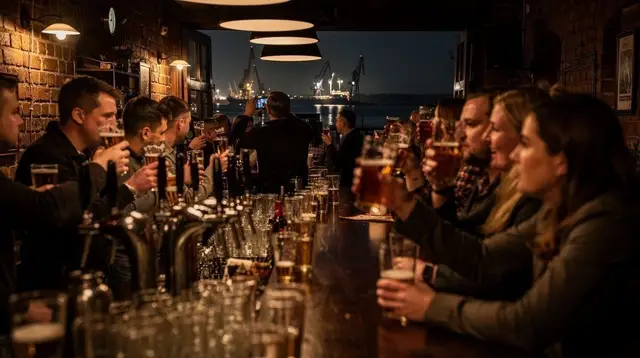
A block north of Długi Targ and running roughly parallel to it, Piwna street — the name literally means “beer street” — is where the Old Town’s evening crowd actually concentrates. Many of the buildings here have cellar-level spaces beneath the ground-floor shops and restaurants, and those cellars are where a lot of the Old Town’s bars and pubs operate, giving the street a different, more layered feel after dark than the open squares nearby. It’s narrower and less manicured than Długi Targ, which suits an evening out better than an afternoon photo stop. Piwna is also one of the more reliable choices in the shoulder seasons and even in winter, because indoor cellar venues don’t depend on outdoor terrace weather the way the riverfront does.
Chlebnicka, the short connecting street between Długi Targ and the Motława, functions as a natural link between the square and the riverfront and picks up some overflow from both — worth a slow walk rather than a destination in itself.
The Motława riverfront: Długie Pobrzeże
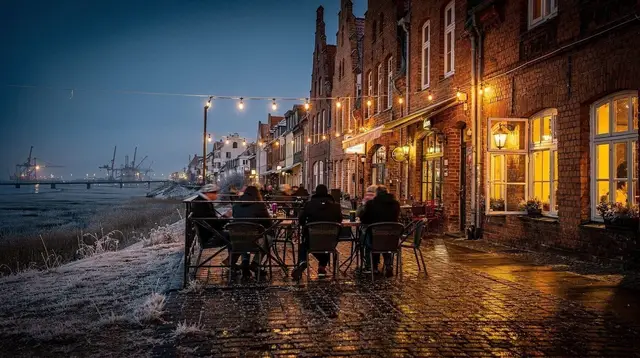
The waterfront promenade along the Motława — Długie Pobrzeże, running between the Green Gate and the medieval crane, Żuraw — is the Old Town’s best warm-weather drinking spot, for one simple reason: it faces open water, catches the evening light, and has the space for the kind of outdoor terraces that a tight, walled square like Długi Targ can’t fit.
From here you can watch river traffic and sightseeing boats pass in front of the crane, one of the city’s genuine medieval survivals and now a branch of the National Maritime Museum. This is where a river cruise along the Motława sets off from, and an early-evening cruise pairs naturally with a drink on the quay afterwards.
The trade-off is seasonal, and it’s worth being upfront about it: this riverfront atmosphere is a warm-season feature. From roughly June through early September the terraces stay full into the evening thanks to long Baltic-summer daylight; through the winter half of the year, many of the same spots close their outdoor seating, shorten hours, or shut for the season entirely, and the quay itself is a colder, darker, and much quieter place to be after dark. A December evening drink on the Motława is a real option, but it’s an indoor one, and a very different outing from a July evening on the same stretch of quay.
Mariacka: quieter, and built for something else
Running from the base of St Mary’s Basilica down to the river, Mariacka street is famous for its ornamental stone porches and its concentration of amber workshops and jewellers — it is, first and foremost, the amber street, not the drinking street. It has cafés and a handful of bars, and it’s a genuinely pleasant place for a slower early-evening drink away from the busier squares, but anyone expecting Piwna-level bar density here will be disappointed. Its appeal after dark is atmosphere rather than choice: fewer crowds, better architecture at eye level, and a calmer pace than the main streets a few minutes away.
Granary Island: the newer alternative across the water
Across the Motława from the Old Town, Wyspa Spichrzów — Granary Island — has been substantially rebuilt over roughly the last decade, reconstructing the footprint of the old grain warehouses that once stood here in a modern architectural style, and it now carries a mix of hotels, restaurants and bars aimed at a slightly different, less purely tourist-strip crowd.
Reaching it from Długi Targ is a five-minute walk across one of the footbridges over the river, and the view back toward the Old Town skyline and the crane at dusk is one of the better free sights in the city. It tends to be noticeably less crowded than the main streets on the other bank, which makes it a reasonable choice on a busy summer weekend when Piwna and the riverfront are packed, or simply for a change of scene partway through an evening.
How the areas compare
| Area | Character | Best for | Winter |
|---|---|---|---|
| Długi Targ | Grand, formal, tourist-facing | Coffee, dinner, a slow first drink | Christmas market atmosphere in December |
| Piwna street | Dense, cellar bars, narrow lanes | Bar-hopping, evening out | Runs year-round, indoor-led |
| Motława riverfront | Open terraces facing the water | Sunset drinks, river views | Largely closes or shrinks |
| Mariacka | Quiet, amber shops, ornamental porches | Slow café-style drink | Quiet, some closures |
| Granary Island | Newer, rebuilt, less crowded | Escaping the main-strip crowds | Fewer options than Piwna |
A realistic evening route
A workable order for a first evening, on foot and in daylight or early dusk, runs from the square outward: start on Długi Targ for an orientation drink or coffee, cut through Chlebnicka to the Motława and walk the riverfront quay toward the crane, cross to Granary Island if the main bank feels crowded, then loop back and finish the night on Piwna, where the cellar bars keep going latest.
That’s roughly a twenty-minute walk stretched across an evening, not a serious hike, and it touches every area in this guide without doubling back unnecessarily. For a food-led version of the same evening, a Gdańsk food tour or a pierogi and Polish cuisine tour covers similar ground with eating rather than drinking as the focus.
Anyone short on time and wanting the layout explained on the spot rather than worked out from a map can also take a guided introduction to the Old Town by day — a guided walk through the Old Town’s main streets and squares
— and come back to the same streets after dark once the geography has stuck. For a private, unhurried version that includes the Artus Court, one of the square’s grandest interiors, there’s also a private Old Town tour taking in Artus Court.
What to drink, and a word on prices
Local specialities worth knowing about even in a geography-first guide: Goldwasser, a herbal liqueur flecked with real gold leaf that has been made in Gdańsk since the late 16th century, is the city’s signature drink and worth trying at least once — a Goldwasser tasting is a tidy way to do that properly.
Poland’s craft beer scene has grown considerably in the last decade, and Piwna’s cellar bars are a reasonable place to find it, backed up by a dedicated craft beer tasting. Polish vodka, unsurprisingly, is everywhere, and a guided vodka tasting is a lower-effort way to get a proper introduction than ordering blind off a menu.
On money: this guide won’t quote drink prices, because they move faster than a page like this can be kept accurate, and any number printed here would be wrong within a season. What’s worth stating plainly is the currency itself — Poland uses the złoty (PLN), not the euro, so budgeting in euros will misread every menu in the Old Town. Cards are accepted almost everywhere; see paying in Poland for the practical detail.
What this guide won’t promise
A few honest limits, stated up front rather than discovered on the night. This page doesn’t name specific bars or quote specific prices, because both change too often for a static guide to get right — treat it as a map to the right streets, then choose on arrival. It also won’t promise year-round, euro-priced, high-season energy: Poland runs on the złoty, and the lively, terrace-led atmosphere described for the Motława riverfront and Długi Targ is substantially a warm-season condition.
From late autumn through winter, short days and cold, often windy evenings thin out the outdoor crowd noticeably, and a good deal of what makes the riverfront appealing in July — tables outside, long light, people lingering on the quay — simply isn’t there in January. Piwna’s cellar bars are the most reliable year-round option for exactly that reason. For a broader sense of how the season changes a visit beyond just drinking, see Gdańsk in winter and, for the opposite end of the calendar, Gdańsk in summer.
If a structured night out with a group and a set pub-crawl format sounds more appealing than working this out street by street, that’s a genuinely different product from what this page covers — a guided pub crawl through several Old Town venues in one night
— and it’s covered in full in the Gdańsk pub crawl guide. For a Tricity-wide comparison of where the nightlife sits, Sopot’s nightlife guide is the natural next read, since Sopot runs a very different, beach-resort version of an evening out from Gdańsk’s Old Town streets.
Practical notes before heading out
The areas covered here — Długi Targ, Piwna, the Motława riverfront, Mariacka and Granary Island — are all within a few minutes’ walk of each other inside the compact, well-lit historic core, and the ordinary caution that applies to any European city centre at night applies here too; see Gdańsk safety and common tourist mistakes for the general picture. If the evening is the tail end of a longer day, pairing it with a look at how much time to give the city overall is worth doing in advance — the two-day Gdańsk and Sopot itinerary builds an evening like this into a wider plan rather than leaving it as an afterthought.
Frequently asked questions about drinking in Gdańsk’s Old Town
Which street in Gdańsk Old Town has the most bars?
Piwna street, running roughly parallel to Długi Targ a block north, has the densest run of bars and pubs in the Old Town, many in cellar spaces under the gabled townhouses. Chlebnicka, connecting Długi Targ to the river, is a close second.
Is the Motława riverfront good for evening drinks?
Yes — Długie Pobrzeże, the promenade along the Motława between the Green Gate and the Crane (Żuraw), is lined with terraces that catch the last light over the water. It’s busiest and most atmospheric from late spring through early autumn, when tables stay outside into the evening.
Is Mariacka street a good place for a drink?
Mariacka is better known for its amber shops and ornamental porches than for nightlife, and it stays relatively quiet in the evening compared with Piwna or the riverfront. It suits a slower coffee or early-evening drink rather than a night out.
What is Granary Island and is it worth crossing for?
Wyspa Spichrzów, or Granary Island, sits on the far bank of the Motława opposite the Old Town and has been rebuilt over the last decade with a mix of hotels, restaurants and bars in a modern take on the old granary architecture. It’s a short footbridge walk from Długi Targ and noticeably less crowded than the main tourist strip.
Do prices in Gdańsk bars run in euros?
No — Poland uses the złoty (PLN), not the euro, and menus are priced in złoty. Card payments are accepted almost everywhere in the Old Town, but budgeting in euros will misread every price on the board.
Does Gdańsk’s Old Town nightlife change in winter?
Substantially. Outdoor riverfront terraces close or shrink to a handful of heated spots, daylight fades by mid-afternoon, and the crowds that fill Długi Targ and the Motława promenade in summer thin out considerably. Indoor cellar bars on Piwna keep running year-round, but the open-air, terrace-led atmosphere is a warm-season feature, not a constant.
Is it safe to walk between these areas at night?
The Old Town core — Długi Targ, Piwna, Mariacka, the riverfront and Granary Island — is compact, well lit and heavily walked in the evening, and the areas covered here are all within a few minutes of each other on foot. Ordinary city-centre caution applies, same as any European old town.
Should I book a pub crawl or just wander these streets myself?
Both work, and they answer different needs — a guided pub crawl handles introductions and pacing for a group in one night, while walking the streets and quays yourself suits a slower pace, a couple, or anyone who wants to choose their own stops. This guide is aimed at the second approach.
Pub crawls
Verified deep-linked GetYourGuide tours. Book through these links and we earn a small commission at no cost to you.
GetYourGuide does not provide a product photo for this activity — the image shows the meeting point, photographed by us.