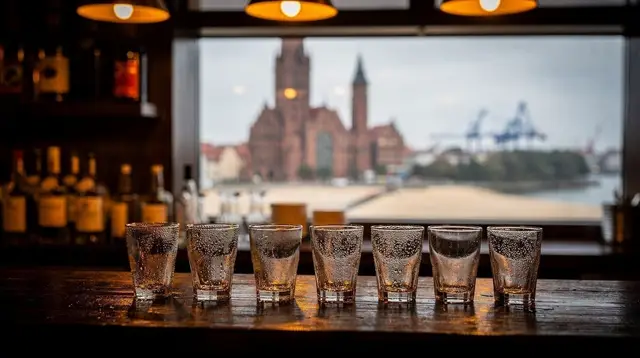
Goldwasser: Gdańsk's Gold-Flecked Liqueur, Tasted Where It Was Born
What is Goldwasser and where does it come from?
Goldwasser is a clear herbal liqueur suspended with flecks of real edible gold leaf, first produced in Gdańsk in 1598. It was never created in Warsaw - Gdańsk's Baltic trading wealth and its access to imported spices and gold are what made the recipe possible here, not anywhere else in Poland.
A liqueur that only makes sense in a port city
Hold a bottle of Goldwasser up to the light and the first thing that happens is always the same: tiny flakes of gold leaf drift and settle through the clear liquid, catching whatever light is in the room. It is a small piece of theatre, and it has been performed the same way since 1598, when the recipe was first produced in Gdansk. Not in Krakow, not in Warsaw - in Gdańsk, and that detail matters more than it sounds like it should.
By the late sixteenth century Gdańsk was one of the wealthiest cities on the Baltic, a leading member of the Hanseatic trading network with ships bringing in goods from across Europe and beyond. A liqueur infused with imported spices and finished with actual gold leaf was not a drink that could plausibly have been invented in a landlocked town with no trading fleet and no access to luxury goods.
It needed a city with money moving through it, warehouses full of exotic cargo, and merchants wealthy enough to want a drink that visibly announced their status. Gdańsk, at the mouth of the Vistula and stitched into Hanseatic trade routes, was exactly that city. Warsaw, Poland’s political capital but never its great Baltic port, has no historical claim on the recipe at all - a distinction worth being precise about, because the two cities get conflated often enough that the error has become a minor cliche.
The Mariacka connection
The clearest place to feel this history is not a museum case but a street: Mariacka, the lane of ornamental stone porches running from St Mary’s Basilica down to the Motława river, traditionally known as Gdańsk’s amber-dealers’ street. Amber and gold are not the same material, obviously, but they belong to the same story. Both are luxury goods that flowed through Gdańsk because the city sat at a crossing point of trade routes and had the wealth to work them into finished products - amber jewellery on one hand, a gold-flecked liqueur on the other.
A stroll along Mariacka and the neighbouring stretch of Dlugi Targ, the grand market street lined with gabled merchant houses, is the closest thing to seeing Goldwasser’s original context still standing. For a longer look at that amber trade specifically, the guide to buying amber on Mariacka street covers the shopping side in detail, and the Amber Museum guide covers the history of the material itself, housed a short walk away in the medieval Foregate.
It is worth being honest about what has and hasn’t survived intact. Gdańsk’s Old Town, including the buildings along Długi Targ and around Mariacka, was largely destroyed in 1945 and rebuilt afterwards - a fact covered in more detail in the piece on Gdańsk being reconstructed rather than untouched. The streets you walk today are careful postwar reconstruction, not preserved sixteenth-century fabric. That doesn’t diminish Goldwasser’s claim to the city - the recipe’s origin in 1598 is a documented historical fact independent of which particular walls still stand - but it is the kind of nuance worth carrying into any visit, rather than assuming every gabled facade is original.
What actually goes into the bottle
Goldwasser is built on a base of herbal and spice infusions - historically described as including anise and caraway among a wider blend of botanicals - rather than being a plain flavoured vodka. The exact historical recipe has shifted over centuries of production and changes of ownership, and no single definitive ingredient list is publicly agreed upon, so it is worth treating any very specific claim about “the original 1598 recipe” with a degree of scepticism. What is consistent is the character: a sweet, aromatic, herbal liqueur, closer in spirit to a spiced cordial than to a neutral spirit, built to be sipped rather than shot.
The gold leaf itself deserves its own explanation, because it is the detail every visitor asks about first. The flakes are thin, food-safe gold leaf, edible and inert - they pass through the body without being absorbed or metabolised, and they contribute essentially nothing to the flavour. Their role has always been decorative and symbolic: a visible, literal display of wealth in a bottle, made possible only because Gdańsk had the trading connections to import gold in the first place. It is a drink that announces its own backstory every time it is poured.
The trade routes that made it possible
It is worth spelling out exactly what “Hanseatic wealth” meant in practical terms, because the phrase can sound like vague historical colour rather than a concrete supply chain. Caraway and anise, the botanicals most consistently associated with Goldwasser, were not exotic in themselves - both grow across temperate Europe. What made a gold-flecked liqueur possible was the other half of the equation: gold leaf, and very likely additional spices, arriving by ship from further afield.
A port city plugged into Hanseatic and broader Baltic shipping lanes had routine access to cargo that a landlocked town simply did not see pass through its markets. Gdańsk’s warehouses along the Motława handled grain exports flowing out and manufactured or luxury goods flowing in, and it was that two-way traffic, not any unique local ingredient, that gave the city’s merchants both the means and the motive to commission a drink built around an imported precious metal. The recipe is, in that sense, less a piece of culinary invention than a piece of economic history that happens to be drinkable.
That context also explains why no other Baltic port produced an identical rival tradition with the same staying power. Wealth alone was not enough; Gdańsk combined trading volume, a stable merchant class willing to spend on conspicuous luxury, and enough continuity across generations for a single recipe to become an established local product rather than a passing novelty tried once and forgotten. Other Hanseatic cities had their own specialities, but Goldwasser is the one that survived as a named, dated, still-produced drink specifically associated with a single city of origin.
Where Goldwasser sits next to Gdańsk’s other traditional drinks
Gdańsk has more than one drink with a claim to local identity, and it is worth being clear about how Goldwasser differs from the others rather than lumping them together.
| Drink | What sets it apart | Where to read more |
|---|---|---|
| Goldwasser | Herbal liqueur with real gold leaf, dated to 1598, historically unique to Gdańsk | This guide |
| Polish vodka | Poland’s best-known spirit category broadly, not a Gdańsk invention specifically | Vodka tasting tour guide |
| Craft beer | A modern brewing scene rather than a centuries-old heritage product | Craft beer tasting guide |
The distinction is worth holding onto: vodka tastings in Gdańsk are about Poland’s national spirit more broadly, and the city’s contemporary craft beer scene is a modern phenomenon with no particular claim to sixteenth-century history. Goldwasser is different in kind - it is the one drink on this list whose origin story is inseparable from Gdańsk itself, tied to a specific year and a specific set of trading conditions that existed in this city and nowhere else in Poland at the time.
Tasting it for real
Goldwasser turns up in a few different settings around the city, and it is worth knowing which one you are walking into. Souvenir shops along the Royal Route and around Długi Targ sell bottles aimed squarely at tourists, often packaged with the gold-flake theatrics foregrounded on the label; some of these are perfectly genuine liqueur, others lean harder into novelty packaging than into quality, so it is worth checking a label and, where possible, a shop’s reputation rather than grabbing the first bottle by the door. Proper liquor stores and better-stocked bars around the Old Town carry more serious versions, sometimes alongside other regional specialities, and are a more reliable bet if the goal is an actual drink rather than a souvenir.
Guided tastings are the other route, and a handful of operators in Gdańsk run sessions that put Goldwasser alongside Polish vodka, flavoured spirits and sometimes other liqueurs, with a guide talking through the history as you go. A three-hour guided vodka tasting tour through Gdańsk is one of the more established formats for this, and while the exact lineup of spirits varies by session, tastings built around Polish vodka traditions often make room for Goldwasser given its local pedigree - it is worth asking directly when booking if seeing it included matters to you.
For something built specifically around Polish spirit categories with a bit more range, a three-course Polish tasting menu paired with wine and spirits gives a fuller sense of how Goldwasser and other traditional drinks sit alongside Polish food, rather than being tasted in isolation.
If spirits are not the priority for the day, a Motława river cruise paired with a pierogi tasting is a gentler way to spend an afternoon on the water that made Gdańsk’s trading wealth - and by extension Goldwasser - possible in the first place, passing the Żuraw crane and the Old Town waterfront from the river side. And for visitors who want to compare Gdańsk’s older traditions against its newer drinking culture, a guided craft beer tasting in Gdańsk makes a useful contrast, showing how differently the city’s beer scene and its centuries-old liqueur trade have each developed.
What not to expect
A few claims are worth heading off directly, because they circulate often enough to need correcting. Goldwasser was not invented in Warsaw, and no credible account places its origin anywhere but Gdańsk in 1598 - if a source says otherwise, treat it as wrong. It is also not a drink woven into daily household life the way, say, tea or coffee might be; it functions today mainly as a heritage specialty, a gift item, and an occasional treat rather than something residents pour with dinner on a Tuesday.
And while it is reasonable to expect prices to vary by bottle size, retailer and time of year, this guide will not hand you a fixed number to expect at the till - comparing a few shops on the day, rather than budgeting around a figure picked up online months earlier, is the more reliable approach.
Buying a bottle to take home
Goldwasser travels well as a souvenir precisely because it does not need refrigeration or careful handling the way food gifts often do - a sealed bottle of liqueur sits happily in luggage or on a shelf for a long time before opening, which is part of why it has functioned as a gift item across generations rather than a one-trip novelty.
What bottle sizes is Goldwasser sold in?
Shops around the Old Town generally stock it in a couple of different formats: full-size bottles aimed at anyone planning to actually drink it at home, and smaller souvenir-format bottles pitched at visitors who want the gold-flake novelty as a gift or a taste without committing to a full bottle. Exact volumes vary by producer, so checking the label rather than assuming a standard size is worth doing if a particular quantity matters.
Can Goldwasser be taken home on a flight?
Treat it like any other bottled spirit. In checked luggage it is generally fine within the destination country’s customs and alcohol-import allowances, though those limits differ by country and are worth checking in advance rather than at the airport. In carry-on, the usual liquids restrictions apply unless the bottle is bought airside after security, in which case duty-free rules for onward travel take over instead. None of this is specific to Goldwasser - it is standard practice for any spirit bought abroad - but it catches enough visitors out that it is worth stating plainly rather than assuming it is obvious.
Making it part of a wider Gdańsk visit
Goldwasser rewards being folded into a walk through the Old Town rather than treated as a standalone errand. A natural route starts at St Mary’s Basilica, continues down Mariacka past the amber stalls, and finishes on Dlugi Targ near the riverfront and the medieval crane, Zuraw - the same stretch of merchant houses that generated the wealth behind the original 1598 recipe.
From there, the Gdańsk Old Town walking tour lays out a fuller circuit of the historic core if there is more time to spend, and the Gdańsk food tour guide is a useful companion for anyone building a day around food and drink rather than sights alone. Evenings are well suited to it too: the best bars in Gdańsk’s Old Town and the wider pub crawl guide both cover venues where a glass of Goldwasser is a realistic order alongside more familiar Polish spirits.
For visitors weighing up how much time to give the city as a whole, the how many days in Gdańsk guide and the first-time in Gdańsk guide both help place a Goldwasser stop within a realistic itinerary rather than treating it as a detour. However it fits into the day, the point of seeking it out is less about the drink itself - a sweet, gold-flecked herbal liqueur, pleasant but not to everyone’s taste - and more about what it represents: tangible proof, in a bottle, of a trading city wealthy enough in 1598 to import gold leaf and exotic spices and turn them into something no other Polish city was positioned to make.
Tastings tours
Verified deep-linked GetYourGuide tours. Book through these links and we earn a small commission at no cost to you.
GetYourGuide does not provide a product photo for this activity — the image shows the meeting point, photographed by us.