Gdynia: Built from Nothing
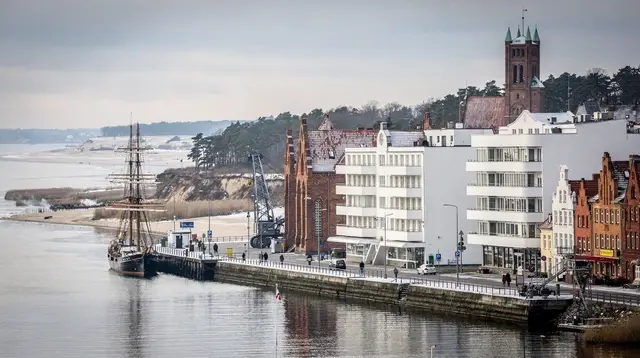
I remember standing on the quay in Gdynia with my back to the sea, looking at the curved white facades stacked along the hillside, and doing the maths in my head. Nineteen twenty-one to today is barely more than a hundred years. That is nothing, by European standards - a blink, a single family’s worth of grandparents. And yet everything in front of me, the harbour, the streets, the apartment blocks with their ship-deck balconies, had been willed into existence in that short span, on ground that a century earlier held a few hundred fishermen and their nets.
That is the thing I keep coming back to about Gdynia. It is not old. It does not pretend to be old. And that turns out to be exactly what makes it worth visiting.
A port built because it had to be
The story starts with a problem, not a plan. When Poland regained independence in 1918 after more than a century of partition, it had a long Baltic coastline on paper but almost no usable port. Danzig - the city we now know as Gdansk - existed, but it was declared a Free City under League of Nations protection, its own semi-autonomous statelet, not simply handed to the new Polish republic; the confusion between that old name and the modern one is common enough that it is worth reading why Danzig is not simply old Gdansk before assuming the two are interchangeable. Poland needed a harbour it actually controlled, and it needed one fast.
So in 1921, construction began at a fishing village called Gdynia, on a stretch of coast that had been more or less marginal until that point. Within a decade it was one of the busiest ports on the Baltic. Within two, it had a population in the tens of thousands where there had been a few hundred. I find that pace genuinely startling when I stand in the city centre today, because nothing about the streets reads as rushed or provisional. It reads as designed.
A city designed in one sitting
That is really the difference. Most European cities are compromises - a medieval core, a Baroque quarter bolted on, a nineteenth-century ring, twentieth-century suburbs, each layer arguing faintly with the last. Gdynia had no such argument to have. It was drawn up more or less in one sitting, by architects working in the confident modernist idiom of the 1920s and 30s, and then built out consistently enough that the result actually holds together as a single statement.
Walking the streets on a Gdynia Modernism route, what struck me was not any single building - though there are handsome ones - but the rhythm of the whole. Curved corner balconies that mimic ship portholes. Horizontal banding on facades that echoes a liner’s hull lines. Flat roofs, porthole windows, a general nautical vocabulary that makes sense the moment you remember this entire city exists because of the sea in front of it. It is not trying to look historic. It is trying to look modern, forward-looking, competent - the physical expression of a young country proving it could build something of its own.
I took a proper walking tour through the modernist centre on my second visit, map in hand, and it changed how I read the buildings. Alone, they are pleasant background. Named and dated, they become a kind of time-lapse: this block from 1932, that one from 1935, the whole thing rising in real time as the port below filled with ships. If you want a guide to walk you through it rather than a map, a private walking tour that also takes in the Kamienna Gora viewpoint covers the same modernist route with a better view at the end of it.
The ships that match the buildings
What sealed it for me, though, was the harbour itself, because two vessels moored there are exactly contemporary with the buildings on the hill. The Dar Pomorza, a tall sailing ship built in the 1900s but adopted as Poland’s training ship from 1930, and the destroyer ORP Blyskawica, launched in the late 1930s and now a museum ship, both sit in the water as floating extensions of the same story. You can walk their decks the same afternoon you walk the modernist streets, and the effect is oddly moving - a maritime nation’s coming-of-age, preserved on land and in the water at once, all from the same handful of years.
Standing at the rail of the Blyskawica, looking back at the shoreline, I thought about how rare this actually is. Most historic ports accumulate their fleets and their architecture over centuries, mismatched. Gdynia got both in a single generation, which means the ships and the buildings genuinely belong to each other in a way you cannot fake or reconstruct later. Seeing that skyline from the water rather than the quay adds something too - a private sailing cruise along the Tricity coast puts the harbour, the museum ships and the hillside facades all in the same frame.
Not a rival to Gdańsk - a different story
I think the mistake first-time visitors make is treating Gdynia as Gdańsk’s less impressive cousin, the place you tack on for an afternoon after the real sightseeing is done. I made that mistake myself the first time. Gdańsk has St Mary’s Basilica, the crane on the Motława, gabled merchant houses along Dlugi Targ - and it is worth remembering, as I found out later, that even that Old Town is a careful postwar reconstruction rather than untouched medieval fabric, a fact laid out in full in why Gdańsk’s Old Town was rebuilt, not preserved. Next to that, a 1930s apartment block can look, on paper, like small beer.
But that comparison only works if you insist both cities are playing the same game. They are not. Gdańsk’s story is one of centuries - Hanseatic trade, Teutonic rule, the Free City years, wartime destruction, patient postwar rebuilding. Gdynia’s story is the opposite kind of achievement: not endurance across centuries, but creation from nothing in barely twenty years, by a country that had just gotten its independence back and wanted proof it could stand on its own coastline.
One city survived. The other was willed into being. Both are remarkable; neither needs to borrow the other’s credentials. If you want the comparison spelled out attraction by attraction rather than as a mood, there is a fuller Gdańsk versus Sopot versus Gdynia breakdown that goes through what each town actually offers.
Once I stopped expecting Gdynia to feel historic in the Gdańsk sense, I started actually seeing it. The clean lines stopped looking under-decorated and started looking deliberate. The absence of a market square and a town hall from the 1300s stopped feeling like a gap and started feeling like the point.
Doing it in the right order
If you are planning a Tricity itinerary, I would genuinely suggest visiting Gdynia after Gdańsk, not before, precisely because the contrast is the experience. Spend a day in Gdańsk’s reconstructed medieval core, then take the SKM train up the coast - it is a short, easy ride - and step out into a city that is doing something completely different with the same short century. One place restores a past that was nearly erased.
The other invented a future and then actually built it. Seeing both in the same trip, in that order, is what finally made Gdynia click for me, and I do not think I would trade the sequence for any other way of understanding this coast. If the modernist centre wins you over enough to consider basing yourself there rather than just passing through, the Sopot versus Gdynia guide to where to stay weighs the two seriously rather than assuming Sopot’s pier automatically wins.
FAQ: Gdynia’s history and modernist architecture
When was Gdynia founded as a city?
Gdynia’s transformation began in 1921, when Poland started building a modern seaport on the site of a small fishing village. It gained city rights in 1926 and grew rapidly through the interwar years.
Why did Poland build a new port at Gdynia instead of using Gdańsk?
After 1918, Gdańsk (then Danzig) was a semi-autonomous Free City under League of Nations protection, not under direct Polish control. Poland needed its own harbour, so it built one at Gdynia from scratch.
What is Gdynia Modernism?
It is the informal name for the coherent style of 1920s-30s architecture built across Gdynia’s city centre during its rapid growth - flat roofs, curved corner balconies and horizontal banding that echo ocean liners, reflecting the young port city’s maritime identity.
Can you visit the ships linked to Gdynia’s interwar history?
Yes. The tall ship Dar Pomorza and the destroyer ORP Blyskawica are both moored in Gdynia’s harbour and open as museum ships, each requiring a separate ticket and roughly an hour to visit.
Is Gdynia worth visiting if I have already seen Gdańsk’s Old Town?
Yes, precisely because it tells a different kind of story. Gdańsk shows centuries of history and postwar reconstruction; Gdynia shows a city designed and built almost entirely within one generation.
How do I get from Gdańsk to Gdynia?
The SKM commuter train connects Gdańsk, Sopot and Gdynia along the coast, with frequent departures and journey times of well under an hour from central Gdańsk.
Is Gdynia part of the Tricity?
Yes. The Tricity (Trojmiasto) is the conurbation of Gdańsk, Sopot and Gdynia strung along roughly 30 kilometres of Baltic coastline, and Gdynia is its youngest member by far.
tours.History
Verified deep-linked GetYourGuide tours. Book through these links and we earn a small commission at no cost to you.
GetYourGuide does not provide a product photo for this activity — the image shows the meeting point, photographed by us.