Baltic Winter: A Season of Its Own in Gdańsk
The first time I stood on Długi Targ in December, it was not yet four in the afternoon and the streetlamps were already on. The gabled facades that look warm and golden in every summer photograph had gone the colour of old brass, lit from below by shop windows and the string lights strung between the buildings for the season. I remember being surprised by how early the dark came, and then surprised again by how little I minded it.
Gdańsk in winter runs on a different clock, and once you stop expecting it to behave like a summer city, it starts to make its own kind of sense.
Why the days feel so short
This is a matter of simple latitude, not mood. Gdańsk sits far enough north that its daylight swings hard between the seasons. In late December, the sun sets around half past three in the afternoon and doesn’t rise again until close to eight the next morning - a window of useful daylight that barely covers a working day.
Compare that with June, when the sky is already light by half past four in the morning and the sun doesn’t properly set until after nine at night, and you get some sense of how far this coast swings between its two extremes. The city runs on Central European Time, UTC+1 in winter, and the clocks don’t spring forward into CEST until late March - so that short winter daylight is exactly what the calendar promises, not a local quirk.
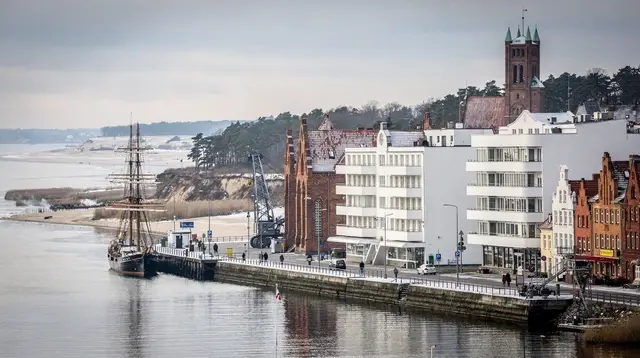
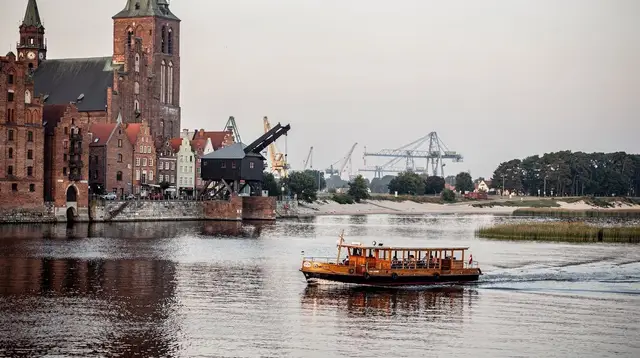
None of this makes December a diminished version of June. It makes it a different city, with a different relationship to light. Streetlamps and shop windows do more of the work than the sky does. Walking along the Motława after dark, with the reflections of the old granaries breaking up on the water, has a stillness that the crowded summer waterfront never quite has.
The cold is real, but it’s not extreme
Daytime temperatures through December, January and February typically sit somewhere between minus three and plus three degrees Celsius - properly cold, especially with wind coming straight off the Baltic, but rarely the kind of hard freeze that shuts a city down. Snow falls, but it tends to come and go rather than settle for weeks, since the sea keeps the coast a few degrees milder than inland Poland. What catches people out is less the thermometer than the wind: a still, sunny morning in the Główne Miasto can turn sharp and biting by the time you reach the open ground near Westerplatte or the water beyond Oliwa. Layers and a proper windproof coat do more good here than a heavy parka.
A quieter, more interior city
What struck me most was not the cold but the quiet. The queues that build up outside St Mary’s Basilica in August simply aren’t there in January. Cafes fill with locals rather than tour groups, and conversations carry across the room instead of dissolving into a hundred others. The European Solidarity Centre and the Gdańsk Shipyard grounds around it feel more like what they are - a serious historical site - without the summer crowds turning it into a photo stop.
This is where the “closed for the season” assumption gets it wrong. Gdańsk’s Old Town was rebuilt after 1945 as a city meant to be lived in, not just photographed in good weather, and its museums, churches and bars are built for indoor, year-round visiting. A walk through the reconstructed streets in low winter light, past the same crane and the same basilica tower that draw the summer crowds, is not a lesser experience - it’s simply a different one, with room to actually notice the architecture instead of the person in front of you.
If I want structure rather than wandering on my own, I’ve taken a private city tour style walk through the Old Town in winter and found it worked just as well as it would in July - arguably better, since a guide has room to actually stop and talk without a crowd bottlenecking behind you.
a private guided walk through Gdańsk’s Old TownFor anyone with Polish roots in the region, winter is also, oddly, a good season to dig into that history - the archives and records offices are far less busy, and a guided session tracing a genealogy walk through Gdańsk’s historical records fits naturally into a shorter, indoor-leaning winter day.
The market on Targ Węglowy
December brings the one event that genuinely reshapes the city’s winter rhythm: the Christmas market on Targ Węglowy, the square beside St Mary’s Basilica. Wooden stalls sell mulled wine, oscypek cheese grilled over charcoal, and the kind of amber jewellery Mariacka street sells all year, now lit by strings of white bulbs against the dark. It runs for most of December, and it’s worth timing a visit around rather than treating as a bonus - it’s as central to the winter identity of this city as the Jarmark Sw. Dominika street fair is to August, just smaller and colder.
I’d pair an evening there with something further out the next day, weather allowing - the coast itself doesn’t fully hibernate. For a slower look at the Old Town from ground level, a golf cart tour through Gdańsk’s historic streets covers more ground than walking without losing the detail. Boat operators run a reduced winter schedule, but a shorter winter cruise out toward the Baltic Sea still gets you the grey, moving water and the skyline from the harbour side, minus the summer queues.
Choosing winter on purpose
None of this is an argument that winter beats summer. June and July give Gdańsk something genuinely irreplaceable: long, bright evenings on the pier in Sopot, warm stone underfoot on Dlugi Targ, the whole city outdoors at once. What I’d push back on is the idea that winter is simply summer with the lights turned off - a compromise for people who couldn’t get the dates they wanted.
It isn’t. It’s a season with its own texture: short days that make the lit-up facades and market stalls feel earned rather than incidental, museums and churches that get to be the main event instead of a shelter from the heat, and a city that, for a few months, moves at the pace of the people who actually live here rather than the people visiting them. If you go in December or January expecting that city, rather than a diminished version of the one in the postcards, it delivers.
Worth knowing before you book: not every part of this coast keeps the same winter identity. Gdańsk’s centre stays genuinely alive through the cold months, but the beach towns and open-air sights scale right back - useful to factor in when deciding how many days to spend here and where to spend them. If the short days and cold don’t appeal, the shoulder months either side - covered in our October and June guides - offer a middle ground. But if you want the market on Targ Węglowy, the empty churches, and a city lit mostly by itself, Gdańsk’s winter is worth choosing on purpose, not settling for by accident of calendar.
Seasonal guide
Verified deep-linked GetYourGuide tours. Book through these links and we earn a small commission at no cost to you.
GetYourGuide does not provide a product photo for this activity — the image shows the meeting point, photographed by us.