Jarmark Dominika: A Fair Older Than Any Shop in Europe
I’ve walked past a lot of “historic” markets in a lot of European cities, and most of the time the word is doing more work than the market deserves. A cobbled square, some mulled wine, a banner claiming roots in some vaguely medieval century — and then you notice the stalls are selling the same fridge magnets you saw in the last three cities. St Dominic’s Fair in Gdansk is not that. It is the one time I’ve stood in a European market and actually believed the date on the sign, because the date on the sign is 1260, and nothing about that number is decoration.
A privilege granted before most of Europe’s institutions existed
Jarmark Swietego Dominika — St Dominic’s Fair — began with a trading privilege granted in 1260 by Duke Swietopelk II of Pomerania, tied to the Dominican friary that stood near what is now St Dominic’s Square, just off Dlugi Targ. Put that year next to almost anything else still trading in Europe today. It predates the oldest universities that still function as universities by decades in some cases and centuries in others.
It predates the Hanseatic League’s formal peak. It predates the printing press by close to two hundred years. Most of what we call “historic” commerce in Europe — a department store, a guild hall turned museum, a market building with a plaque — is measured in centuries, singular. This fair is measured in centuries, plural, and it has never really stopped.
That’s the part I keep coming back to. Continuity, not age. A ruin is old. A fair that has been held, in some form, in more or less the same streets, for 765 years, is something else — it’s a habit a city has never broken. Wars flattened the buildings around it. Regimes changed the name over the door — Danzig, then Gdańsk, then Danzig again, then Gdańsk for good, a whiplash I’ve written about separately at why Danzig isn’t Gdańsk today.
The Old Town itself was reduced to rubble in 1945 and rebuilt from drawings and photographs, a fact I still find genuinely disorienting when I’m standing in front of those gabled facades, and one I go into properly in why Gdańsk’s Old Town isn’t original. Through all of that, the fair kept returning to its own streets every summer. That’s not nostalgia. That’s an institution refusing to die.
Why a trading city defends a market like this
Gdańsk doesn’t have to manufacture a merchant identity — it earned one. This was a leading member of the Hanseatic League from the fourteenth century, a port that grew rich moving grain, amber, timber and textiles between the Baltic and the rest of Europe. The wealth is still legible in the brick gables lining Dluga and Długi Targ, built by merchant families who had every reason to want their trading privileges protected and renewed. St Dominic’s Fair isn’t a modern tourist add-on wearing that history as a costume; it’s the actual surviving mechanism of that history, still doing roughly what it was chartered to do — bring traders and buyers into the same streets for a few weeks each summer.
That distinction matters more than it sounds like it should, and it’s the reason I think this fair deserves defending on its own terms rather than being filed under “seasonal event, see also: every other city’s summer festival.” A city that invents a heritage market from scratch is doing marketing. A city that has kept one running, with interruptions for war and occupation but never real abandonment, since before the Teutonic Knights built Malbork Castle, is doing something closer to preservation. I’d rather spend an August afternoon inside a fair that’s earned its age than inside one that’s borrowed it.
What three weeks in the Old Town actually looks like
The fair runs for roughly three weeks, starting on the Saturday nearest the start of August and running into the middle of the month, spreading out from St Dominic’s Square and Dlugi Targ through the wider Main Town.
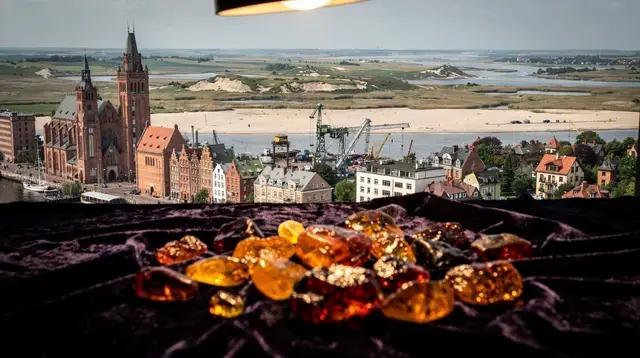
I’ve found the character changes noticeably across those three weeks — the opening weekend is loud, packed and a little chaotic, while a Tuesday morning in week two lets you actually talk to the stallholders and look properly at the amber on offer, which matters given how much of it is sold near Mariacka street, a lane I trust far more than most fair stalls for the real thing (there’s a reason the Amber Museum exists a few minutes’ walk from here — it’s worth knowing what genuine Baltic amber looks like before you buy any of it at a stall).
If a booked walk through the Old Town appeals more than wandering on your own, a guided walking tour of the Old Town timed around the fair puts the market in its proper historical context rather than leaving it as background noise, and a private city tour of Gdańsk is a reasonable way to fit the fair alongside the Shipyard, the Motława waterfront and St Mary’s Basilica without losing a full day to crowds.
For something that steps away from the stalls entirely, a morning catamaran cruise from Gdańsk or Sopot gives the Old Town a rest and the harbour some air.
Don’t confuse it with December
I want to be direct about this because I’ve seen it trip people up when planning a trip: St Dominic’s Fair and the Gdańsk Christmas market are not the same event wearing different weather. St Dominic’s Fair is a summer institution, running late July into mid-August, with roots in 1260 and a home base on Długi Targ.
The Christmas market, with its mulled wine and lights against those same gabled facades, is a much more recent addition to the calendar, held in December on Targ Węglowy, a different square with a different atmosphere and a different history. If you’re planning around when to visit Gdańsk in summer, you want the fair; if you’re planning a festive trip, you want the market. They share a city and, loosely, a spirit of commerce in public squares, but conflating the two dates is an easy way to book the wrong month.
Why I keep coming back to this one
I don’t think every old thing deserves automatic respect just for surviving. Plenty of “historic” markets are historic in name only, propped up for photographs. What sets St Dominic’s Fair apart, for me, is that it never really needed reviving — it just kept happening, through the Hanseatic centuries, through the Free City years, through the rubble of 1945, into whatever Gdańsk is now. Walking through it isn’t like visiting a museum piece.
It’s like joining something that was already in progress before your country had a name it still uses, and that will very probably still be running in the streets around Gdańsk’s Old Town long after this particular August ends. If you’re mapping out a first visit, it’s worth building a day in Gdansk around whichever three weeks the fair happens to fall on — everything else in the Old Town is there year-round; this isn’t.
Winter activities
Verified deep-linked GetYourGuide tours. Book through these links and we earn a small commission at no cost to you.
GetYourGuide does not provide a product photo for this activity — the image shows the meeting point, photographed by us.