Why Gdańsk Has No Metro (And Why I Stopped Missing One)
The first time a friend visited me here, she pulled up a transit app before her flight and asked, half-joking, which metro line went to the Old Town. I had to tell her: there isn’t one. No colour-coded map, no underground platforms, no line numbers. She looked faintly betrayed, like I’d withheld something. A few days later, after we’d ridden the train along the coast to Sopot and back with sea views the whole way, she admitted she didn’t miss it at all.
That reaction is common enough that I think it’s worth explaining properly, because the absence of a metro in Gdansk isn’t a gap. It’s a fairly logical response to the shape of the place.
The shape of the city is the whole answer
Picture most cities with a metro — Warsaw, Berlin, London — and you’re picturing something roughly round: a centre, with neighbourhoods radiating outward in every direction. A metro’s grid or spoke-and-hub layout exists to connect points scattered across a circle. That’s what the technology is for.
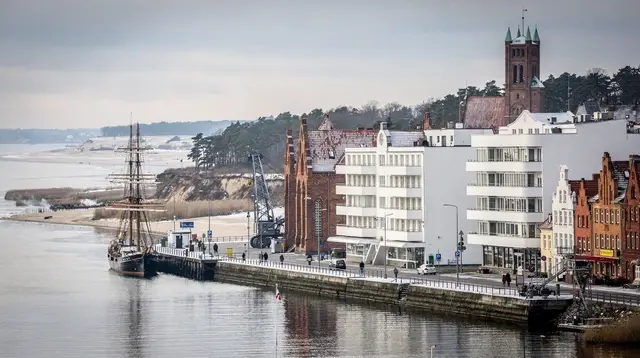
The Tricity isn’t a circle. It’s a ribbon. Gdańsk, Sopot and Gdynia sit in a line along maybe 30 kilometres of Baltic coastline, hemmed in by the sea on one side and a ridge of hills on the other. There’s very little “outward” to grow into — the geography simply doesn’t allow it. So the conurbation grew lengthwise instead, like beads on a string, with Reda and other commuter towns further along the same thread.
A metro is the wrong tool for a ribbon. What you actually want is a train that runs the length of it, stopping often, moving fast. Which is, more or less, exactly what already exists.
The SKM does the job a metro would have done
The SKM — Szybka Kolej Miejska, the “fast urban railway” — has been running along this coast since the 1950s, decades before anyone here would have seriously debated tunnelling a metro under a UNESCO-adjacent Old Town. It threads through central Gdańsk, out past Oliwa, through Sopot, into Gdynia, and on to smaller towns beyond. Trains run every 10 to 20 minutes at peak times, which is frequent enough that I genuinely never check a timetable — I just walk to the platform.
The distances involved are short enough that the difference between “metro” and “commuter train” barely registers in practice. Gdańsk to Sopot is about 20 minutes. Gdańsk to Gdynia is around 35. I’ve had slower commutes on an actual metro in cities that have one. And because the SKM runs mostly at ground level along the shore rather than underground, you get a strip of sea between stations instead of a tunnel wall — not a small thing on a sunny afternoon.
There’s also the PKM, a newer line that extends service further south into areas the older SKM route doesn’t reach, plus a dense network of trams and buses filling in the gaps — the side streets and inland neighbourhoods a coastal railway line was never going to cover on its own. If you want the full breakdown of how the pieces fit together, I’d point you to a proper guide on getting around the Tricity by SKM, tram and bus rather than trying to cram it all in here.
The one thing that trips visitors up
Here’s the catch, and it’s the part my friend actually struggled with once she understood the rest: the SKM ticket and the tram or bus ticket are not the same thing. They’re run by separate operators, so a train ticket doesn’t cover a tram, and a tram ticket doesn’t cover the train. If you’ve used a city where one card taps onto everything — buses, trains, trams, all one system — this feels like a design flaw. It isn’t, exactly; it’s just two networks that grew up under different owners and never fully merged their ticketing.
For a short visit, this barely matters — you buy what you need at the machine or in an app, and the fares are cheap enough that double-checking rarely costs you more than a couple of zloty in a wasted ticket. If you’re staying several days and moving around a lot, it’s worth knowing that a combined metropolitan pass exists, covering both the SKM and the local trams and buses under one ticket for a set period. That single purchase removes the friction entirely and is what I’d actually recommend to anyone planning more than a day or two of hopping between Gdansk, Sopot and Gdynia.
What this means for a visitor, practically
You won’t need a car here, and I’d actively steer you away from renting one for a Tricity-only trip — parking near the Old Town is more hassle than it’s worth, and the train does the coastal run faster than driving in summer traffic ever will. If you’re weighing that decision in more detail, there’s a longer piece on whether you should rent a car in Gdansk that goes through the trade-offs properly.
What you will want is a rough sense of the geography, because “no metro” really just means “think in a straight line, not a circle.” Old Town Gdańsk, the Gdańsk Shipyard, Sopot’s pier and Gdynia’s modernist centre all sit on or near the same rail line, roughly in that order along the coast. Plan a day around that line rather than around a transit map with branches, and the whole conurbation opens up without much thought. If you land at the airport first, the transfer into the city centre plugs into this same network rather than a separate metro link, which is one less system to learn.
For a first orientation, I still think the best way to get a feel for how compact and walkable this coastline actually is comes from a guide walking you through it in person — I booked a private city tour of Gdańsk on my second visit and it clarified the layout faster than any map had.
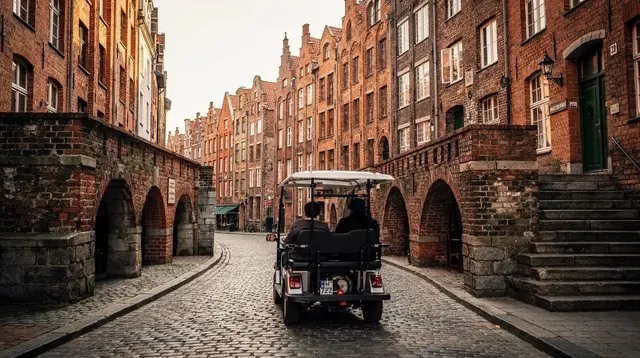
If you’d rather explore the Old Town lanes at your own pace first, an Old Town walking tour covers the historic core on foot before you ever need to think about trains. And once you’ve got your bearings, seeing the coast from the water on a breakfast cruise along the bay is a good reminder of just how directly the whole Tricity hugs a single shoreline — the same shoreline the SKM has been quietly following for seventy years.
If you’re mapping out how many stops to actually make, a three-day Tricity itinerary or the shorter Gdańsk and Sopot in two days route both lean on exactly this train line rather than a car. For deciding where to base yourself among the three cities, Gdańsk versus Sopot versus Gdynia is worth a read, and if you’re still working out how long to spend here overall, how many days in Gdansk covers that separately.
For cyclists, the coast also has a good cycling route linking Gdańsk, Sopot and Gdynia that runs roughly parallel to the railway, and for a wider look at things to do around Gdynia and the Tricity beyond transport, there’s more to explore. I still keep a map of the region open on my phone more out of habit than necessity — the line along the coast really is that simple to follow.
No metro, no problem
I understand the instinct to expect one. Most cities this size, with this many visitors, have something underground. But a metro solves a problem the Tricity doesn’t have. What it has instead is a coastline shaped like a ribbon, and a train that’s been running the length of that ribbon since before most metros existed. It’s not a workaround. It’s just the right answer for the shape of the place — and after a few days here, I stopped thinking of it as a substitute for anything at all.
tours.Explainer
Verified deep-linked GetYourGuide tours. Book through these links and we earn a small commission at no cost to you.
GetYourGuide does not provide a product photo for this activity — the image shows the meeting point, photographed by us.