Family-Friendly Activities in Gdańsk and the Tricity
What are the best family activities in Gdańsk and the Tricity?
Oliwa Park and its small zoo, the beaches at Sopot, Gdynia and Brzezno, the Sopot pier, and a handful of indoor backups like escape rooms or a golf-cart city tour cover most ages. None of these are free everywhere or guaranteed to suit toddlers and teenagers equally, so it is worth checking each site's own page before setting out, especially if rain is forecast.
This page is not a step-by-step itinerary. It is a list to pick from: a spread of activities across Gdańsk, Sopot and Gdynia that tend to work well with children, grouped loosely by what they need (outdoors, indoors, a ticket, no ticket at all), so a family can scan it and build a day out of whatever suits their kids, the weather and how much walking anyone has left in them. For a more structured, age-by-age approach to Gdańsk itself, see Gdańsk with Kids; this page instead ranges across the whole Tricity and leans more practical than narrative.
Picking a pace: half a day or a full one
Not every family wants to cover all three cities in one day, and trying to do so with young children usually backfires. A half-day plan built around Oliwa Park and its zoo, or around Sopot’s pier and beach, keeps travel time low and leaves room for a slow lunch and an unplanned nap. A full-day plan that adds Gdynia’s aquarium and ships, or a golf-cart tour of the Old Town, works better for families with older children who tolerate more transit and less downtime. There is no single right answer here: a toddler and a group of ten-year-olds have very different tolerances for a train, a queue and a museum in the same afternoon, so it is worth choosing the pace before choosing the stops, rather than the other way round.
Oliwa: a park, a small zoo, and an organ
Oliwa Park, in the northern part of Gdańsk, is the closest thing the city has to an obvious default family outing. The park itself is free, shaded, and laid out with gentle paths that suit a stroller or a toddler on a scooter without much trouble. Inside the park boundary sits a small zoo — modest by international standards, more petting-zoo-and-aviary than safari park, but genuinely popular with younger children and priced as a separate ticket from the park itself. Next to the park stands Oliwa Cathedral, whose historic pipe organ gives short recitals through the day, more frequent in summer and considerably thinner in the off-season; the seats fill for the popular slots, so arrive a little early rather than assuming a spot.
None of this is free across the board — plan on paying for the zoo and possibly for the best organ recital seats — and none of it is equally gripping for every age; a five-year-old and a fourteen-year-old will not rate the organ recital the same way. The full detail on tickets, timing and what to see in what order lives on the dedicated page: Oliwa Park, Zoo and Cathedral Guide. Oliwa itself sits a short SKM ride from central Gdańsk; see /destinations/oliwa/ for the district in context, and Gdańsk with Kids: Oliwa and the Zoo for a kids-first take on the same neighbourhood.
Sobieszewo Island: for families who want fewer crowds
Most family lists in the Tricity stop at Oliwa, Sopot and Gdynia, and skip Sobieszewo Island entirely, which is a shame for families with children who like birds, water and open space more than shops and ticket queues. The island sits at the mouth of the Vistula on the edge of Gdańsk and functions as a bird reserve, with boardwalks and flat paths that suit a stroller reasonably well away from the reserve’s wilder stretches.
It is quieter than anywhere else on this list, which cuts both ways: there is little in the way of cafes, toilets or shade once away from the main access points, so it suits a family that has packed water and snacks rather than one expecting facilities at every turn. It is also further out than Oliwa or Sopot and needs more planning to reach, which is exactly why it stays uncrowded. See /destinations/sobieszewo-island/ for the practical detail.
The beaches: Sopot, Gdynia, Brzezno
The Tricity’s beaches are its other reliable family default, and they are spread across all three cities rather than concentrated in one. Sopot’s beach, right below the pier, is the most central and the easiest to combine with a walk, an ice cream and a look at Europe’s longest wooden pier. Gdynia’s beaches, including the one at Orlowo near the cliff, tend to be a little quieter and sit close to the marine attractions along the waterfront. Gdańsk’s own beach at Brzezno, north of the centre, is the option that needs no trip out of the city at all.
All three are sandy and shelve gently, which is what makes them workable for small children, but the sea itself is the honest catch: the Baltic rarely climbs past 18-20 degrees Celsius even at the height of summer, lifeguard cover runs only through the warm months, and a windy afternoon can turn a calm morning swim into a choppy one within an hour. None of these beaches guarantee clement weather or warm water, and none of them are staffed year-round — a September or October visit to any of them is a walk-and-look outing, not a swimming one. The full picture, including which beach suits which kind of family day, is on Gdańsk Beaches and Baltic Swimming Guide.
Gdynia: an aquarium, ships, and a modernist walk
Gdynia earns its own half-day on a family list, and for reasons beyond the beach. The city has a marine aquarium on its waterfront, close to the docked museum ships — including the tall ship Dar Pomorza and the destroyer Blyskawica — that draw families for an hour or two apiece; each of these is a separate ticket, so budgeting a morning for the ships and aquarium together and an afternoon for something else tends to work better than trying to fold all of it into one rushed visit.
Gdynia is also, distinctively, a twentieth-century city: built almost from nothing as Poland’s main seaport after 1918-20, its centre is full of interwar modernist buildings that read more like a self-guided architecture trail than a conventional old town, and older children with some patience for buildings can get something out of a slow walk through it even without a formal tour.
The background on that architecture is on Gdynia Modernism Guide; the district itself is at /destinations/gdynia/. Families who want the history explained rather than self-guided can look at a tour that links Gdańsk, Oliwa, Gdynia and Sopot into a single guided day, which removes the logistics of stitching the three cities together by train.
Sopot: the pier, and not much else needed
Sopot does not need a long list of separate activities — the pier itself, the beach beneath it, and the pedestrian streets running back from the seafront are enough to fill an afternoon without any particular plan. The pier charges a small seasonal entry fee (often unenforced out of season) and needs no booking; walking to the end and back, with stops, takes most families the better part of an hour. For families who prefer a fixed structure to their walk rather than wandering, Sopot Walking Tour lays out a route. The district overview is at /destinations/sopot/.
Getting around with a stroller or a wheelchair
The Tricity is not uniformly easy going with a buggy or a wheelchair, and it is worth knowing where the friction sits before setting out. Sopot’s pier is boarded and flat for its whole length, and Gdynia’s modernist streets are generally wide, paved and gently graded, which makes both straightforward. Gdańsk’s Old Town is a different story: much of Długi Targ and the streets around it are cobbled, which is manageable but slow going and genuinely uncomfortable over any distance for a wheelchair or an unsprung stroller.
The SKM trains that link the three cities have level or near-level boarding at most stations, but not every platform has a lift, so a family relying on one is better checking a specific station in advance rather than assuming. A fuller picture, station by station and site by site, is on Wheelchair-Accessible Attractions in the Tricity and Accessible Transport in Gdansk.
On the water, without swimming
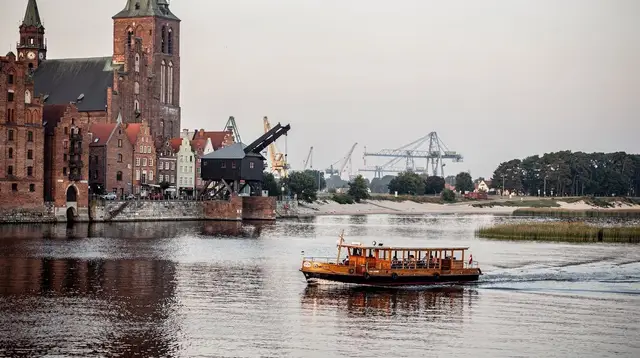
Not every family wants to get in the sea to enjoy it. Boat trips along the Motława and out into the bay are a way to see Gdańsk, Westerplatte or the Tricity coastline from the water without anyone needing to swim, and they tend to hold a child’s attention better than a walking tour of the same distance. Families travelling as a larger group, or wanting something a notch more private than a scheduled public boat, can look at a private catamaran cruise between Gdańsk and Sopot — worth booking ahead in summer, since private boats have limited daily slots and fill up on weekends.
Indoor backups for a grey day
Baltic weather does not cooperate on demand, and a rainy afternoon is common enough in the Tricity that it is worth having a plan rather than hoping. A covered, motorised alternative to a walking tour is a golf-cart ride through the Old Town, which keeps everyone dry and moving without asking small legs to cover several kilometres on foot; one option pairs the ride with a look at the city’s beer history, via a golf-cart city tour that also covers Gdańsk’s beer traditions — best treated as an adults-plus-older-teens option given the theme, rather than one for younger children.
Escape rooms are a more reliably all-ages indoor option scattered across the city; see Gdańsk Escape Rooms Guide for what is on offer. For families who want music rather than puzzles, a piano concert programmed specifically for a whole family audience runs indoors regardless of the forecast. A broader rundown of what actually holds up when the sky turns grey is on Gdańsk in the Rain.
For families with more energy to burn
Some children — and more than a few parents — want something with a pulse rather than a walk. Karting is the obvious outlet, covered on Gdańsk Karting and Adrenaline Activities, though it suits older children rather than toddlers and is worth checking for a minimum age or height before booking.
On the water rather than the road, the Tricity’s watersports scene runs from paddleboarding to sailing; a family version of a coastal boat trip that leans toward fun rather than sightseeing is the private boat outing with music on board around Gdańsk and Sopot — again, one to treat as a mixed-age or older-teen option rather than a young children’s activity given the party format.
What this list will not promise
A few honest limits, because a family list is only useful if it does not oversell. Not everything here is free: the zoo, the organ recitals’ best seats, most boat trips and every tour charge admission, and only the parks, the beaches and a self-guided walk through Gdynia cost nothing at all. Not everything suits every age: a toddler and a fourteen-year-old rarely enjoy the same stop on this list equally, so it is worth matching the activity to your own children rather than assuming a “family” label covers everyone. And the weather is not guaranteed to cooperate — the Baltic coast is genuinely windy and prone to sudden showers even in summer, so treat the indoor options above as a real plan B, not an afterthought.
Roughly what a day costs
None of this needs to be expensive, but it is rarely free either, and it helps to know where the money actually goes before arriving. The single biggest variable is tickets: the Oliwa zoo, the Gdynia aquarium and museum ships, and any tour or boat trip each carry their own admission, and these add up fast if a family tries to do all of them in one visit.
The cheapest version of a Tricity family day costs almost nothing beyond train tickets and food: Oliwa Park, any of the three beaches, Sopot’s streets and a walk through Gdynia’s modernist centre are all free to simply walk through. The more expensive version, stacking the zoo, the aquarium, a golf-cart ride and a boat trip into one day, adds up meaningfully once several tickets are multiplied by a family’s headcount. A broader sense of what things cost across the region, not just for families, is on Gdańsk Budget Travel Guide.
A couple more questions
Is Sobieszewo Island worth the extra trip with children?
For families who enjoy nature and are not chasing a checklist, yes — the bird reserve and its boardwalks are a genuine change of pace from the museums and ticketed sights elsewhere on this list. It suits children who are happy walking and looking rather than expecting a playground or a cafe at the end, and it is not the right choice for a family with only a single free afternoon and a long list of other stops still to cover.
Is the Tricity manageable for a family using a stroller or a wheelchair throughout?
Parts of it, yes, and parts of it are genuinely difficult. Sopot’s pier and Gdynia’s modern streets are easy going, the SKM trains mostly have level boarding, and Oliwa Park’s paths are smooth, but the cobbled streets of Gdańsk’s Old Town slow everyone down and are uncomfortable over distance. Plan the Old Town portion of any day as the slower, more deliberate stretch rather than assuming the same pace throughout.
Getting between the pieces
Because this list spans three cities, transport matters more than it would for a single-city day. The SKM commuter train links Gdańsk, Sopot and Gdynia along the coast every 10-20 minutes at peak times, and it is the practical backbone for stitching together a park visit in Oliwa, a beach afternoon in Sopot and an aquarium stop in Gdynia without needing a car. The mechanics of tickets, trains and trams are covered on Getting Around the Tricity: SKM, Tram and Bus.
Families building a longer stay around activities like these, rather than a single day, can look at Family Tricity Week for a fuller shape, or browse the things to do in Gdynia and the Tricity category page for more options grouped by location. For Oliwa specifically, the Oliwa parks and zoo category lists further nearby options beyond the park and zoo themselves.
Family activities
Verified deep-linked GetYourGuide tours. Book through these links and we earn a small commission at no cost to you.
GetYourGuide does not provide a product photo for this activity — the image shows the meeting point, photographed by us.