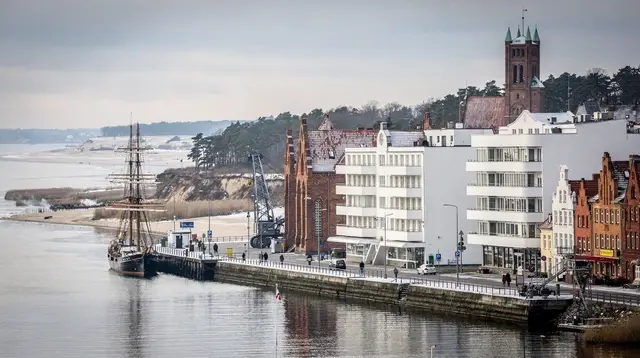
Sobieszewo Island sits at the very edge of Gdańsk, where the Vistula river splits into two branches on its way to the Baltic Sea and encloses a flat, wooded stretch of land between them. It belongs to the city administratively, but it does not feel like the city. There is no Gothic old town here, no gabled merchant houses, no crowds spilling out of amber shops. What there is instead is a protected bird reserve, several kilometres of open, largely undeveloped beach, and a quiet that is hard to find anywhere else within Gdańsk’s boundaries.
That quiet is the honest selling point, and it is worth being upfront about what it does and doesn’t mean. This is not a warm-water beach escape and not a miniature Sopot. The Baltic stays cold here just as it does everywhere else along this coast, and the island has no seafront promenade, no pier, no cluster of bars and hotels. What it offers instead is space: room to walk, room to watch birds, room to stand on an empty stretch of sand that would be unthinkable in July in a resort town. Visitors who come expecting a livelier alternative to Sopot will be disappointed; visitors who come for a change of register after a few days in the Main Town tend to leave satisfied.
A reserve built around migration, not spectacle
The island’s best-known feature is Ptasi Raj, or “Birds’ Paradise,” a protected wetland reserve at the mouth of the Vistula’s Dead Vistula (Martwa Wisla) branch. The reserve exists because this stretch of coast sits directly on a major migratory flyway: waterbirds moving along the Baltic in spring and autumn use the shallow lagoons, reedbeds and sandbars here to rest and feed, and a resident population nests through the summer. Species recorded in the area include various gulls, terns, waders, ducks and geese, with the reserve’s marshy interior and open water drawing the largest concentrations during the spring and autumn migration windows.
This is not a zoo or a visitor centre with staffed exhibits. It is a working protected landscape with marked paths, a few observation points, and signage — the kind of place that rewards patience and a pair of binoculars far more than a quick drive-by. Early morning and late afternoon are the most productive times to see activity, as they are at most bird reserves, and a completely silent approach along the boardwalks and paths will produce more sightings than a noisy one.
Visitors without binoculars can still enjoy the walk itself: the terrain is flat, the paths run through pine woodland and open marsh, and the sense of being somewhere genuinely wild, a short bus ride from a city of half a million people, is itself part of the appeal. Those who would rather have a naturalist point things out along the way can join a guided nature walk and wildlife tour of the reserve instead of navigating the marked trails alone.
Families with children who enjoyed the more curated wildlife setting at Oliwa Park’s cathedral grounds and zoo should recalibrate expectations here: Sobieszewo is unstructured nature, not a family attraction with facilities, though older children with a genuine interest in birds or open-air walking often respond well to it. For a broader sense of what else works well with children in the area, the family-friendly activities guide for Gdańsk and the Tricity covers more structured options alongside places like this one.
The beaches: wide, quiet, and cold
The island’s beach frontage runs along the open Baltic on its northern edge, and it is a different experience from the beaches closer to the city centre or in Sopot. There are no beach bars, no rented loungers stacked in rows, no volleyball courts drawing crowds. What there is instead is a long, wide stretch of pale sand backed by dunes and pine forest, often close to empty even in the warmer months, particularly away from the main access points.
It would be misleading to describe this as a swimming destination in the way that phrase is usually meant. The Baltic Sea along this whole coast rarely exceeds 18-20 degrees Celsius even at the height of summer, and a windy day can drop the water temperature noticeably within hours. A swim here is brisk and short, a bracing dip rather than a lounge in warm water, and that is true of every beach on this coast, not a shortcoming specific to Sobieszewo. What sets the island’s beaches apart is not warmer water but simply fewer people and more room.
Anyone comparing notes with Sopot’s beach scene, or wondering why the two places feel so different, will find the contrast explained plainly in why Sopot isn’t the Baltic’s answer to Saint-Tropez and in the wider context of why this coast is not a Mediterranean stand-in. For a fuller picture of where the region’s beaches sit relative to each other, the Baltic swimming guide is the better starting point before choosing where to spend a beach day.
Facilities near the beach access points are modest: a handful of seasonal kiosks selling drinks and simple food, some marked parking, and little else. Away from those points, the beach empties out quickly. Visitors who want lifeguard-monitored swimming areas, changing facilities or food options close at hand should stick closer to town; visitors who want a long, uncrowded walk by the sea with the option of a cold swim will find exactly that here.
Seasonal rhythms: migration months versus the beach season
The reserve and the beach reward visitors at different times of year, and conflating the two seasons is a common planning mistake. Spring migration, roughly March through May, and the autumn passage from August into October, are when Ptasi Raj sees the highest concentration of birds, as waders, ducks and geese stop to rest on their way along the Baltic flyway. Summer nesting activity continues through June and July, but the sheer volume of passing birds is lower than at the migration peaks. Visitors who come purely for birdwatching and can be flexible with dates are often better served by a shoulder-season visit than a July one, even though July is when the beach is at its most pleasant for walking and a quick swim.
Winter is a different island altogether. The seasonal kiosks close, the guesthouses that stay open thin out further, and the beach becomes a genuinely bracing, near-empty stretch of sand and dune grass under a grey Baltic sky. The reserve itself stays open year-round and can still reward a cold, quiet walk, since some waterfowl overwinter on the unfrozen stretches of the Dead Vistula, but this is a visit for someone who wants solitude rather than comfort, and public transport frequency drops along with everything else.
Practicalities: parking, signal and what not to expect
A handful of details are worth knowing before setting out, since they rarely make it into a quick glance at the map. Mobile phone signal is patchy in parts of the reserve and along the beach away from the settlements, so downloading a trail map or the bus timetable in advance is more reliable than counting on a live connection once there. Cash is worth carrying in small amounts: the seasonal kiosks and smaller guesthouses do not always take cards, unlike almost everywhere in central Gdańsk. Public toilets exist near the main beach access points and around Ptasi Raj’s entrance, but they thin out quickly away from those spots, so it is worth planning around them rather than assuming facilities will appear along the trail.
Parking near the main beach access points and the reserve entrance is informal rather than a managed car park with barriers and machines, and it fills up on sunny weekends in July and August, though never to the degree seen at Sopot or the city beaches closer to Gdańsk’s centre. There is no bike rental point on the island itself, so cyclists need to bring or hire a bicycle before crossing the bridges. None of this makes the island difficult to visit; it simply means treating it as a rural day out rather than an extension of the city’s tourist infrastructure, and packing accordingly rather than expecting to improvise once there.
Getting there, and what to expect once you arrive
Sobieszewo Island is reached from central Gdańsk by city bus, a journey of roughly 45 to 60 minutes that typically involves a change, or by car over the bridges that cross the Vistula’s two branches, similarly around 45 minutes to an hour depending on traffic and time of day. Travellers who would rather approach by water than by road can instead take a guided powerboat tour from central Gdańsk that comes ashore on the island.
There is no direct SKM rail connection onto the island itself, which is one of the clearest signs that this is a genuinely peripheral destination rather than an extension of the city centre. Cyclists with more time can also reach the island via riverside paths, though the distance and lack of shade make this a fair-weather option rather than a year-round one; anyone weighing that approach should look at the broader cycling routes across the Tricity or the dedicated Gdańsk bike tour guide for practicalities before committing to it.
That travel time matters when planning a day. Sobieszewo Island should not be treated as a quick add-on to a morning in the Main Town or an easy stop between other sights, the way a short walk to the Shipyard or Westerplatte might be. It is a half-day commitment at minimum once travel is factored in, and closer to a full day if the plan includes both the reserve and a proper stretch of beach time.
Visitors building a short itinerary, such as the two-day Gdańsk and Sopot plan or a tightly packed one-day Gdańsk itinerary, will generally find there isn’t room for the island without cutting something else; it fits far more comfortably into a longer stay, which the how many days in Gdańsk guide addresses in more detail.
Once on the island, movement is mostly on foot or by bicycle. The terrain is flat throughout, in keeping with the whole of this stretch of coast, and paths connect the reserve, the beach access points and the small settlements scattered across the island. There is no equivalent to the dense infrastructure of Gdynia or the promenade culture of Sopot; the island’s few guesthouses and cafes are modest and seasonal, and visitors should not expect the kind of choice in dining or accommodation available in the city or the coastal resort towns.
What Sobieszewo Island is not
It is worth being direct about the comparisons that don’t hold up, because they are the ones visitors most often carry in with them. Sobieszewo Island is not a version of Sopot with fewer crowds: Sopot has a working pier, a dense strip of restaurants and bars, and a resort identity built up over more than a century, none of which Sobieszewo has or is trying to have.
It is not a place for warm-water swimming; the sea temperature here follows the same cold Baltic pattern as the rest of the coast, and claiming otherwise would simply be inaccurate. And it is not a central, easily-dropped-into stop the way the Main Town or even Oliwa are — it sits at the city’s outer edge, meaningfully further out, with correspondingly longer travel times and thinner services.
What it is, instead, is a genuine change of pace: a protected wetland with real bird activity, a long and largely empty Baltic beach, and the kind of quiet that is otherwise in short supply on this coast in summer. For visitors who have already spent a day or two absorbing the history and architecture of central Gdańsk — the reconstructed gables of the Main Town, the shipyard gates, the weight of Westerplatte — a slower half-day here, binoculars in hand or simply walking the sand, is a reasonable and well-earned change of subject. It rewards visitors who come with the right expectations and, just as importantly, disappoints those who come with the wrong ones.
Sobieszewo Island: frequently asked questions
Is Sobieszewo Island actually an island?
Yes, technically. It sits between two branches of the Vistula river where it meets the Baltic, cut off from the rest of Gdańsk by water on both sides, though it is administratively part of the city and reached by ordinary road bridges rather than a ferry.
Can you swim at the beaches on Sobieszewo Island?
Yes, but manage expectations: the Baltic here rarely warms past 18-20 degrees Celsius even in August, and there is no resort infrastructure. It’s a bracing dip and a long walk on wide, quiet sand, not a warm-water beach holiday.
How do you get to Sobieszewo Island from central Gdańsk?
By city bus (roughly 45-60 minutes from the Main Town, with a change), by car via the bridges over the Vistula’s branches (also around 45-60 minutes depending on traffic), or by bicycle along riverside paths for those with more time and stamina.
What is the bird reserve on Sobieszewo Island?
It’s part of the Ptasi Raj (Birds’ Paradise) reserve, a protected wetland at the mouth of the Vistula that draws migrating and nesting waterbirds, with marked trails and observation points rather than paid attractions or guided facilities on site.
Is Sobieszewo Island worth visiting if you’re short on time in Gdańsk?
Only if you’ve already covered the Main Town and want a genuinely different, quieter experience; with one or two days in the city, the historic core, the Shipyard and Oliwa are the stronger priority.
Does Sobieszewo Island have hotels and restaurants like Sopot?
No. It has scattered guesthouses, a handful of simple cafes and seasonal snack kiosks near the beach access points, nothing like Sopot’s promenade of restaurants, bars and hotels. That absence of development is largely the point.
What should you bring for a day on Sobieszewo Island?
Comfortable walking shoes for sandy and forest paths, binoculars if birdwatching is the goal, a windbreaker even in summer, and food or water, since options for buying either thin out quickly away from the main access points.
Does Sobieszewo Island get crowded in summer?
Not in the way Sopot or the city beaches do. Parking near the main access points can fill up on sunny July and August weekends, but the island’s beach frontage is long enough that crowding rarely extends far from those entry points, and the reserve stays quiet even in peak season.
Is Sobieszewo Island a good winter visit?
Only for visitors who want solitude over comfort. The seasonal kiosks and some guesthouses close, bus frequency drops, and the beach turns cold and empty, but the reserve stays open year-round and some waterfowl overwinter on the unfrozen stretches of the Dead Vistula.