Gdańsk by Bike: Covering the Old Town and the Motława Faster
Is a bike tour a good way to see Gdańsk?
Yes, for covering more ground than a walking tour allows, especially along the Motława riverfront and out toward Wrzeszcz or the shipyard. It works best as a complement to Gdańsk's tram and SKM network rather than a replacement for walking the Old Town's pedestrian core, where cobbles and foot traffic slow any wheeled transport.
Why cycle Gdańsk instead of walking it
Gdańsk has no metro. The city, and the wider Tricity it anchors, run on a combination of the SKM commuter train, trams and buses — a real and frequent network, but one built around fixed lines and stops, not door-to-door coverage. Between where those lines run and where a visitor actually wants to go — along the Motlawa embankment, out to a specific gate, into a side street with one particular building — there is a gap that walking fills slowly and a bike fills quickly. That gap is the honest case for a bike tour here: not that cycling replaces the tram, but that it covers more ground per hour than walking without needing you to time a connection.
This matters more in Gdańsk than in a compact old town elsewhere, because the areas worth seeing are spread out rather than clustered. The medieval core around Dlugi Targ is walkable in twenty minutes end to end, but the story of the city extends well past it: the Gdańsk Shipyard and the birthplace of the Solidarity movement sit north of the centre, the leafy residential district of Wrzeszcz further out again, and Oliwa with its cathedral and park further still.
A walking tour of the Old Town alone, of the kind covered in the Old Town walking tour guide, rarely tries to connect all of these in one outing, because on foot it simply takes too long. A bike closes that distance in a way a single tram ride, which follows one line, cannot.
None of this requires much fitness. A typical bike tour route is flat — Gdańsk sits at sea level and the riverside and residential streets it covers have no real gradient — so the physical demand is closer to a brisk, sustained pedal than a workout. What actually tires people out on a longer route is less the cycling itself than the accumulated stopping and starting: dismounting for photos, walking the bike through a crowded stretch, remounting, repeating. A two-hour route with several stops can end up feeling longer than the distance alone would suggest, which is worth knowing if you’re weighing a shorter fixed-route option against a longer private one.
What a Gdańsk bike tour actually covers
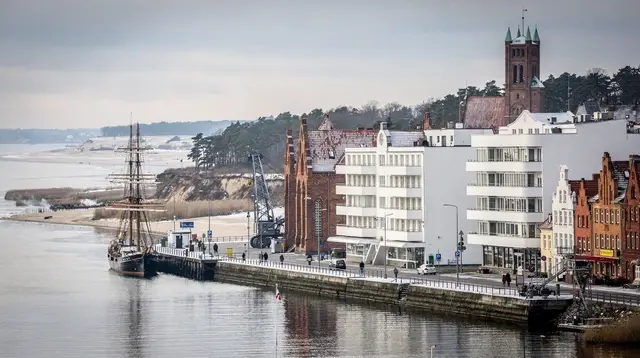
Bike tours here typically link the Motława riverfront — past the medieval crane known as Żuraw and along the waterfront promenade — with stretches further out that a walking itinerary would have to skip. A common route threads from the river out toward the shipyard gates associated with the 1980 strikes, before looping back through quieter residential streets. Because the bike covers distance faster, guides can afford to add context stops that a purely pedestrian itinerary would cut for time: a pause at a shipyard monument, a detour past a Free City-era building in Wrzeszcz, a stretch along the water where a walking guide would simply point and keep moving.
a private bike tour through Gdańsk’s riverfront and Old Town surroundings is the most flexible version of this: routes and pace adjust to the group, and stops can run longer at sites that interest you and shorter elsewhere. A more standard, fixed-route option is an everyday bike tour covering the city’s central sights, which runs on a set schedule with a shared group rather than a private one.
For visitors specifically interested in the shipyard and its surrounding streets — the district covered in more depth by the shipyard and Solidarity guide — there is also a private bike route through Wrzeszcz and the shipyard district, which trades some of the riverfront scenery for a closer look at the city’s twentieth-century industrial and political history. This pairs naturally with a stop at the European Solidarity Centre, reached easily by bike from either the Old Town or Wrzeszcz.
Where a bike helps, and where it does not
Not every part of Gdańsk suits cycling equally, and it is worth being upfront about the limits rather than letting a tour itinerary promise more than the streets allow.
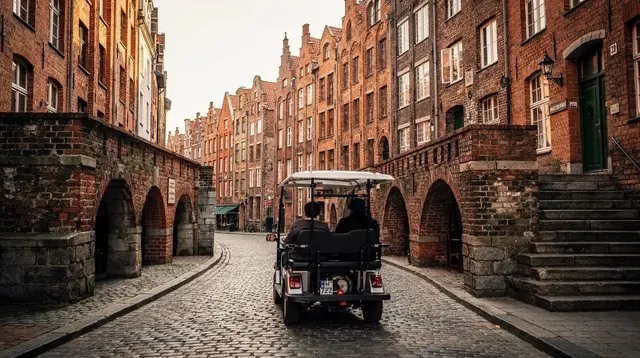
The Old Town’s tightest lanes — Mariacka street with its amber-trading porches, the narrow streets between Długi Targ and St Mary’s Basilica — are cobbled, often pedestrianised, and crowded with foot traffic for much of the day. A bike is not meaningfully faster here than walking, and in the busiest hours it can be slower and more awkward than simply getting off and walking the bike through. Tours that include this stretch generally treat it as a walking segment, not a riding one.
The Motława embankments and the wider boulevards are where cycling earns its keep: broad, mostly flat, and long enough that the time saved over walking actually adds up. The same is true of the routes out toward Wrzeszcz and the shipyard, where distances stretch past what most visitors want to walk in one go but remain well within a comfortable bike ride.
Weather is a genuine variable, not a footnote. The Baltic coast runs cooler and windier than inland Poland, and a clear, mild morning can turn to rain within a few hours — a pattern covered in more detail by the rainy-day guide. A bike tour in a downpour is a worse experience than a walking one, since there is no awning to duck under mid-ride, and organised tours generally reschedule or shorten routes in genuinely bad weather rather than push through it. Dressing in layers and checking the forecast the morning of a booking is worth the two minutes it takes.
A citywide bike-share scheme is not something to count on in advance. Kiosk and app-based bike-sharing does appear in the Tricity at various points, but which operator runs, how many docks are active, and what the pricing looks like all shift between seasons. Rather than build a plan around a specific self-service system being live when you land, a booked tour with its own bicycles removes that uncertainty entirely — you know the bike, the helmet and the route are arranged before you arrive.
Timing it right: crowds, opening hours and season
Morning departures tend to work better than afternoon ones, and not just for the obvious reason of avoiding the day’s heat or the worst of any wind coming off the Baltic. The Motława embankment and the streets closest to Długi Targ fill with day-trippers, cruise-ship groups and market stalls as the morning wears on, and a bike route sharing that space with heavier foot traffic slows down in exactly the stretches meant to be quick. A tour that sets off before mid-morning generally moves through the riverfront with more room to actually ride rather than weave.
Season matters as much as time of day. Bike tours run through the warmer months in reasonable numbers, but availability thins outside the June-to-September window, and some operators pause entirely over the coldest, darkest weeks of winter, when short daylight hours and the risk of icy cobbles make a ride a harder sell than a walking or museum-based alternative.
A visit built around the Christmas market guide or timed to Gdańsk in winter more generally should treat a bike tour as a maybe rather than a given, and check what is actually running before building a day around it. Shoulder months — May and September in particular — often strike the best balance: fewer crowds than peak summer, but still enough daylight and mild enough weather for a comfortable ride.
It is also worth being realistic about how a booking window works in practice. Private tours generally confirm a start time regardless of small variations in weather, while fixed-departure group tours are more likely to be the ones cancelled or rescheduled if conditions turn genuinely poor on the day. Neither is wrong, but the trade-off — more schedule certainty with a private booking, more flexibility on price with a shared one — is worth weighing before choosing between the two options above.
Choosing between a short taste and a fuller route
Visitors with only a spare hour or two before catching a train, or slotting a ride between other bookings, are usually better served by the shorter, fixed-route option than by trying to compress a longer private itinerary into less time than it needs. A shared route delivers a set, tested loop efficiently, without the pressure of watching the clock on a route designed to run longer. Visitors with a half-day or more to give, by contrast, get more out of a private booking precisely because the extra time allows for real stops — a coffee break by the water, a longer pause at a shipyard monument — rather than a route ridden past at a fixed pace.
This is also the point at which it is worth being honest about what a bike tour will not do: it will not replace a genuinely detailed look at any single site. A route that pedals past the shipyard gates and a Free City-era building in the same morning necessarily gives each less time than a dedicated visit would. Visitors whose priority is the European Solidarity Centre itself, rather than the surrounding streets, are better off treating a bike tour as the way to get there and back, with the museum visit itself booked and timed separately.
Bike tours compared with other ways to move around
| Option | Best for | Limits |
|---|---|---|
| Guided bike tour | Covering the Motława, Wrzeszcz and shipyard in one outing | Cobbled Old Town lanes still mean walking sections |
| Walking tour | The compact Old Town core around Długi Targ and Mariacka | Slow for anything beyond the centre |
| SKM train / tram / bus | Fixed routes between the Tricity’s town centres | No door-to-door coverage; Gdańsk has no metro |
| Segway tour | A guided, motorised alternative to walking in the centre | Same cobbled-street limits as cycling, different balance |
The Segway tour of the Old Town covers similar ground to a short bike route but on a different vehicle, and is worth comparing if balance or fitness is a consideration — a Segway needs less pedalling effort but handles cobbles and crowds no better than a bike does. For a shipyard-specific version of that same motorised option, a one-hour Segway tour of the Gdańsk Shipyard covers the same district as the bike route above in a shorter, fixed session.
If the Solidarity story is the main draw rather than the ride itself, a guided Solidarity tour through the shipyard and its landmark sites goes deeper into the history with a focus on walking and explanation rather than covering distance, and pairs well with a visit to the Lech Wałęsa and Solidarity history guide beforehand.
Building a bike tour into a longer visit
A single bike tour, typically two to three hours, fits comfortably into a first full day in the city alongside time in the Old Town on foot — the kind of pairing laid out in the one-day Gdańsk itinerary. Visitors staying longer, following something closer to the two-day Gdańsk and Sopot itinerary, often use a bike morning to cover the shipyard and Wrzeszcz before switching to the SKM for the coastal stretch out to Sopot, where the flat seafront promenade suits a slower walk instead.
For visitors deciding how many days the city as a whole deserves, the broader planning questions are addressed in how many days in Gdansk; a bike tour is one component of that plan rather than a full day’s activity on its own. It also complements water-based options — the Motława river cruise covers some of the same riverfront from the water rather than the towpath, and choosing between the two often comes down to whether you’d rather sit or move under your own effort.
Families weighing a bike tour against other active options will find more context in the family-friendly activities guide, since not every operator accommodates young children on a shared-route ride, and private tours tend to be more flexible on pace for mixed-age groups.
A note on what not to expect
A bike tour in Gdańsk is not a substitute for a detailed walking tour of the Old Town’s architecture and history — routes designed to cover distance efficiently spend less time at any single stop than a dedicated walking guide would, so visitors chiefly interested in the fine detail of Długi Targ’s facades or St Mary’s Basilica are better served by the Old Town walking tour first, with a bike tour added afterward for the wider districts.
Nor is it a guaranteed dry-weather activity — the Baltic coast’s changeable conditions apply to cyclists as much as anyone else, and no operator can promise sunshine for a booking made days in advance. Treated as what it actually is — a faster, more flexible way to cover the ground between the Old Town, the Motława and the districts beyond it — a bike tour earns its place alongside Gdańsk’s trams, trains and its considerable amount of walking.
What time of day should I book a Gdańsk bike tour?
A morning departure generally works better than an afternoon one. The Motława embankment and the streets near Długi Targ fill with foot traffic and day-trippers as the day goes on, which slows a bike down in exactly the stretches meant to be quick. Setting off earlier also leaves the afternoon free for a museum visit or a walk through the Old Town at its own pace.
Do bike tours run in Gdańsk in winter?
Availability drops sharply outside the June-to-September window, and some operators pause over the darkest, coldest weeks entirely, when short daylight and icy cobblestones make cycling a harder sell than a walking or indoor alternative. If visiting in winter, check what is currently running rather than assuming a bike tour will be available, and have a walking-tour backup in mind.
Frequently asked questions about Gdańsk bike tours
Bike & segway tours
Verified deep-linked GetYourGuide tours. Book through these links and we earn a small commission at no cost to you.
GetYourGuide does not provide a product photo for this activity — the image shows the meeting point, photographed by us.