Kayaking on the Motława: Gdańsk from the Water
Can you kayak on the Motława river in Gdańsk?
Yes, guided kayak trips run on the Motława through central Gdańsk, passing the Żuraw crane and the Old Town quays from the water. The river carries current and boat traffic on its way to the Bay of Gdańsk, so this is a guided or supervised activity rather than an unsupervised paddle for first-timers.
Every visitor to Gdansk sees the Żuraw crane and the gabled merchant houses of the Long Embankment from the quay, cameras raised at roughly the same angle everyone else uses. Fewer see them from the water itself, at the low, slightly unsteady vantage point of a kayak, with the Old Town’s brick facades rising up on one side and the working traffic of the Motława moving past on the other. It is a genuinely different way to read the same stretch of riverfront that the Old Town walking tour covers on foot, and it takes maybe an hour or two rather than a full day.
What the Motława actually is
It helps to be clear about what this river is before getting into a boat on it. The Motława is not a canal or an ornamental waterway threaded quietly through the city for the benefit of visitors — it is a branch of the Vistula delta that flows past central Gdańsk and out into the Dead Vistula (Martwa Wisla), which in turn opens into the Bay of Gdańsk. That matters for anyone paddling it.
A river connected to a tidal bay carries current, and a working port city’s river carries traffic: passenger cruise boats running the same sightseeing routes that first-time visitors take, water trams heading out toward Westerplatte, the occasional larger vessel, and other kayaks and small craft sharing the same stretch of water, especially on a warm evening in July.
None of that makes the Motława a dangerous river for a supervised, guided paddle — thousands of people do exactly this every summer without incident. It does mean this guide will not pretend the river is a flat, empty, current-free pond, and it will not hand over specific rules about right-of-way, minimum distances from moored vessels or exactly how close a kayak should get to a passing tour boat.
Those rules exist, they are enforced by the operators and by Polish inland waterway regulations, and they are the kind of detail a guide on paper cannot responsibly improvise. A guide briefs paddlers on the actual day, with the actual river conditions and the actual boat traffic in front of them, and that briefing is worth listening to properly rather than treating as a formality before the fun starts.
Weather and river conditions are the other variable a guide on paper cannot pin down in advance. A stretch of open water in the middle of a historic city centre still answers to wind, rain and the wash of passing vessels, and operators reserve the right to shorten a route, delay a departure or cancel outright if conditions on the day are not safe for the group booked in. That is a sign the operation is being run properly, not a flaw in the activity — but it does mean a Motława kayak trip is a poor choice to schedule as the very last activity before a flight home, with no slack in the day if it has to move.
The route through the historic centre
The stretch of Motława that kayak tours cover runs along the Main Town waterfront, broadly the same water that the passenger cruise boats and water trams use, which is also why paddlers need to be alert to that traffic rather than assume the river is theirs alone. From the water, the sequence of landmarks is the same one visible from the quay, just seen from a different height and a different pace:
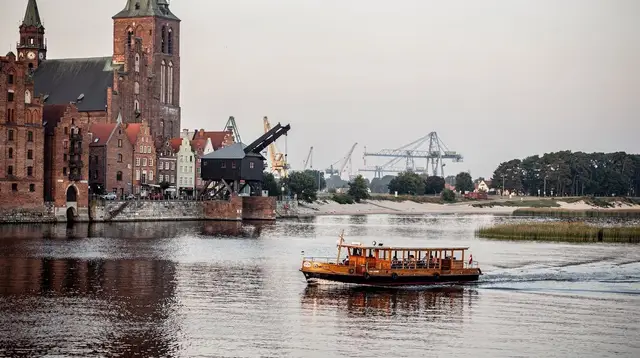
The Żuraw, the medieval port crane that has become one of the most photographed structures on the whole waterfront, is the obvious anchor point of the route — a wooden, twin-towered gate crane dating back to the Hanseatic era, now part of the National Maritime Museum, and one of the few surviving devices of its kind anywhere in Europe. Passing beneath it by kayak, rather than photographing it from the embankment above, is the single most-repeated reason people give for trying this in the first place.
Beyond the Żuraw, the route runs along the Dlugie Pobrzeze (Long Embankment), the line of tall, narrow merchant houses with ornate gabled fronts that defines the Motława waterfront’s postcard image — a reconstruction of the prewar Hanseatic skyline rather than untouched medieval fabric, since almost all of central Gdańsk was rebuilt after 1945, but a convincing and carefully researched one. Moored historic vessels, including replica ships and the occasional tall ship, line stretches of the bank, and the general texture of a working port city — cranes, pontoons, small industrial buildings mixed in with the tourist-facing quay — is visible in a way it is not from the pedestrianised embankment itself.
A typical guided route stays within this central stretch rather than venturing far downstream toward the Dead Vistula or out toward the bay, which keeps paddlers within sight of the Old Town and within easy reach of a landing point if weather, fatigue or a change of plan calls for it.
Meeting points cluster around the pontoons and small jetties on the Long Embankment side of the river, within easy walking distance of Długi Targ and the main Old Town sights, so there is no separate trek out of the centre to reach the water — one of the reasons this pairs so easily with an afternoon of ordinary sightseeing. Groups tend to be small, often somewhere between four and a dozen paddlers per departure depending on the operator and the number of kayaks in the water that day, which keeps the briefing personal rather than shouted over a crowd.
Guided tours versus renting on your own
Kayak rental kiosks appear seasonally along stretches of the Gdańsk waterfront, and in principle it is possible to rent a kayak and go without a guide. This guide is not going to recommend that route for anyone without real paddling experience and real familiarity with the river. A guided tour comes with a safety briefing, a group structure that keeps paddlers together and visible, a guide who knows the current boat traffic and the day’s conditions, and — not a small thing — someone who actually knows the water well enough to point out what you are looking at rather than leaving visitors to guess which gabled house is which.
a guided kayak tour along the Motława waterfront is the standard way most visitors do this, typically in a small group with an instructor setting the pace and handling the practical decisions about where to go and when to turn back. For anyone without confident swimming ability, anyone travelling with children, or anyone who has simply never sat in a kayak before, this is the sensible starting point rather than an unsupervised rental.
Worth flagging honestly: this is not an effortless, sit-back activity. Climbing down onto a low pontoon and settling into a narrow hull takes a degree of balance and mobility, and holding a course against current and the wash of a passing boat uses real core and shoulder strength over the course of an hour or more. Most reasonably fit adults and older children manage it without difficulty, but anyone with vertigo, a bad back, a heart or breathing condition, or limited mobility is better off asking the operator directly what the trip actually involves before booking, rather than assuming a city-centre paddle is automatically the gentle option compared with open-water kayaking further along the coast.
For a different mood entirely, an evening kayak tour on the Motława covers the same central stretch after the day-trip crowds have thinned, with the gabled facades lit up and the water quieter. Long midsummer daylight in Gdańsk means an “evening” paddle in June or July can still run in good light for hours; later in the season, darkness falls earlier and operators adjust their routes and timing accordingly, so treat any advertised start time as seasonal rather than fixed year-round.
Cold-weather paddlers are not entirely left out either. a winter kayaking tour on the Motława runs through the colder months for visitors who want the same river view of the Żuraw and the Old Town without waiting for summer, generally with warmer clothing supplied or recommended and a shorter, more contained route than the peak-season trips. It is a niche option — most of Gdańsk’s kayak traffic is a warm-weather activity — but it exists, and it draws a genuinely different kind of visitor than the July evening crowd.
What this is not
It is worth being direct about a few things this activity is not, because kayak listings online sometimes blur them together. This is not a swimming activity: the Motława is a working river mouth, not a beach, its water is not managed for bathing, and nobody should plan to swim from a kayak here regardless of the season. Anyone looking for a swim should be thinking about the Baltic beaches instead, where the water — while still cool by Mediterranean standards — is at least the right kind of water for it.
This is also not the same activity as the sea kayaking and watersports scene further along the coast. The Hel Peninsula, the fishing town of Jastarnia and the bay around Puck are open-water, wind-and-wave territory, covered in their own right in the Baltic coast watersports guide and the kitesurfing guide to Puck Bay.
Paddling technique, boat type, water conditions and the whole feel of the activity are different out there — bigger, more exposed, more weather-dependent — than a sheltered urban river route through the historic centre of Gdańsk. If open-water paddling or kitesurfing is the goal, those pages are the right starting point, not this one.
Nor is this an activity with a fixed, quotable timetable. Rental kiosks and tour operators along the Motława adjust their opening hours, boat numbers and prices through the season, closing altogether over winter in most cases outside the dedicated cold-weather tours, and no printed guide can responsibly promise a specific slot will be available on a specific afternoon. The reliable approach is to book a guided tour in advance for a fixed departure time, or to check directly with a rental operator on the day for anything more casual.
Comparing the three Motława kayak options
| Option | Typical mood | Best for |
|---|---|---|
| Guided daytime kayak tour | Structured, instructional, standard pace | First-time paddlers, families, anyone wanting a safety briefing |
| Evening kayak tour | Quieter water, lit facades, later light in summer | Visitors who have already done the Old Town by day and want a different view |
| Winter kayaking tour | Shorter route, cold-weather gear, small groups | Off-season visitors and paddlers who want the river without the summer crowds |
Getting the most from a short paddle
Most Motława kayak trips run well under a full day, which makes them an easy add-on rather than a trip in themselves. Pairing one with a walk along the Old Town waterfront beforehand, so the landmarks make sense from the water afterward, is the simplest way to get more out of both.
Travellers building a one-day Gdańsk itinerary can slot a short guided paddle into a morning or late-afternoon gap without it swallowing the whole schedule, and anyone comparing things to do in Gdansk more broadly will find kayaking sits alongside, rather than replaces, the river cruises covered on the Motława river cruise and Motława sunset cruise pages, for anyone who would rather watch the waterfront go by than paddle it themselves.
Seasonally, Gdańsk in summer is when the river is busiest with kayaks, water trams and passenger boats alike, while Gdańsk in winter narrows the options down to the dedicated cold-weather tours and a much quieter waterfront generally. Either way, a kayak on the Motława is a short, low-commitment way to see the crane, the gables and the working river of central Gdańsk from an angle almost nobody bothers with, and that alone is usually reason enough to try it.
Can a kayak trip on the Motława be cancelled?
Yes, and it is worth planning around rather than being surprised by. These trips run on a shared, working river, not a sheltered lake, so operators will hold or cancel a departure for strong wind, heavy rain, poor visibility or unusually heavy boat traffic rather than take a group out into conditions they are not comfortable managing. That is the right call for safety, but it means a Motława paddle is a poor fit for the last free slot before a flight home — better to book it earlier in a trip, with a spare afternoon in hand if a departure has to move.
Is kayaking on the Motława suitable for someone with limited mobility or a health condition?
Not automatically. Getting into and out of a kayak from a low pontoon, and staying balanced in a narrow hull while the current and passing wash move the boat around, both call for a reasonable level of physical mobility, balance and core strength. It is manageable for most reasonably fit visitors, including many families with older children, but anyone with a mobility impairment, vertigo, a recent injury, or a heart or breathing condition is better off phoning or emailing the operator ahead of time to ask exactly what a specific trip involves, rather than assuming a city-centre paddle is inherently gentler than the open-water options further along the coast.
Kayaking tours
Verified deep-linked GetYourGuide tours. Book through these links and we earn a small commission at no cost to you.
GetYourGuide does not provide a product photo for this activity — the image shows the meeting point, photographed by us.