Goldwasser Is Gdańsk's Liqueur, Not a Generic Souvenir
I bought my first bottle of Goldwasser in a shop just off Długi Targ, on my first evening in Gdańsk, mostly because the gold flecks catching the light through the glass looked like exactly the kind of thing a souvenir shop invents to separate tourists from their zloty. I was wrong about that, and it took a conversation with a bar owner two streets over, and a fair amount of reading afterward, to understand why.
A drink older than the idea of visiting Gdańsk
The recipe dates to 1598. That number is worth sitting with for a second, because it means Goldwasser was already an established product in this city roughly three and a half centuries before anyone thought to call Gdańsk a tourist destination. It was not invented for people like me. It was invented for a working Hanseatic port at the height of its trading power, a city moving grain, amber, timber and textiles through the Baltic in volumes that made Gdańsk one of the wealthiest ports on the sea. A luxury liqueur with real gold suspended in it is not a casual product for a town like that - it is a flex, the 16th-century equivalent of a merchant showing off what the harbour brought in.
That context matters because it is so often stripped out. Ask a few people where Goldwasser is from and you will hear “Poland” in the vaguest sense, or a guess at Germany, or occasionally a shrug toward Warsaw, as though any old city in the region could have produced it. None of that holds up. This is a Gdańsk product, tied to a specific moment when the city’s Hanseatic trade made a gold-flecked luxury spirit both possible to produce and worth producing - there had to be a market of merchants and guild members with money to spend on something purely decorative to drink.
Warsaw, inland and on a different trajectory entirely, has no claim on it. The generic-German-liqueur framing misses the more interesting truth, which is that this drink is a direct product of Gdańsk’s Hanseatic identity, brewed by a specific trading culture in a specific port at a specific moment in its economic history.
The gold was never the point of the flavour
It is easy to assume the gold is a gimmick layered on top of an otherwise ordinary drink, and in a narrow sense that is true - the flakes are tasteless, they add no aroma, and they exist purely to be seen catching candlelight or the low evening sun coming off the water. But the choice to suspend real gold in a drinkable liquid, rather than simply making a good herbal liqueur, tells you something about what the product was for. It was not made to be efficient or subtle. It was made to be shown. You poured it for a guest and the gold moved when you swirled the glass, and everyone at the table understood what that gesture cost.
The base spirit underneath the spectacle is a proper herbal liqueur - anise, caraway, and a mix of macerated roots and citrus peel that varies by producer, giving it a sweetish, slightly spiced character closer to a digestif than to a neutral spirit. It sits at the end of a meal, not the start of one, which is part of why I think the souvenir-shelf version of Goldwasser sells the drink short. Treated as a bottle to fly home with and never open, it is just a curiosity. Treated as what it actually is, a spirit meant to close out a proper regional meal, it makes a lot more sense.
What it sits next to on the table
This is where I think the real argument lives. Goldwasser does not belong in isolation, wrapped in tissue paper in a suitcase - it belongs at the end of a meal built around what this stretch of the Baltic actually produces. Smoked fish is the backbone of that table here: flet, a flatfish pulled from the shallow coastal waters, and wegorz, smoked eel, both traditional along this coast in a way that has nothing to do with tourism and everything to do with a fishing economy that predates any hotel on the waterfront. Zurek, the sour rye soup, is the other constant, a dish built on fermentation rather than spectacle, the kind of food that tells you a region has been feeding itself the same way for a very long time.
Put a small glass of Goldwasser at the end of a meal like that and it stops being a strange, shiny outlier. It becomes the last course of a cuisine that makes sense as a whole - fermented soup, smoked fish from a working coastline, and a gold-flecked digestif born from a port city’s trading wealth. None of those three things needs the others to justify itself, but seeing them together is what convinced me the drink deserved more respect than I gave it on that first evening near Długi Targ.
Where this fits into a Gdańsk visit
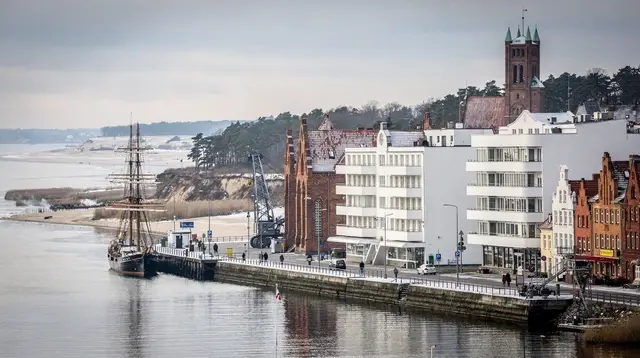
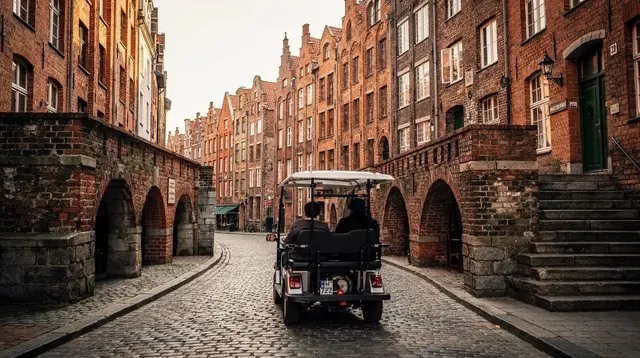
If you want the history straight rather than filtered through gift-shop packaging, spend some time in the Old Town itself, where the merchant wealth that made a drink like this possible is still legible in the building facades along the Motława. A walk through the Old Town with an eye on the Mariacka amber trade gives you the same trading-port context that produced Goldwasser in the first place - both were, in their own way, products of a Baltic city with money moving through it.
For the drink specifically, a tasting session beats a shop-shelf bottle every time, since a guided Goldwasser tasting usually places it against other regional spirits so the contrast is obvious. Pairing that with a proper sit-down meal is worth the effort too - a Gdańsk food tour or a dedicated stop for pierogi and Polish cuisine will usually put zurek and smoked fish on the same table, which is exactly the context that makes the liqueur click.
If you are curious how it compares to the rest of the region’s drinking culture, a vodka tasting or a look at craft beer in Gdansk fills in the rest of the picture, and an evening finishing at one of the Old Town bars is as good a place as any to order a proper glass rather than a bottled souvenir.
A guided vodka tasting is a good way to put Goldwasser’s sweetness in context against the sharper spirits it shares a shelf with, and for something closer to the digestif’s own showy streak, a session built around Old Town legends, cocktails and tastings tends to work Goldwasser into the lineup alongside the stories behind it.
History-minded visitors might also want to see how this drink sits against the city’s wider Hanseatic story - the European Solidarity Centre and the Amber Museum both cover different chapters of Gdańsk’s trading and civic identity, and a first-time Gdańsk itinerary or a longer Tricity stay gives you room to fit a proper Goldwasser dinner in without rushing it.
A few nearby stops worth folding in on the same walk are Dlugi Targ, the Żuraw crane on the Motława, and Sopot if you want the coastal contrast the next day. There is also a good companion piece on why the Old Town looks the way it does, which is its own lesson in not taking Gdańsk’s appearance at face value - much like the liqueur, the city rewards a second look past the first impression.
I still have that first bottle, mostly untouched, sitting on a shelf back home. What changed is that I no longer think of it as a shiny thing I bought because it looked touristy. It is a small glass jar of a specific Baltic port’s history, and it deserves to be opened at the end of a proper meal, not kept sealed as evidence that I went somewhere.
tours.Food
Verified deep-linked GetYourGuide tours. Book through these links and we earn a small commission at no cost to you.
GetYourGuide does not provide a product photo for this activity — the image shows the meeting point, photographed by us.