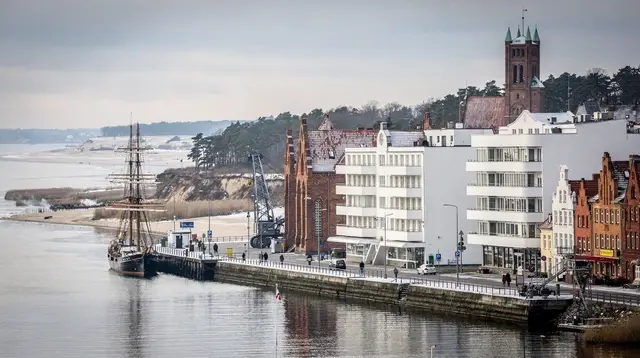
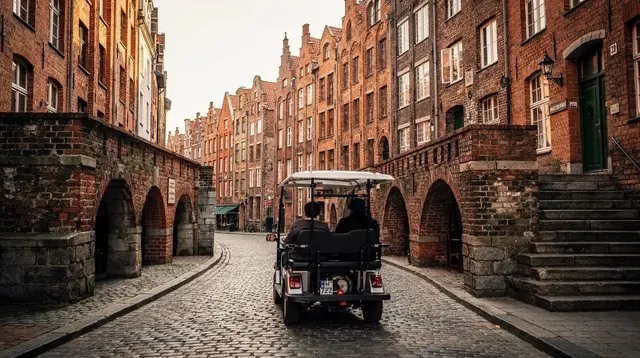
Tricity, Hel Peninsula and Malbork: A 5-Day Itinerary
This five-day route covers the three cities of the Tricity, then adds one coastal day trip and one historical day trip in opposite directions from Gdańsk. It is built to work entirely without a car, on the region’s train network and, in summer, its seasonal passenger boats. The two day trips are kept firmly apart: the Hel Peninsula lies north-west along the coast, Malbork lies south-east inland, and trying to fit both into one day means arriving late and leaving early at each. Anyone tighter on time should look at Tricity in 3 Days instead; anyone with more time can extend this into One Week in Pomerania.
Day 1: Gdańsk Old Town and the Motława
Start in Gdansk itself, since the rebuilt Old Town rewards a full, unhurried day. Begin at Długi Targ, the main square lined with Hanseatic-era gabled townhouses, then work down to St Mary’s Basilica — free to enter as a working church, though the separate tower climb (over 400 steps, no lift) is a different ticket and closes earlier than the church itself, especially outside summer. A guided walking tour is a good way to make sense of the postwar reconstruction, since most of what looks medieval here was rebuilt from rubble after 1945, not preserved intact.
Head next to Mariacka street, the amber-dealers’ lane running down to the river, then the Motława waterfront, where the medieval crane Żuraw is actually the entrance to a branch of the National Maritime Museum rather than just a photo stop — an hour inside is enough for most visitors. For an oriented first pass through the city with a local guide, a private city tour of Gdańsk covers the Old Town, the waterfront and the historical context in one half-day.
In the afternoon, walk or take a short bus to the Gdańsk Shipyard and the European Solidarity Centre, the museum built at Gate No. 2 where the 1980 strikes began — a genuine two to three hours, not a quick detour. Finish with dinner in the Old Town; see Gdańsk Food Tour for where locals actually eat.
Day 2: Westerplatte and Oliwa
Day two stays in Gdańsk but moves outward to two sites on opposite sides of the city. In the morning, reach Westerplatte, where the Second World War began on 1 September 1939, either by a scenic water tram along the Motława (45-75 minutes each way, running roughly April to October) or by city bus in under 30 minutes year-round. The site is a free, open memorial park with ruined barracks and a hilltop monument — the boat is the pleasant option, not the fast one, and in winter it usually stops running, leaving the bus as the only route.
In the afternoon, head to Oliwa for its cathedral, famous for its historic pipe organ, still used for short recitals several times a day in summer and far less often off-season — check the schedule rather than assume a recital is running. Oliwa Park next door is a calm, leafy contrast to the Old Town’s crowds.
Those with a taste for deeper history can add the Museum of the Second World War, which genuinely needs two to three hours on its own and is best treated as an alternative to Oliwa rather than an add-on to it. Wind down with an evening in Wrzeszcz, the residential district linked to Gunter Grass, reachable on the same SKM network used throughout this itinerary.
Day 3: Sopot and Gdynia
Day three uses the SKM commuter train to cover both remaining Tricity cities in one day, since each needs roughly half a day rather than a full one. Start early in Sopot, home to Europe’s longest wooden pier — a 30-45 minute walk to the end and back, with a small seasonal entry fee that is often waived out of season. A private walking tour of Sopot’s Old Town highlights is a relaxed way to see the spa-town streets behind the pier before the midday crowds build. See Sopot Walking Tour for a self-guided version of the same route.
By early afternoon, take the SKM on to Gdynia, a city built almost entirely in the twentieth century and known for its interwar architecture — the Gdynia Modernism trail is worth following with a map, since it is outdoor and needs no ticket. The docked museum ships nearby, including the tall ship Dar Pomorza, each need a separate ticket and roughly an hour. A private maritime legends tour of Gdynia with tickets included bundles the ships and the city’s port history into one outing. Return to Gdańsk by SKM in the evening; the ride itself hugs the coast with sea glimpses for much of the way.
Day 4: The Hel Peninsula
Day four is dedicated entirely to the Hel Peninsula — a narrow sand spit roughly 35 km long attached to the mainland near Władysławowo, not an island, though it is often mistaken for one.
There are three ways to get there: a direct summer train from Gdańsk (around two hours), a seasonal passenger boat from Gdańsk, Sopot or Gdynia (roughly 90 minutes to two hours, weather-dependent and running mainly May to September), or driving — which in August means serious traffic along the single peninsula road, so this itinerary recommends the train or boat instead. A Baltic Sea cruise from Gdańsk covers the boat option with sea views along the way.
Once in Jastarnia or Hel town, the main attraction is the seal sanctuary (Fokarium), which runs feeding talks two to four times daily depending on season — worth timing the visit around. The Baltic here rarely exceeds 18-20°C even in August, so this is a day for walking the beach and dunes rather than a long swim; see Hel Peninsula Day Trip Guide and Baltic Coast, Not the Mediterranean for what to actually expect from the water. Much of Hel’s tourist infrastructure scales down outside summer, so this day works best between May and September. Return to Gdańsk by the same train or boat before evening.
Day 5: Malbork Castle
Day five heads the opposite direction, inland and south-east, to Malbork, the largest brick castle in the world by land area. Regional trains from Gdańsk Glowny take roughly 35-40 minutes, and the castle is a short walk from the Malbork station — no car needed. This is a full-day commitment on its own: the complete circuit of the High, Middle and Low Castles genuinely takes three to four hours for anyone reading the rooms rather than marching through, and in high season the museum sells timed entry slots rather than open walk-up access, so booking ahead on the official calendar is worth doing before arrival.
A Malbork Castle day tour from Gdańsk with audioguide handles the timed-entry booking and the return journey together, and an audioguide is included at the castle either way. See Malbork Castle Visitor Guide and Getting to Malbork Castle from Gdansk for the practical detail, or Malbork Day Trip Itinerary for a version built solely around the castle. Return trains run through the afternoon and evening, so there is no need to rush the visit to catch a specific departure.
Planning notes for this route
| Day | Focus | Transport | Full day needed? |
|---|---|---|---|
| 1 | Gdańsk Old Town, Shipyard | On foot / bus | Yes |
| 2 | Westerplatte, Oliwa | Water tram or bus | Yes |
| 3 | Sopot, Gdynia | SKM train | Yes (split in two) |
| 4 | Hel Peninsula | Train or seasonal boat | Yes |
| 5 | Malbork Castle | Regional train | Yes |
Hel and Malbork are never combined: they lie in opposite directions from Gdańsk, and each already fills a full day once travel time, timed entry and the sites themselves are accounted for. Travelers who would rather see Malbork on a shorter add-on can compare it with an alternative day trip in Malbork vs Toruń Day Trip, and those weighing a guided day versus independent travel should see Guided Tour vs DIY Day Trips from Gdansk.
FAQ: Planning a 5-Day Tricity, Hel and Malbork Itinerary
Can Hel and Malbork be visited on the same day?
No. They lie in opposite directions from Gdańsk — Hel north-west along the coast, Malbork south-east inland — and each needs a genuine full day once travel time and timed entry are factored in. Combining them means arriving late and leaving early at both.
Is the Hel Peninsula an island?
No, Hel is a narrow peninsula roughly 35 km long, attached to the mainland near Władysławowo. It is reachable by road, train or seasonal boat, not only by boat as an island would require.
Do I need a car for this itinerary?
No. The Tricity runs on a frequent SKM commuter train, Hel is reachable by summer train or seasonal boat, and Malbork is a short regional train ride from Gdańsk Glowny. Driving to Hel in August specifically means real traffic on the single peninsula road.
Will I be able to swim comfortably on the Hel Peninsula day?
The Baltic rarely exceeds 18-20°C even in August, and a windy day can drop it further within hours. This is a day for beach walks and the seal sanctuary rather than a long, warm swim.
How far in advance should Malbork Castle tickets be booked?
In summer, book the timed entry slot on the official calendar a few days ahead if possible; walk-up tickets exist but queues in July and August can push the wait past an hour. Off-season, booking a day or two ahead is usually enough.
How long does the train from Gdańsk to Malbork actually take?
Around 35-40 minutes on a regional or PKP Intercity train from Gdańsk Glowny, with the castle a short walk from Malbork station.
What if I only have three or four days instead of five?
Drop either the Hel day or split the Tricity across two rather than three days; see Tricity, Hel and Malbork in shorter form or Tricity in 3 Days for compressed versions of this same route.
Is this itinerary better in summer or winter?
It is built around summer conditions, when the Hel boat and much of the peninsula’s tourist infrastructure operate; in winter, the boat option usually stops and the train becomes the only practical way to reach Hel, so travelers visiting outside May-September should confirm current schedules before committing to Day 4.
tours.5 days
Verified deep-linked GetYourGuide tours. Book through these links and we earn a small commission at no cost to you.
GetYourGuide does not provide a product photo for this activity — the image shows the meeting point, photographed by us.